In South India, horses are kept for riding, for weddings and festival processions, for some cart and pack work, and by owners who raise foals. A horse can work for many years — Tamil Nadu's rules allow work up to about 20–21 years of age (TNAWB) — so before you buy one, check its age, soundness and papers, and plan its stable, feed and hoof care.
What horses are kept for
- Riding and carriages. NRCE, the national research centre on horses, sorts India's horses into fast saddle horses for riding or drawing carriages and slow pack ponies of the hills (ICAR-NRCE). Marwari and Kathiawari horses are used for riding and in ceremonies (ICAR-NRCE).
- Weddings and joyrides. In Tamil Nadu, only horses registered and microchipped by the Tamil Nadu Animal Welfare Board may be hired out for joyrides, weddings or any other paid work (TNAWB).
- Work. Horses, ponies and mules still carry loads and pull carts, mostly for landless and small farmers, and matter most where roads are poor (ICAR-NRCE).
- Foals. Some owners keep mares to raise foals. A mare carries her foal for about 335 days, or 11 months (ICAR-NRCE).
How horses are kept
- A dry, airy stable. Build it on a safe site, with a non-slip floor that slopes so water drains away. NRCE suggests a stable about 12 × 12 feet for one horse (ICAR-NRCE), and Tamil Nadu's registration asks for at least that, with a roof (TNAWB). Round off corners and remove nails and other sharp things.
- Dry bedding. Spread dust-free dry grass or paddy straw, and remove wet, dirty bedding at once (ICAR-NRCE).
- Feed little and often. Horses are not ruminants. Make good fodder at least half the ration, give grain in 2–3 small meals, and feed by weight, not by the scoop. Change the feed slowly, over 7–10 days, or up to 3 weeks for a big change, because sudden changes cause colic; too much grain can cause laminitis, a painful hoof disease. Never feed dirty, mouldy or stale feed (ICAR-NRCE).
- Water. Keep clean water in front of the horse at all times (ICAR-NRCE, TNAWB).
- Hooves. Clean out the hooves regularly and trim them about every 6 weeks; shoe the horse when needed. Keep the stable clean, because a horse standing in mud and wet, dirty bedding gets thrush, a hoof infection that makes it lame (ICAR-NRCE).
- Grooming and exercise. Groom the horse every day, before and after riding; it helps you spot cuts, skin problems and injuries early. Exercise it regularly, and after work let it dry off and rest before you give small amounts of water and grain (ICAR-NRCE).
- Safe handling. Never wrap a lead rope around your hand, and never tie a horse by a rope around its neck; tie it at shoulder height. Keep barbed wire and thorny fences away from horses (ICAR-NRCE).
- Heat and rest. Tamil Nadu's registration rules say a horse must not be worked between 10 am and 4 pm, nor used after the 6th month of pregnancy until 3 months after foaling (TNAWB).
- Mares and foals. Feed a mare more in late pregnancy. Make sure the foal drinks its mother's first milk (colostrum) soon after birth, and wean it at 4–6 months (ICAR-NRCE).
Horse breeds
India's registered horse breeds come from the Himalayas, the north-east, Rajasthan and Gujarat; none is from South India (NBAGR register). Two of them are tall riding horses, and each has its own page:
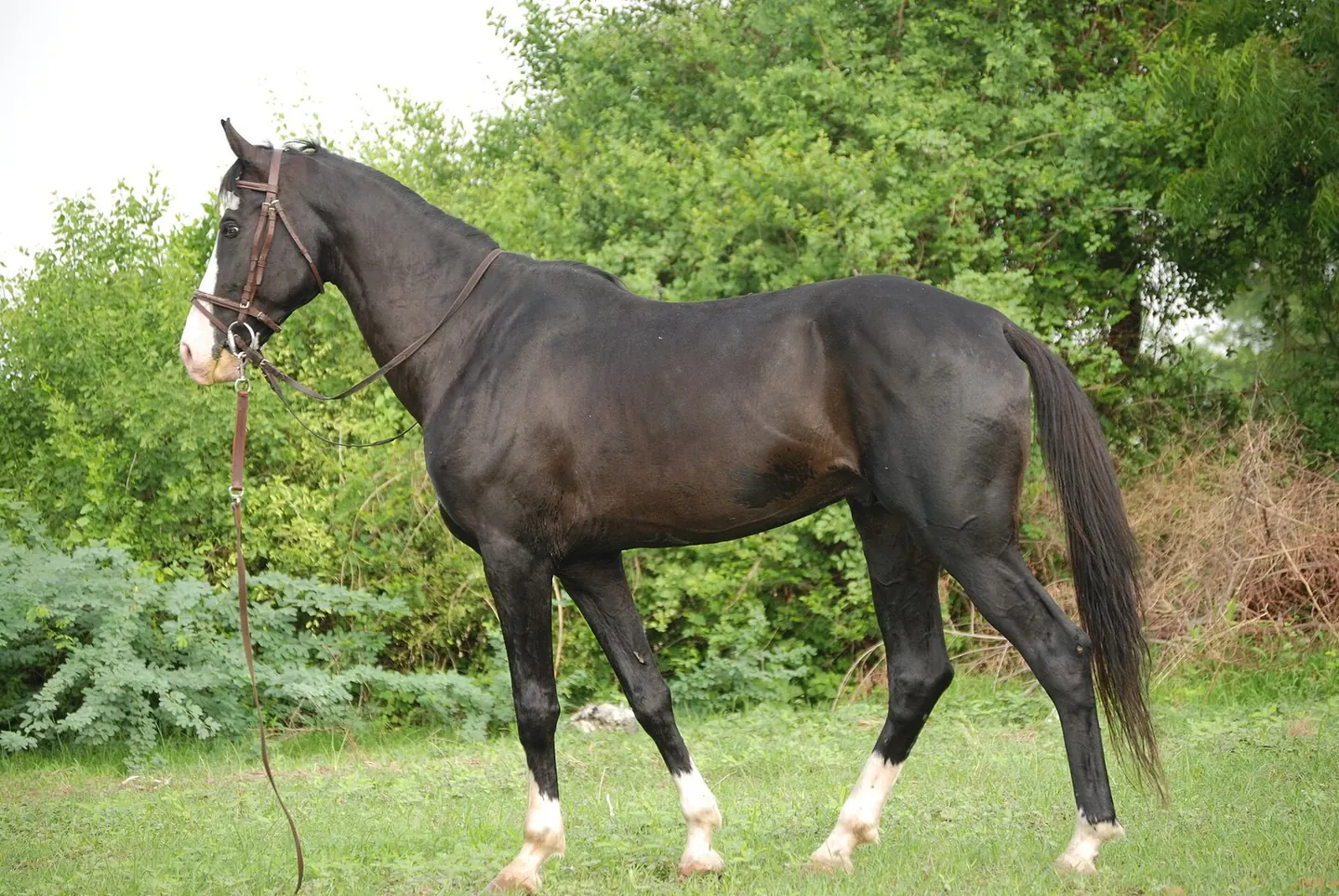
Horse
Marwari
a riding horse from the Marwar region of Rajasthan, known for ear tips that curve inward and often touch.
Stallion 361 kg · Mare 339 kg
Horse
Kathiawari
a riding horse from the Kathiawar (Saurashtra) region of Gujarat, known for endurance; its small ears curve in until the tips overlap.
Stallion 337 kg · Mare 321 kg
NBAGR also registers Kachchhi-Sindhi horses of Gujarat and Rajasthan and the hill ponies Manipuri, Spiti, Zanskari and Bhutia (NBAGR register); its database adds Bhimthadi horses of Maharashtra (NBAGR database), and the Kashmiri pony was registered in 2026 (ICAR-NBAGR). Many Indian horses belong to no fixed breed (ICAR-NRCE).
Buying a horse
See the horse yourself, in daylight, and watch it walk and trot. Judge its age from the front teeth of the lower jaw (USU Extension):
| What you see | Age, about |
|---|---|
| Middle pair of permanent front teeth in | 2.5 years |
| Next pair in | 3.5 years |
| Corner pair in; all front teeth permanent ("full mouth") | 4.5–5 years |
| Hollow "cups" worn off the middle, next and corner teeth | 6, 7 and 8 years |
After about 8 years the teeth are harder to read, and the guide is only approximate (USU Extension); ask a vet.
- Ask a vet to check soundness. Before you pay, have a vet look at how the horse moves and at its legs, hooves, eyes, nose, gums, coat, body condition and breathing (ICAR-NRCE).
- Papers. Ask for the vaccination record, and write a receipt with the date, the seller's name and village, the horse's colour and markings, any microchip number and the price.
- In Tamil Nadu, register the horse. Horses must be registered with the Tamil Nadu Animal Welfare Board, with a microchip number, a vaccination record and a vet's fitness certificate every 6 months, and an owner may not sell or transfer a horse without the Board's permission first (TNAWB). Ask the seller for the registration, and apply to transfer it before you pay. Rules change — confirm with your nearest veterinary hospital or animal husbandry office.
- Moving the horse. Every load of horses moved by road or rail needs a qualified vet's certificate, made within 12 hours before the trip, that the horses are fit to travel, free of infectious disease and vaccinated; without it the carrier must refuse them. In a goods vehicle, carry 4–6 horses at most, with an anti-slip floor, padding, an attendant and feed and water, and drive at not more than 35 km per hour (AWBI).
- Glanders. This disease spreads through animal fairs and horses moved between states (ICAR-NRCE). For a horse from another state or a fair, ask for a recent negative glanders test.
- Pay safely. Never pay an advance for a horse you have not seen: see paying safely.
Keep horses healthy
- Look every day. A healthy horse is bright and alert, eats and drinks well, and has moist pink gums and a glossy coat. Call your vet if it stops eating, has a dull coat or a discharge from the nose or eyes, or keeps rolling, pawing and looking at its belly: these are signs of colic, a common cause of death in horses (ICAR-NRCE).
- Vaccinate with your vet. NRCE's schedule (ICAR-NRCE):
| Disease | First doses | After that |
|---|---|---|
| Tetanus | 2 doses, 4–8 weeks apart | Every year |
| Equine influenza | 2 doses, 4 weeks apart | Every year |
| Rabies | Foals at 3–4 months, or at 6 months if the mare was vaccinated | Every year |
| Equine herpes (abortion) | Pregnant mares in the 5th, 7th and 9th months | Each pregnancy |
- Worms, flies and ticks. Ask your vet for a deworming plan. Keep flies down in the stable and check for ticks: flies spread surra and ticks spread piroplasmosis, two blood diseases of horses (ICAR-NRCE).
- Teeth. Horses need regular dental checks; sharp teeth make eating hard (ICAR-NRCE).
- Keep new and sick horses apart. Keep a newly bought horse away from your other horses for 30–45 days, and a sick horse away from healthy ones (ICAR-NRCE).
- Glanders. A deadly disease of horses, donkeys and mules that can also infect people. It must be reported, there is no vaccine, and it is controlled by testing: horses that test positive are put down under the government's control plan (ICAR-NRCE). When a case is found, horse movement and gatherings are stopped within 25 km (ICAR-NRCE). Tell your vet at once about thick nasal discharge or nodules and sores on the skin.
Frequently asked questions
How can I tell a horse's age?
From the lower front teeth: the permanent middle pair comes in at about 2.5 years and the corners at about 4.5, and the hollow cups wear off between about 6 and 8 years (USU Extension). After that, ask a vet.
Do I need to register a horse in Tamil Nadu?
Yes. The Tamil Nadu Animal Welfare Board registers horses with a microchip, a vaccination record and a vet's fitness certificate every 6 months, and only registered horses may be used for paid joyrides or weddings (TNAWB).
How big should a horse's stable be?
About 12 × 12 feet for one horse, with a roof, a dry, non-slip floor and good air (ICAR-NRCE, TNAWB).
How long is a mare pregnant?
About 335 days, or 11 months (ICAR-NRCE).
Next
Read about the two big Indian riding breeds, Marwari and Kathiawari. To see what horses farmers and owners near you are selling, browse horses for sale.

Find horses near you on Kattutharai
See horses for sale direct from owners near your village, with photos, the village name and the distance. No middlemen. Call or chat with the owner, see the horse walk and trot, and have a vet look at it before you pay.
Looking for a particular breed? Search its name in the Kattutharai app, for example Marwari or Kathiawari.

