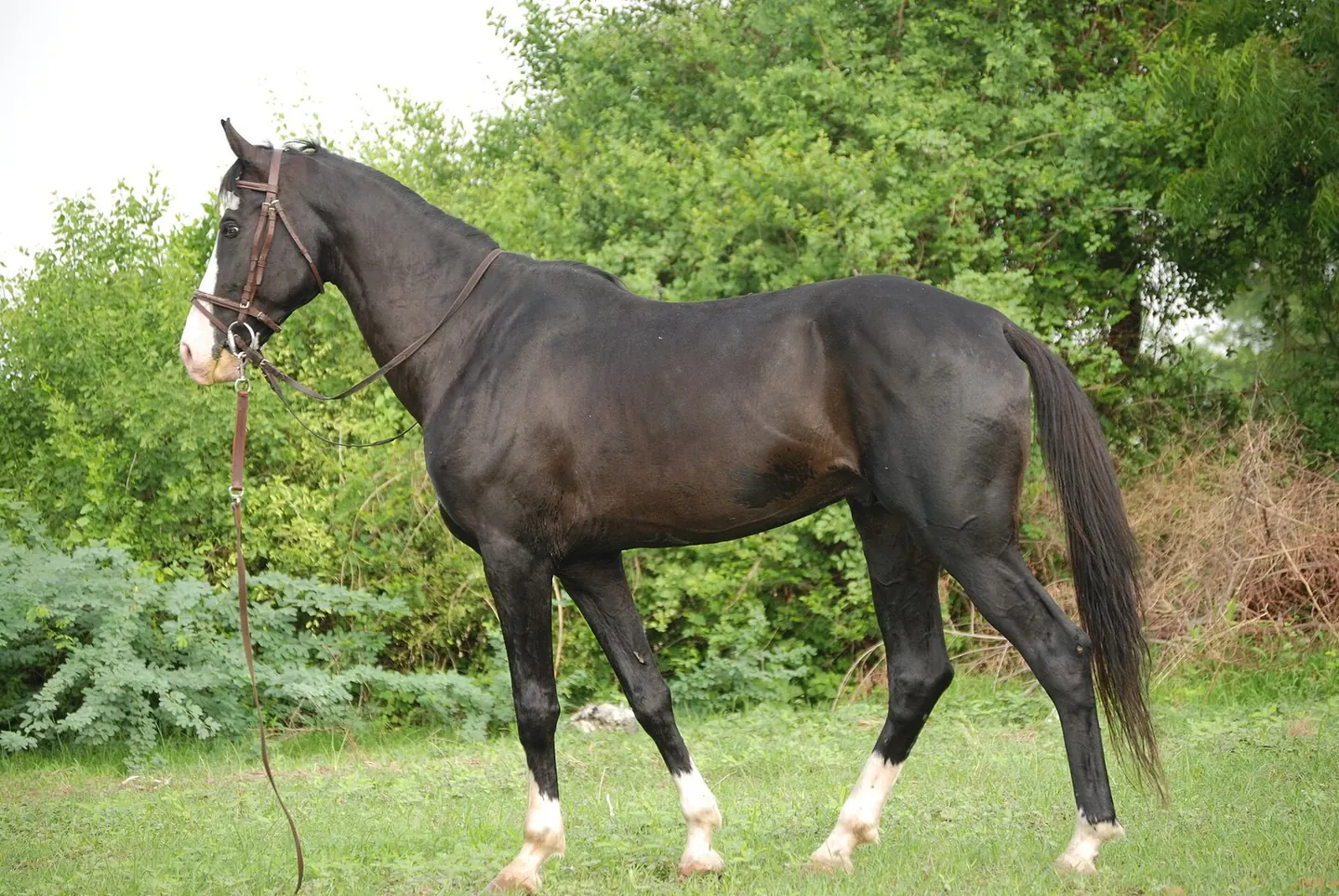
The Marwari is a riding horse from the Marwar region of Rajasthan, best known for ear tips that curve inward until they often touch. Rajput rulers bred it for their cavalry, and today it is kept for riding, police work, ceremonies and weddings (NBAGR database). NBAGR registers it as a horse breed of Rajasthan (NBAGR register).
How to recognise it
- Ears: medium-sized and soft, curving inward at the tips, which often touch; the horse can turn them through 180 degrees (NBAGR database). NRCE describes the tips as pointed and curved like a sickle, meeting or overlapping when the horse turns them (ICAR-NRCE).
- Head: long, with a flat, broad forehead, a long, flat nasal bone and a soft muzzle (NBAGR database).
- Colour: many colours. NBAGR lists dark brown, bay, dark bay, chestnut, dun, grey, flea-bitten grey, skewbald and piebald (NBAGR database); NRCE says brown is the most common (ICAR-NRCE).
- Body: strong legs with clearly defined tendons, a square frame and a thin coat (NBAGR database).
- Height and weight: NBAGR's averages are about 156 cm at the withers for stallions and 154 cm for mares, with stallions weighing about 361 kg and mares about 339 kg (NBAGR database). NRCE gives a height range of 152–160 cm (ICAR-NRCE).
What it is good for
- Riding. NBAGR lists riding as the breed's work, and notes that Marwari horses are now kept as police mounts, for ceremonies and weddings, and by owners who keep them for the love of it (NBAGR database).
- Hot, dry country. The breed comes from arid and semi-arid land. Its thin coat helps it cope with heat and cold without losing too much water, and it has a keen sense of smell and hearing (NBAGR database).
- Safaris. In Rajasthan, some Marwari breeders take tourists on horse safaris and treks (ICAR-NRCE).
- Foals. One at a time. Mares have their first foal at a little over 5 years on average, and then one about every 21 months (NBAGR database).
Where it comes from
The breed is named after Marwar, and another name for it is Malani. NBAGR's breed record names Udaipur, Sikar, Pali, Jhunjhunu, Barmer and Ajmer districts of Rajasthan, with the Malani area of Barmer district as the heart of the breed, and notes Marwari horses in Banaskantha and Mehsana districts of Gujarat as well (NBAGR database). NRCE's list adds Jodhpur, Jalore, Nagaur, Sirohi, Jaisalmer and Rajsamand (ICAR-NRCE).
The 2013 breed survey counted 38,696 Marwari horses (NBAGR database), and NBAGR's 2022 Breed Watchlist puts the breed in its "not at risk" group (Breed Watchlist), though ICAR reports that numbers are now falling (ICAR). NRCE's campus at Bikaner works to conserve the breed: in 2023 it produced India's first Marwari foal by embryo transfer and began freezing Marwari embryos (ICAR).

Looking for Marwari horses?
Kattutharai works across India. Search “Marwari” in the app to look for Marwari horses, or browse horses for sale near you. The seller names the breed and Kattutharai does not check it, so look at the horse yourself before you pay.


Rearing tips
- Close care. In the home tract, Marwari horses are kept in small groups of 2–3, sometimes up to 20, fed on fodder and concentrate, and groomed twice a day; NBAGR notes that owners care for them like their own children (NBAGR database).
- Stable, feed and hooves. Give a dry, airy stable, good fodder, clean water at all times and regular hoof care: see how horses are kept.
- A lively horse. NRCE describes Marwari horses as active, with an unpredictable temper (ICAR-NRCE). Handle them calmly, and leave training to an experienced rider.
- Health. Vaccinate with your vet, and keep a newly bought horse apart from your others for the first weeks: see keep horses healthy.
Buying tips
- Check the ears and head: ear tips that curve in and meet, or nearly meet, and a long head with a broad, flat forehead (NBAGR database).
- Marwari or Kathiawari? Both have inward-curving ears. NRCE notes that Marwari horses are taller, with longer ears, face, pasterns and neck and a convex nose line, while Kathiawari horses have a dished face and smaller ears (ICAR-NRCE). See Kathiawari horse: breed, height and how to recognise it.
- Crosses are common. NRCE says few true Marwari horses remain because of indiscriminate crossbreeding in the home area (ICAR-NRCE). The breed name in an ad is the seller's word, and Kattutharai does not check it. Ask about the parents, and check the horse yourself.
- Age, soundness and papers: read the teeth, have a vet check the horse, and get the papers your state asks for: see buying a horse.
- Pay safely. Never pay an advance for a horse you have not seen: see paying safely.
Frequently asked questions
Why do a Marwari horse's ears touch?
Its ears curve inward at the tips, and the tips often meet. It is the breed's best-known sign, and the horse can turn its ears through 180 degrees (NBAGR database).
How tall is a Marwari horse?
About 156 cm at the withers for a stallion and 154 cm for a mare on average; stallions weigh about 361 kg and mares about 339 kg (NBAGR database).
Are Marwari and Kathiawari the same breed?
No. They are two separate registered breeds, from Rajasthan and Gujarat (NBAGR register). They look alike, but the Marwari is taller, with longer ears (ICAR-NRCE).
Is a Marwari good for a first-time owner?
It can be, if you buy a calm, trained horse and learn from an experienced rider. Marwari horses are lively (ICAR-NRCE), and a horse needs daily care for many years.
Next
Compare the Marwari with the Kathiawari of Gujarat. Read Horse rearing in South India: care, buying and health for care, buying and health, and browse horses for sale.