Buffaloes (erumai) are kept in South India mainly for milk, which is richer in fat than cow milk, and in some places for farm work. They feel the heat more than cows, so they need shade, and water to wallow in or a shower, every day. This page covers their uses, care and breeds, and what to check before you buy. To start or run a dairy farm, read the dairy farming guide.
What buffaloes are kept for
- Milk. The breeds on these pages average about 7–8% fat (NBAGR database), and TNAU notes that buffalo milk is preferred for butter and ghee for that reason (TNAU).
- Farm work. NBAGR lists draught work for Murrah, Jaffarabadi, Pandharpuri and Toda buffaloes (NBAGR database). In Kerala's Kuttanad, local buffaloes plough flooded paddy fields where tractors cannot go (ICAR-CIRB).
- Home milk and manure. In the Bargur hills of Erode, buffaloes are kept for manure and for milk used at home as curd and buttermilk (NBAGR database).
- A slow start. A buffalo usually has her first calf at about 3.5–4 years, then one about every 14–16 months (NBAGR database), and she carries each calf for about 310 days (ICAR-CIRB).
How buffaloes are kept
Buffaloes have dark skin and few sweat glands, so heat troubles them more than cattle. A buffalo that is too hot eats less, grows less and gives less milk (ICAR-CIRB).
- Water to wallow in, or a shower. At 30–40 °C, let them wallow in clean water, or splash or sprinkle water on them, at least twice a day (ICAR-CIRB). In summer this also helps them come into heat and conceive (ICAR-CIRB).
- Shade and a simple shed. For each adult buffalo, ICAR-CIRB suggests about 30–40 sq ft under a roof, 80–100 sq ft of open yard and 2.5 ft of feeding trough. A thatched roof is cooler than asbestos or tin sheets (ICAR-CIRB).
- Water all day. Buffaloes need more water than cattle, so keep clean, cool water in front of them at all times (TNAU).
- Fodder first. Base the feed on green and dry fodder; buffaloes digest straw and other coarse fodder better than cattle do. Add concentrate only for growth, pregnancy and milk, and always give mineral mixture (TNAU). In summer, feed green fodder in the cool of the night (ICAR-CIRB).
- Watch for heat. Buffaloes often show heat only faintly, and many show none in summer (ICAR-CIRB). Watch them morning and evening, and write down the dates of heat, insemination and calving (TNAU).
Buffalo of South India
ICAR-NBAGR, India's breed register, lists 23 buffalo breeds. Three come from South India, two from Tamil Nadu and one from Karnataka (NBAGR register):
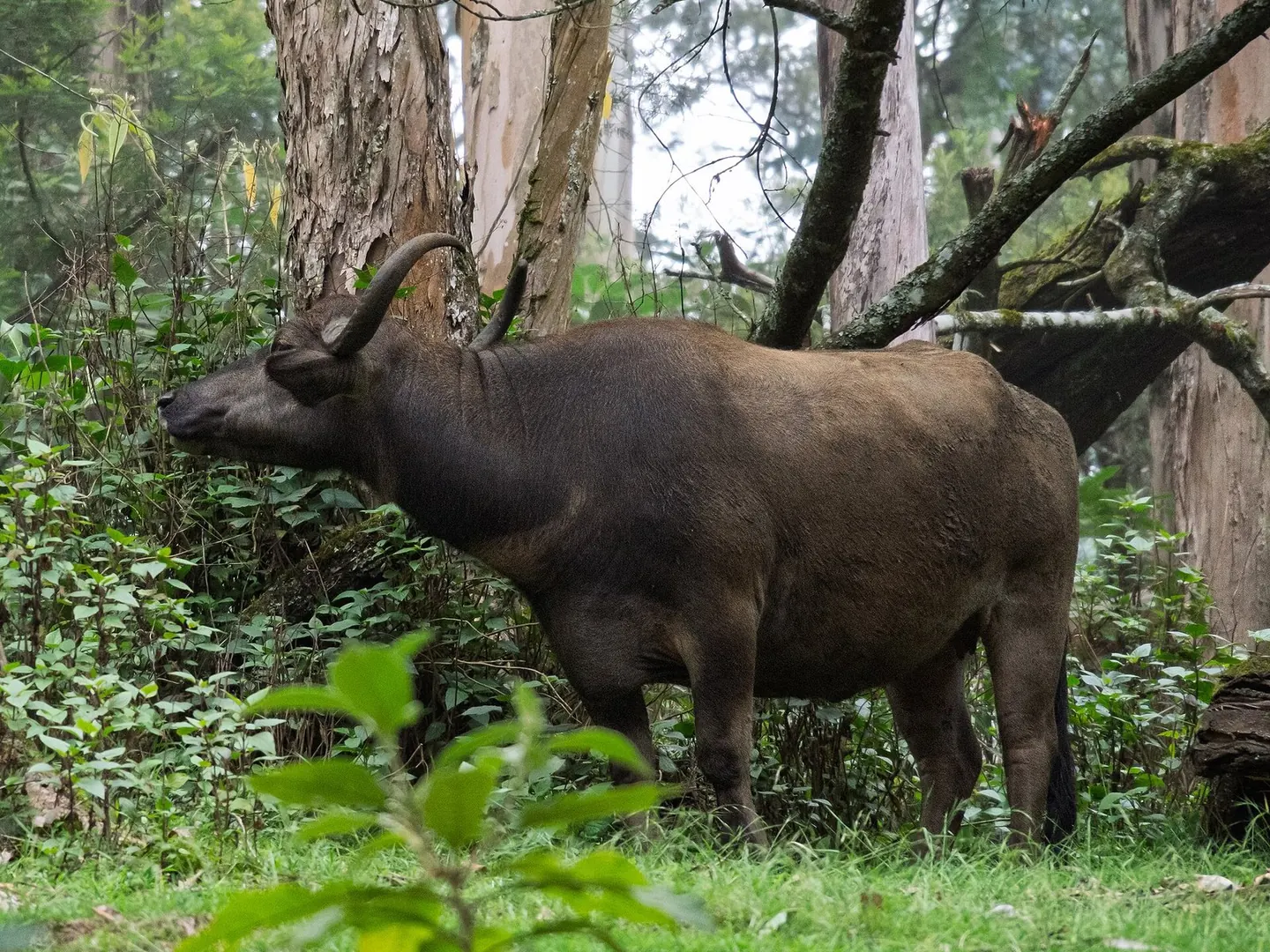
Buffalo
Toda
a fawn to ash-grey hill buffalo with crescent-shaped horns, kept on grazing by the Toda people of the Nilgiris; NBAGR lists it for draught work, and its milk is very rich in fat.
Buffalo
Bargur
a small brown or brownish-black buffalo of the Bargur hills in Erode district, kept on forest grazing for milk and manure; locally called malai erumai, the hill buffalo.
You will also meet local buffaloes, Murrah crosses and local types named after their area, such as the Godavari buffalo of Andhra Pradesh, bred from local buffaloes and Murrah (TNAU), and Kerala's Kuttanad buffalo (ICAR-CIRB). NBAGR does not list these local types as breeds.
Buffalo breeds from elsewhere
These registered breeds come from north and west India (NBAGR register); Murrah in particular is kept all over the country (TNAU):
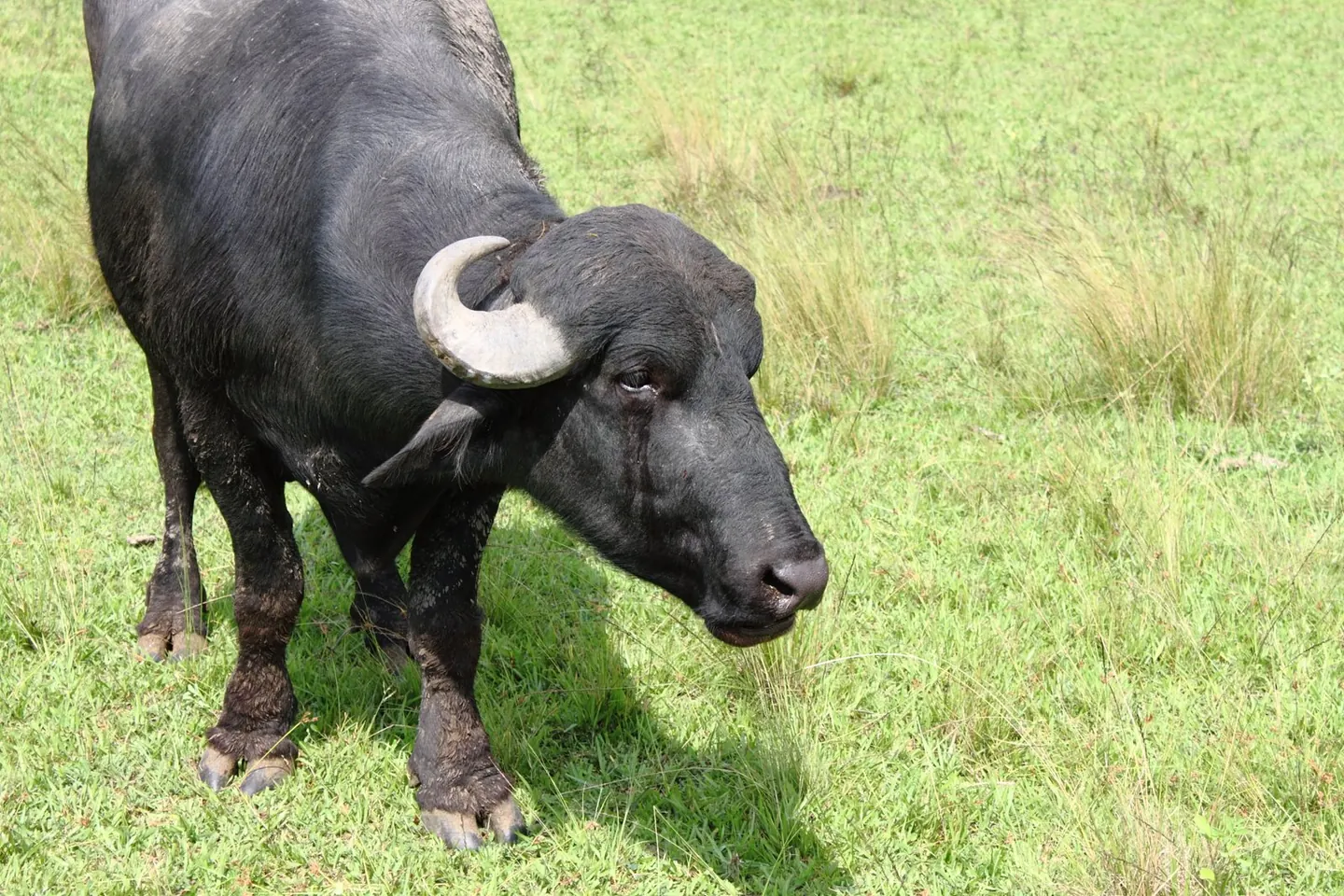
Buffalo
Murrah
a jet-black milk buffalo from Haryana with short, tightly curled horns, used across India to improve local buffaloes.
Bull 567 kg · Cow 516 kg
Buffalo
Mehsana
a mostly black milk buffalo of north Gujarat, believed to come from Murrah and Surti; it milks steadily and calves regularly.
Bull 565 kg · Cow 484 kg
Buffalo
Surti
a medium-sized, brown to silver-grey milk buffalo of central and south Gujarat, with sickle-shaped horns and two white collars on the neck; it eats less than the heavy breeds.
Bull 435 kg · Cow 401 kg
Buffalo
Jaffarabadi
the heaviest Indian breed: a black buffalo of Saurashtra and the Gir forest in Gujarat, with heavy, drooping horns, kept for milk and heavy draught work.
Bull 700 kg · Cow 620 kg
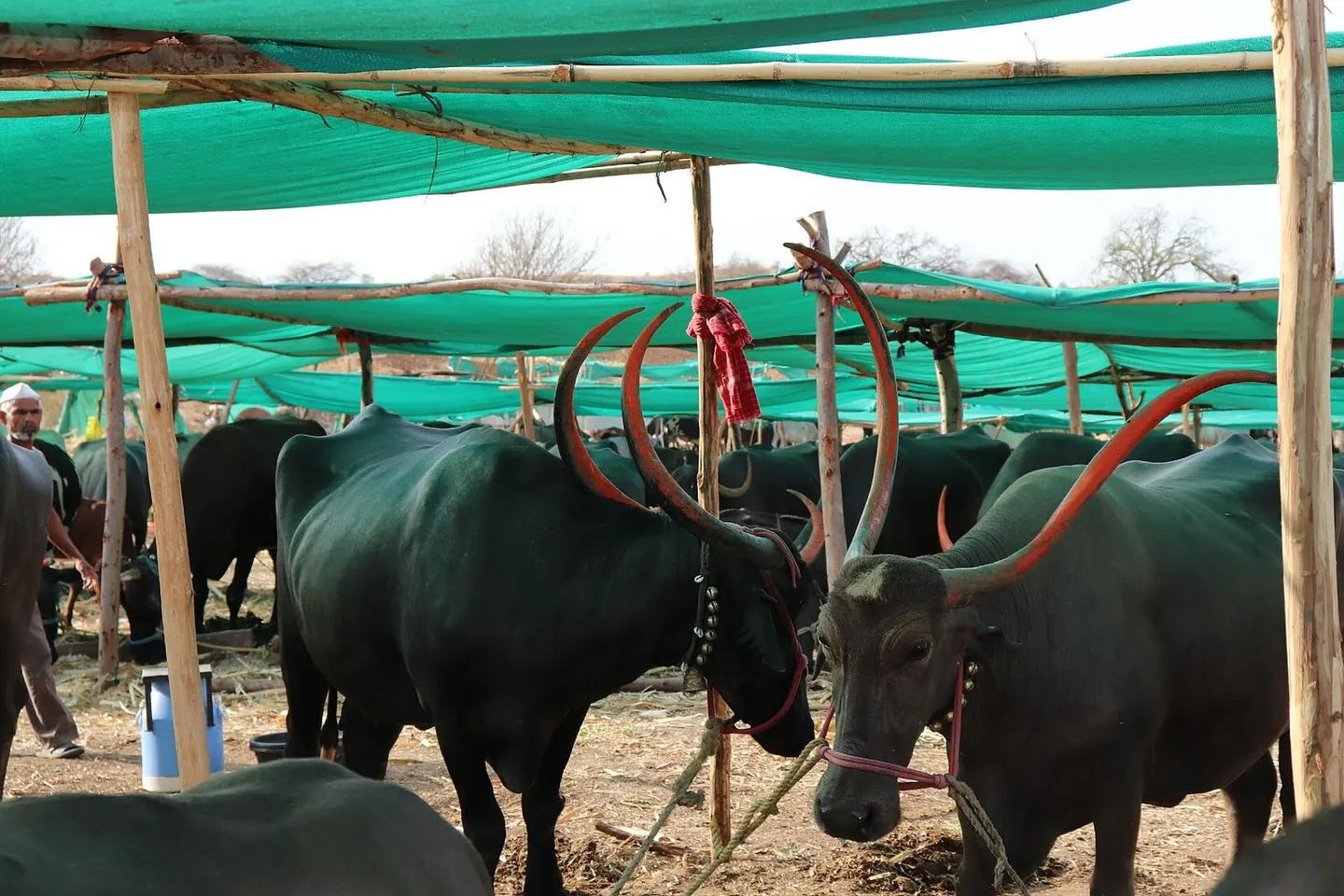
Buffalo
Pandharpuri
a black milk buffalo of Solapur, Sangli and Kolhapur in Maharashtra, with very long horns that reach past the shoulders.
Buying a buffalo
- See her milked by hand, more than once. Watch her milked at her usual times; TNAU advises taking the average of three milkings in a row. Check that she lets a new person milk her. The best time to judge is her first or second lactation, about a month after calving (TNAU).
- Check the udder. All four teats should milk freely, and the first squirts should show no clots, blood or wateriness (TNAU). Expect less milk for some days after the move: buffaloes hold back milk when they are stressed or have a new milker (TNAU).
- Tell the age by the teeth. Buffaloes get their eight large permanent front teeth later than cows, with the full set only at about 5–6 years. Worn, flat teeth with gaps between them mean an old animal (NDDB).
- Get a vet to confirm pregnancy. If she is sold as pregnant, ask for the insemination date and have a vet examine her before you pay.
- Check the ear tag and health card. Animals vaccinated under the government programme carry an ear tag with a 12-digit number recorded on the Bharat Pashudhan portal, and the owner gets a health and vaccination card (DAHD, PIB). Ask for the card and match it to the tag.
- Move her by the rules. The Transport of Animals Rules treat buffaloes as cattle: a vet's certificate that she is fit to travel, feed and water before loading, anti-slip matting, no more than six in a goods vehicle, and an attendant (AWBI). Never move a sick, weak or lame buffalo, one that calved in the last 72 hours or may calve on the way, or a newborn calf (AWBI). Ask your veterinary hospital what papers your state also needs.
- Pay only at the handover. Never send an advance for an animal you have not seen; see paying safely.
- The breed in an ad is the seller's word. Kattutharai does not check it, so check the signs on the breed's page yourself.
Health: prevention
Buffaloes catch most of the diseases that cattle catch, and haemorrhagic septicaemia (HS) hits them harder (ICAR-CIRB, TNAU). Vaccinate on time with your vet:
| Disease | First vaccination | Then |
|---|---|---|
| Foot-and-mouth disease (FMD, komari) | calves at 4–5 months, booster 4 weeks later | every 6 months |
| Haemorrhagic septicaemia (HS, thondai adaippan) | at 6 months | every year, before the rains |
| Black quarter (BQ, sappai) | at 6 months | every year, before the rains |
| Brucellosis | female calves at 4–8 months | once in a lifetime |
The FMD and brucellosis timings follow the national programme (DAHD); HS and BQ follow ICAR-CIRB's vaccination table (ICAR-CIRB). Your vet may adjust the timing for your area.
- Look after the calves. Calf deaths cause the biggest losses in buffalo farming (ICAR-CIRB). Let the calf drink colostrum within about half an hour of birth, and deworm calves from their first weeks as your vet advises (ICAR-CIRB). Keep young calves out of ponds and wallows, where they can catch infections or drown if an adult rolls onto them (ICAR-CIRB).
- Milk cleanly. Milk with clean, dry hands on a clean floor. The teat stays open for up to half an hour after milking, so give feed then to keep her standing (TNAU); this helps prevent mastitis (madi noi).
- No injections to let down milk. Buffaloes let down their milk slowly, after about 2 minutes on average and sometimes 10 (TNAU). Wash and massage the udder or let the calf suckle first, and do not give any injection to let down milk without a vet.
- Act fast in the heat. On a hot day, a buffalo that breathes fast or stops eating needs shade and water at once (ICAR-CIRB).
- Call 1962 for a mobile veterinary unit at your door, where the service runs (PIB).
Frequently asked questions
Which buffalo breed gives the most milk?
Of the breeds on these pages, NBAGR's records give the highest averages for Jaffarabadi (about 2,240 kg in a lactation), Mehsana (about 1,990 kg), Pandharpuri (about 1,790 kg) and Murrah (about 1,750 kg) (NBAGR database). Single animals vary widely and feeding matters most (TNAU), so choose a breed you can feed, water and keep cool.
Is buffalo milk different from cow milk?
It is thicker and has more fat, about 7–8% on average in the breeds on these pages (NBAGR database). That is why it is preferred for butter and ghee (TNAU) and for sweets such as Dharwad peda (ICAR-CIRB).
Can I keep buffaloes without a pond?
Yes, if you cool them another way: splash, sprinkle or shower them at least twice a day in hot weather, and keep them in shade (ICAR-CIRB).
Is there a loan or insurance for buffaloes?
Ask your bank about the Kisan Credit Card, and your veterinary hospital about livestock insurance. Our loans and insurance guide, written for dairy farmers, explains how these schemes work.
Next
Start with Murrah, the breed with by far the most animals in India's 2013 breed survey (NBAGR database), or a breed of your own state such as Toda. For cows and bulls, see Cows and bulls: native breeds, crossbreds, buying and care. To find buffaloes near you, browse buffaloes for sale.

Find buffalo near you on Kattutharai
See buffalo for sale direct from farmers near your village, with photos, the village name and the distance. No middlemen. Call or chat with the farmer, then see the buffalo milked by hand and check it yourself before you pay.
Looking for a particular breed? Search its name in the Kattutharai app, for example Murrah, Toda or Jaffarabadi.

