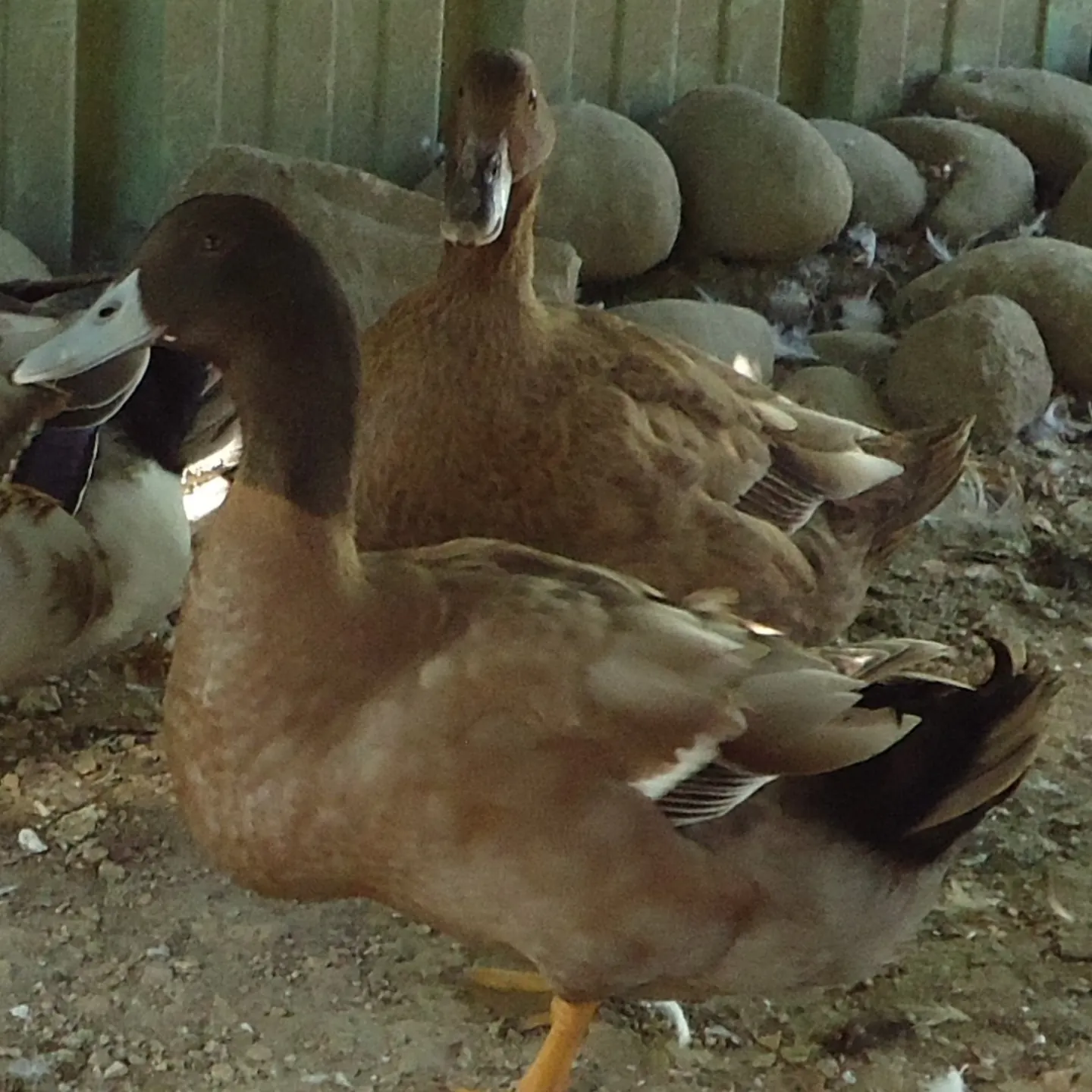
Khaki Campbell is an egg-laying duck breed from the United Kingdom, brought to India by government duck farms. It is often sold on the promise of 300 eggs a year, but Indian field studies record about 120–193 (ICAR-DPR review). It is a foreign breed, not on India's breed register (ICAR-NBAGR).
How to recognise it
- Colour. The duck is khaki (a dull brown) all over, with a greenish-black bill and brown legs. The drake is khaki with a darker head, usually olive green, a green bill and dark orange legs (ICAR-DPR review).
- Other varieties. Besides the common khaki, there are dark and white varieties (ICAR-DPR review).
- Size. A light duck: ducks weigh about 2–2.2 kg and drakes about 2.2–2.4 kg (TNAU, ICAR-DPR review).
- Eggs. The shells are off-white (ICAR-DPR review).
What it is good for
- Eggs a year in India. It is kept for eggs. In field studies, Khaki Campbells laid about 120–140 eggs a year in Assam, about 127 in Jharkhand and 193 in West Bengal (ICAR-DPR review).
- The "300 eggs" claim. Handbooks credit the breed with 250–340 eggs a year (ICAR-DPR review), and TNAU writes "up to 300 eggs" in a laying cycle (TNAU). But ICAR-DPR scientists point out that Indian research has not shown 300 eggs a year. Output varies widely, and after a long time with no breeding programme, India's Khaki Campbells lay well below what the breed could do when it was brought in (ICAR-DPR).
- Egg size and first eggs. Eggs weigh about 65–75 g (TNAU); in a Jharkhand village study they weighed 61–64 g. Young ducks start laying at about 5–7 months of age (ICAR-DPR review).
- Crosses. Crosses of Khaki Campbell with local ducks usually do better than the local ducks, and in some trials better than both parents (ICAR-DPR).
Where it is mainly found
The breed comes from the United Kingdom (ICAR-DPR review). India imported Khaki Campbell ducklings from the UK in 1971 and 1981 for government duck farms. The Central Duck Breeding Farm at Hessarghatta, Bengaluru, started working in 1982 and is now the Central Poultry Development Organisation and Training Institute; ICAR-DPR scientists think most Khaki Campbells in India today come from that farm (ICAR-DPR).
In Tamil Nadu, research stations keep Khaki Campbells, but duck farmers have stayed with local ducks, which lay bigger eggs, are hardy and manage on little. TANUVAS researchers note that the Khaki Campbell may not fit the state's herded, free-range duck keeping (TANUVAS study).

Looking for Khaki Campbell ducks?
Kattutharai works across India. Search “Khaki Campbell” in the app to look for Khaki Campbell ducks, or browse ducks for sale near you. The seller names the breed and Kattutharai does not check it, so look at the birds yourself before you pay.


Rearing tips
- Housed farms suit it best. ICAR-DPR scientists suggest Khaki Campbell for intensive egg farming (ICAR-DPR). In a closed house, ducks live on deep litter of paddy husk or chopped straw, with feed and water inside, with or without water channels (ICAR-DPR review).
- Feed. Ready-made duck feed is not sold in most parts of India, so farmers mix their own for each stage of growth and laying. Never use mouldy feed: ducks are very sensitive to aflatoxin, the mould poison of badly stored maize and groundnut (ICAR-DPR review).
- Azolla. In ICAR-DPR trials, dried azolla, a water fern, made up 10% of the feed of Khaki Campbell layers, improved egg quality and cut the feed cost (ICAR-DPR review).
- Health. Ask your vet about vaccination against duck plague and duck cholera, and report sudden deaths at once: see keep ducks healthy.
Buying tips
- Check the colour. Ducks are khaki all over and drakes have a darker, greenish head. Patchy or mixed colours point to a cross.
- Don't buy on a number. Be wary of a seller who promises 300 eggs a year. Ask the age of the birds and how many eggs the parent flock lays.
- Ducklings. Buy from government duck farms or known hatcheries where you can; ask your nearest veterinary hospital which ones supply ducklings near you.
- The seller's word. The breed name in an ad is the seller's word, and Kattutharai does not check it. Look at the birds yourself.
- Health and papers. Check each bird and ask for the vaccination record: see buying ducks.
Frequently asked questions
Does a Khaki Campbell really lay 300 eggs a year?
Not in Indian studies. Field studies in India found about 120–193 eggs a year, and ICAR-DPR scientists say Indian research has not shown 300 (ICAR-DPR review, ICAR-DPR).
Khaki Campbell or local ducks?
For a housed farm with mixed feed, Khaki Campbell is the egg breed ICAR-DPR scientists suggest (ICAR-DPR). For herded flocks on paddy fields, Tamil Nadu's duck keepers prefer local ducks, which lay bigger eggs and are hardier (TANUVAS study).
How heavy is a Khaki Campbell?
Ducks weigh about 2–2.2 kg and drakes about 2.2–2.4 kg (TNAU).
When does a Khaki Campbell start laying?
At about 5–7 months of age in Indian field studies (ICAR-DPR review).
Next
Compare it with Kerala's Kuttanad duck, the meat breed White Pekin and the Muscovy (Manila) duck. Read Duck rearing in South India: breeds, buying and health for rearing, buying and bird-flu rules, and browse ducks for sale.