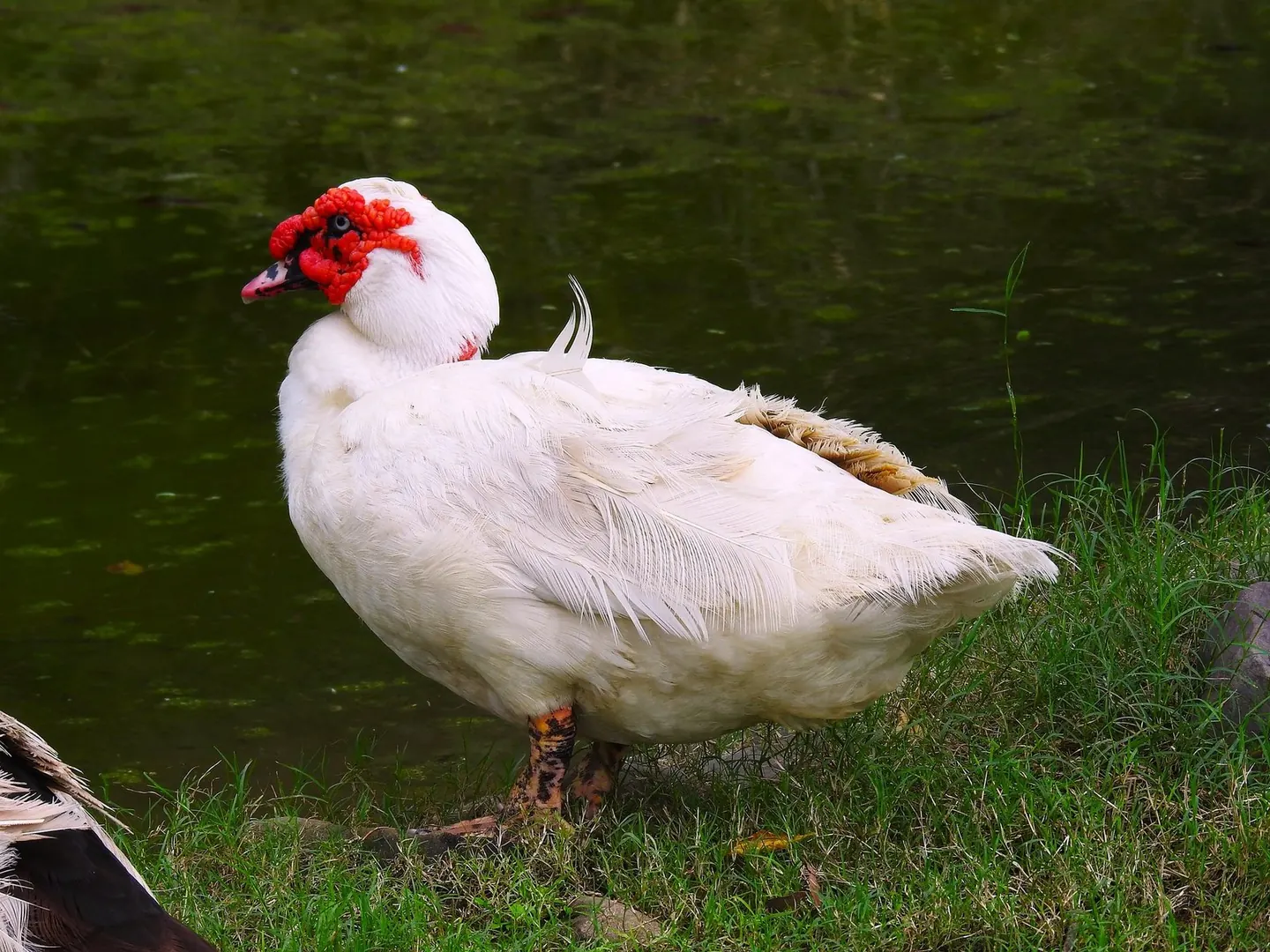
The Muscovy is a big, quiet duck kept mainly for its lean meat, and many sellers in Tamil Nadu call it the Manila duck. It is a different species from other farm ducks, Cairina moschata, and comes from South America (ICAR-DPR review). It is a foreign breed, not one of India's registered duck breeds (ICAR-NBAGR).
How to recognise it
- Face. Bare, red, bumpy skin around the eyes and above the bill. Drakes have a fleshy knob on top of the bill (ICAR-DPR review).
- Colour. The wild type is black, with a glossy green sheen on the back and large white wing patches. Farm birds are mainly of two kinds: white, or a shiny blue-black with some white (ICAR-DPR review). Village flocks in Odisha are black, white or brown (ICAR-DPR).
- Size. Drakes are far bigger than ducks: adult drakes weigh about 4.5–6.4 kg and ducks about 2.2–3.1 kg (ICAR-DPR review). In village flocks in Odisha, drakes weighed about 3.5 kg and ducks about 2.5 kg (ICAR-DPR).
- Other signs. Muscovies do not quack; they hiss. They have long, sharp claws and can fly, and the drakes have no curled tail feathers. Young birds grow their full feathers only at about 16 weeks, against 12 weeks in other ducks (ICAR-DPR review).
What it is good for
- Lean meat. It is a meat breed, with lean meat and a high share of breast meat (ICAR-DPR review). ICAR-DPR scientists note that India's Muscovies are well adapted to backyard rearing and could be developed as backyard meat birds (ICAR-DPR).
- Few eggs. A Muscovy duck lays only about 50–60 eggs a year in Assam (50–80 in Odisha), and starts late: at 300–315 days of age in Assam and 6–8 months in Odisha (ICAR-DPR review, ICAR-DPR).
- A slow hatch. Muscovy eggs take about 35 days to hatch, a week longer than the 28 days of other ducks (ICAR-DPR review).
- A good mother. Muscovy ducks are calm and go broody readily; in Indonesia they are often used to hatch other ducks' eggs (IPB University).
- Little water. Muscovies need less water than other ducks, and they graze grass (ICAR-DPR review).
Where it is mainly found
The Muscovy comes from South America, from Brazil in particular (ICAR-DPR review). In India it is kept in backyards in Odisha and Chhattisgarh, where it is called Moti Hans, in Assam, where it is called Cina Hanh, and in other duck-keeping states; nobody knows exactly how it spread here (ICAR-DPR). In Kerala, KVASU's poultry and duck farm at Mannuthy keeps and supplies Muscovy ducks (KVASU).
In Tamil Nadu many sellers call it the Manila duck. The same name is used in Indonesia, where the bird is said to have arrived through the Philippines (IPB University).

Looking for Manila ducks?
Kattutharai works across India. Search “Manila” in the app to look for Manila ducks, or browse ducks for sale near you. The seller names the breed and Kattutharai does not check it, so look at the birds yourself before you pay.


Rearing tips
- Backyard keeping. A safe night shelter and daytime grazing suit it, and it needs less water than other ducks. For housing and feed, see how ducks are raised.
- Fence them in. Muscovies can fly, so keep them in a fenced yard by day and a closed pen at night.
- Hatching. If you hatch Muscovy eggs together with other duck eggs, under a broody hen or in an incubator, remember that the Muscovy eggs need about a week longer.
- Breeding. A Muscovy drake mated with an ordinary duck gives "mule" ducks, which cannot breed; the reverse cross, an ordinary drake with a Muscovy duck, gives birds that are not wanted for meat or eggs (ICAR-DPR review). To breed Muscovies pure, keep them apart from other ducks.
- Health. Ask your vet about vaccination, never give mouldy feed, and report sudden deaths at once: see keep ducks healthy.
Buying tips
- Check the face. A true Muscovy has bare red skin around the eyes and above the bill, and it hisses instead of quacking. A white duck with a plain, smooth face and an orange-yellow bill is more likely a White Pekin.
- Drakes and ducks. In a pure pair the drake is clearly much bigger than the duck.
- Ask about the parents. Mule ducks cannot breed. If you want to hatch your own ducklings, ask whether both parents were Muscovies.
- The seller's word. The breed name in an ad is the seller's word, and Kattutharai does not check it. Look at the birds yourself, and buy from known farms, such as KVASU's at Mannuthy, where you can.
- Health and papers. Check each bird and ask for the vaccination record: see buying ducks.
Frequently asked questions
Is the Manila duck the same as the Muscovy?
Yes. Manila duck is the name many sellers in Tamil Nadu use for the Muscovy, and the same name is used in Indonesia (IPB University).
Is the Muscovy a real duck?
It is a duck, but of a different species. Almost all other farm ducks descend from the wild mallard; the Muscovy does not (ICAR-DPR review). That is why its eggs take longer to hatch and its crosses with other ducks cannot breed.
How many eggs does a Muscovy lay?
About 50–60 a year in Assam and 50–80 in Odisha (ICAR-DPR review, ICAR-DPR). Keep Muscovies for meat and for hatching, not for eggs to sell.
How long do Muscovy eggs take to hatch?
About 35 days, against 28 days for other ducks (ICAR-DPR review).
Next
Compare it with the meat breed White Pekin, Kerala's Kuttanad duck and the egg breed Khaki Campbell. Read Duck rearing in South India: breeds, buying and health for rearing, buying and bird-flu rules, and browse ducks for sale.