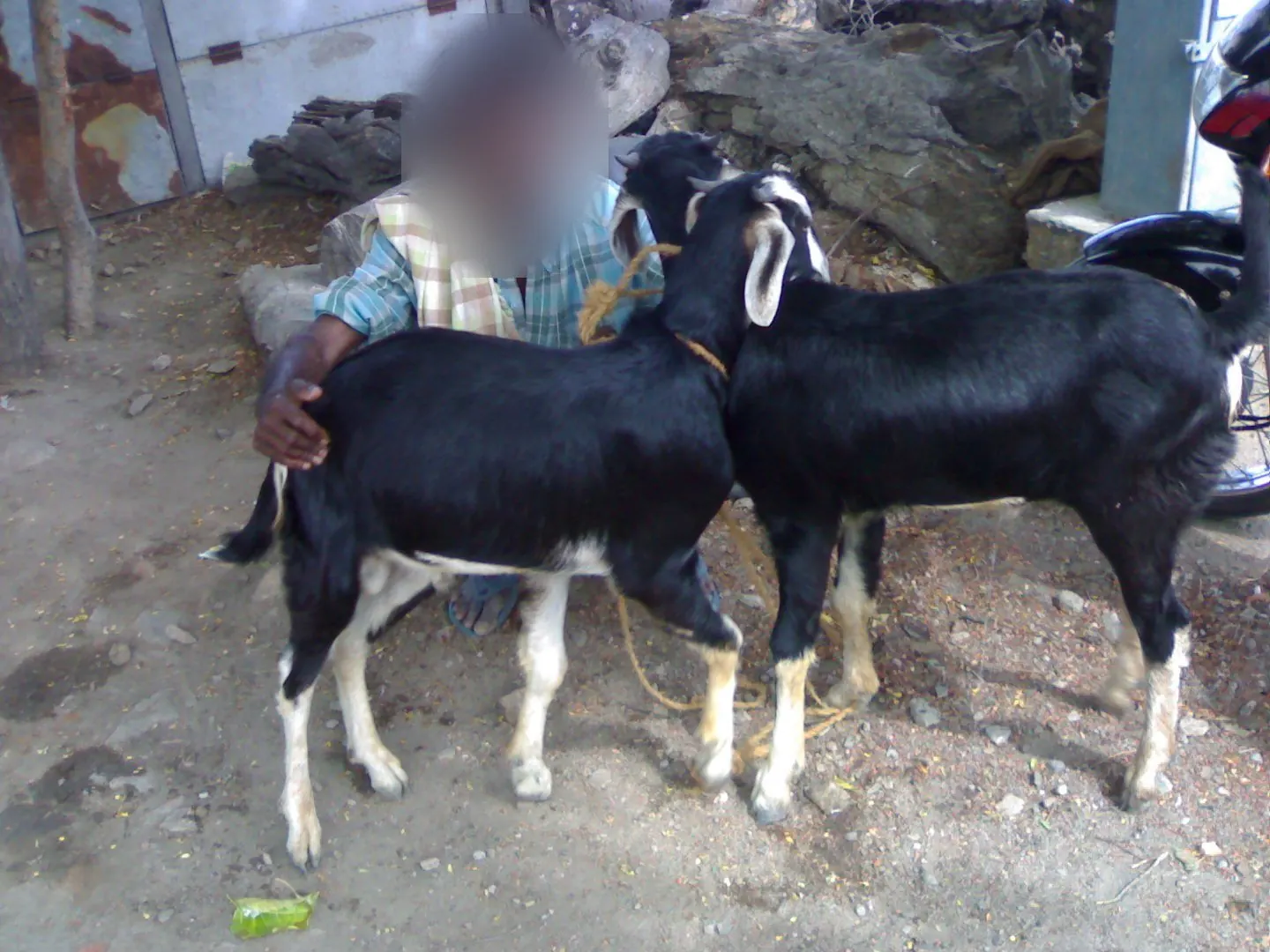
Kanni Adu is a medium-sized meat goat from the dry south of Tamil Nadu, easy to know by the white stripe down each side of its black face. It is one of the state's three registered goat breeds, at home in Virudhunagar, Thoothukudi and Tenkasi districts. This page shows how to recognise a true Kanni, what it gives, and what to check before you buy.
How to recognise it
- Colour: black, with a white stripe on each side of the face from the base of the horn to the corner of the mouth. The belly and the inner side of the legs are white, the ear edges carry a white line, and most goats have a white patch or line on each side of the neck (ICAR-NBAGR).
- Two colour types: farmers call the goats with white markings Pal Kanni, and those whose markings are reddish-brown instead Chen Kanni (TNAU).
- Head and ears: a straight face with a medium to broad forehead, and leaf-shaped ears, more than 16 cm long, that hang half-way down.
- Horns: two, mostly pointing backwards and outwards; medium-sized in bucks and small in does.
- Beard: about half the bucks (55%) and a few does (15%) have one.
- Size and weight: a tall goat. Adult bucks weigh about 34 kg and does about 28 kg on average (ICAR-NBAGR).
What it is good for
- Meat. NBAGR classes Kanni Adu as a meat breed (ICAR-NBAGR), and TNAU notes that Tamil Nadu's goat breeds are kept mainly for meat and skin (TNAU).
- Growth. Kids weigh about 2 kg at birth, about 12 kg at 6 months and 21–22 kg at 1 year.
- Kids. About 1.9 kids per kidding on average. In the breed survey, does were first mated at about 9 months, had their first kids at about 14 months, kidded again about every 7 months, and had 10–12 kiddings in a lifetime (ICAR-NBAGR).
- Milk. Little: about 0.7 litre a day early in the lactation, falling to about 0.4 litre by the third month — enough for the kids, not for selling.
Where it is mainly found
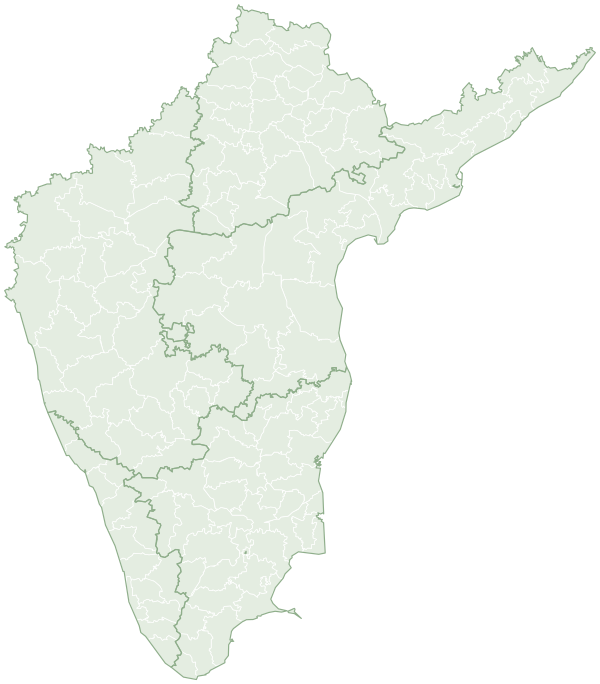
NBAGR's breed descriptor gives a small home tract: Sattur and Sivakasi taluks of Virudhunagar district, Kovilpatti and Vilathikulam taluks of Thoothukudi district, and Sankarankovil taluk, which was part of Tirunelveli district when the breed was described and is now in Tenkasi district (ICAR-NBAGR). NBAGR registers Kanni Adu as a Tamil Nadu breed (breed register). Farmers keep it well beyond that tract: in the government's 2013 breed survey, about 7 lakh goats were recorded as Kanni Adu (NBAGR database).

Looking for Kanni goats?
See goat ads in the districts where Kanni goats come from, or search “Kanni” in the Kattutharai app to find them near you. The seller names the breed and Kattutharai does not check it, so look at the animal yourself before you pay.
Goat and sheep ads in its home districts, 1 Nov 2026:


Rearing tips
- Grazing by day, a pen at night. In the home tract, Kanni goats go out as a herd to graze and are penned only at night, in open pens or sheds next to the house. They live on tree loppings, shrubs, crop leftovers after the harvest and weeds from field edges (TANUVAS study). Herds commonly walk 5–10 km a day to graze (NBAGR database).
- Plan for the lean months. NBAGR's record lists fodder and concentrate alongside grazing for adult goats (NBAGR database). Plan green and dry fodder for the dry season: see Goat feeding: fodder, concentrate mix and water.
- Look after the kids. In the TANUVAS study, about one kid in four died, and most farmers vaccinated only when a disease had already broken out (TANUVAS study). Give colostrum early, keep kids dry and vaccinate on time instead: see Goat kid care: colostrum, creep feed and weaning and the vaccination calendar.
- Control mating. In the same study, bucks ran with the herd all year. Change the buck every 2–3 years so that he does not mate his own daughters: see avoid inbreeding.
Buying tips
- Check the face first. A true Kanni is black, with the white (or reddish-brown) stripe on each side of the face, a white belly and white inner legs. A black goat without the stripes is not a Kanni, and white patches on the back or sides suggest a cross.
- Do not mix it up with Kodi Adu. Kodi Adu, from the same region, is white with black or reddish-brown splashes, very tall, with a long neck and body (TNAU). See Kodi Adu goat: breed, weight and where it is found.
- Crosses are common, so a goat sold as Kanni may be a cross. The breed name in an ad is the seller's word, and Kattutharai does not check it. See the mother and the herd, ask where the parents came from, and check the signs above yourself.
- Check health and age before you pay, with the checklist in How to buy goats safely: health, age and fraud checks and the teeth table.
Frequently asked questions
Is Kanni Adu good for a beginner?
It can be, if you live in or near its home districts, have grazing for the herd, and local buyers ask for it. Breeds farmed in their home area usually do better than breeds brought from far away: see match the breed to your area.
How much does an adult Kanni goat weigh?
About 34 kg for a buck and 28 kg for a doe on average, and 21–22 kg at 1 year (ICAR-NBAGR). Your own goats will vary with feed and care.
What is the difference between Pal Kanni and Chen Kanni?
Only the colour of the markings: white on Pal Kanni, reddish-brown on Chen Kanni (TNAU). Both are Kanni Adu; NBAGR lists them as the breed's two strains.
Can I milk Kanni goats?
They give little milk — about 0.7 litre a day at first — and the kids need it. Keep Kanni goats for meat; if milk matters to you, see start with your purpose.
Next
Compare Kanni with Tamil Nadu's other goat breeds, Kodi Adu and Salem Black, or see all goat and sheep breeds. To find Kanni goats near you, browse goats for sale.