Salem Black is a tall, completely black meat goat from the dry north-west of Tamil Nadu — Salem, Dharmapuri, Krishnagiri and Erode districts. Farmers there call it Karuppu Adu. It matures early, often has twins and copes well with heat and poor grazing; ICAR-NBAGR registered it as a breed in 2017.
How to recognise it
- Colour: completely black, with a glossy coat. Under the breed standard, any white spot or marking rules an animal out (ICAR-NBAGR).
- Build: tall, long, lean and leggy, with a compact body, long straight legs and a thin tail that curls upwards (ICAR-NBAGR).
- Head and ears: a straight, medium-length head, small bright eyes with black eyelashes, and medium-sized, leaf-shaped ears that hang half-way down.
- Horns: both bucks and does have horns — round, slender, mostly pointing up and back with a sharp tip, about 20 cm long in bucks and 14 cm in does. They are ash-grey to grey (TANUVAS).
- Wattles and beard: most have wattles (89% of bucks, 76% of does), and some have a beard (43% of bucks, 22% of does). Bucks carry medium-length, rough hair on the neck and withers (ICAR-NBAGR).
- Weight: adult bucks weigh about 38 kg and does about 30–32 kg (ICAR-NBAGR, TANUVAS).
What it is good for
- Meat. Salem Black is kept mainly for meat, with skin and manure as extras; the does are not milked (ICAR-NBAGR). Buyers in its home area prefer its meat (NBAGR database).
- Growth. Kids weigh about 2 kg at birth, 11–12 kg at 6 months and 17–21 kg at 1 year (ICAR-NBAGR).
- Early and prolific. Bucks and does are first mated at about 9–10 months, does have their first kids at about 15 months and kid again about every 7 months. On average a doe has 1.6 kids per kidding: 40% of kiddings bring twins, 8% triplets and a few quadruplets, so nearly half bring two or more kids (ICAR-NBAGR).
- Hardy. It is well adapted to the hot, semi-arid north-west of Tamil Nadu, does well where fodder is poor, and makes good use of crop leftovers such as groundnut and gingelly haulms (NBAGR database).
Where it is mainly found
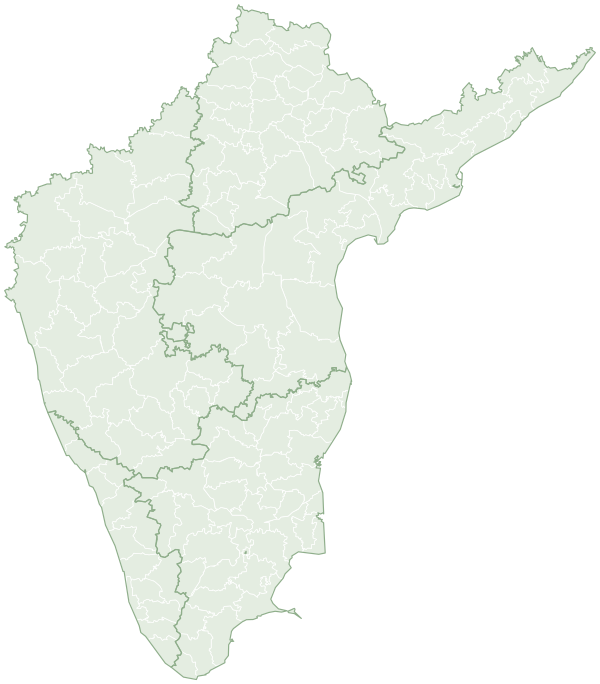
NBAGR's registration gives the home tract as Salem, Dharmapuri, Krishnagiri and Erode districts (ICAR-NBAGR), and its breed register lists Salem Black for Tamil Nadu. TANUVAS adds nearby parts of Namakkal, and says the most true-to-type goats are found in Mettur and Omalur taluks of Salem and in Pennagaram, Palacode and Harur taluks of Dharmapuri (TANUVAS); TNAU notes that they are most common around Omalur and Mecheri (TNAU). About 87,000 Salem Black goats were counted in the home tract in 2002 (ICAR-NBAGR).

Looking for Salem Black goats?
See goat ads in the districts where Salem Black goats come from, or search “Salem Black” in the Kattutharai app to find them near you. The seller names the breed and Kattutharai does not check it, so look at the animal yourself before you pay.
Goat and sheep ads in its home districts, 1 Nov 2026:


Rearing tips
- Browsing by day. In the home tract, herds go out for 7–8 hours a day, up to 3–6 km, to bushes along roadsides, waste land, forest edges and harvested fields, and are housed at night (NBAGR database). See choose a feeding system.
- Plan summer feed. When grazing runs short in summer, farmers feed acacia pods, tapioca leaves and peel, groundnut haulms, paddy straw and horse gram haulms, and some give concentrate (NBAGR database). See Goat feeding: fodder, concentrate mix and water.
- Feed the mothers of twins well. A doe carrying or suckling two or three kids needs more feed, and her kids need close care in the first weeks: see feeding by stage and Goat kid care: colostrum, creep feed and weaning.
- Prevent disease. Keep the night shed dry and follow the vaccination calendar and deworming advice in Goat health: vaccination schedule and deworming.
- Use good bucks. TANUVAS's Mecheri Sheep Research Station keeps a Salem Black herd to supply better animals to farmers (TANUVAS). Change the buck every 2–3 years: see avoid inbreeding.
Buying tips
- All black, no white. A white spot or patch anywhere means the goat does not meet the breed standard and may be a cross (ICAR-NBAGR).
- Black is not enough. Many goats are black. A Salem Black is also tall and leggy, with leaf-shaped, half-hanging ears and horns in both sexes, and usually has wattles. A black goat with white stripes on the face is a Kanni Adu, not a Salem Black (TNAU); see Kanni goat: breed, weight and where it is found.
- Crosses are common, so a goat sold as Salem Black may be a cross. The breed name in an ad is the seller's word, and Kattutharai does not check it. See the mother and the herd, ask where the parents came from, and check the signs above yourself.
- Check health and age before you pay: see How to buy goats safely: health, age and fraud checks.
Frequently asked questions
Is Salem Black good for a beginner?
It can be, if you live in or near its home districts, have land where the goats can browse, and local buyers ask for it. It is hardy and has many twins, but like every goat it needs care every day: see Goat farming for beginners: is it right for you?.
How much does an adult Salem Black weigh?
About 38 kg for a buck and 30–32 kg for a doe, and about 17–21 kg at 1 year (ICAR-NBAGR). Your own goats will vary with feed and care.
Do Salem Black goats often have twins?
Yes. In the breed's registration data, 40% of kiddings brought twins and 8% triplets, an average of 1.6 kids per kidding (ICAR-NBAGR).
Where can I buy a pure Salem Black buck?
From farmers in the home tract who keep pure herds, after checking the animal yourself. TANUVAS's Mecheri Sheep Research Station at Pottaneri, Salem district, keeps a Salem Black herd for farmers (TANUVAS station); ask the station or your nearest veterinary hospital whether stock is available.
Next
Compare Salem Black with Kanni Adu and Kodi Adu, or see all goat and sheep breeds. To find Salem Black goats near you, browse goats for sale.