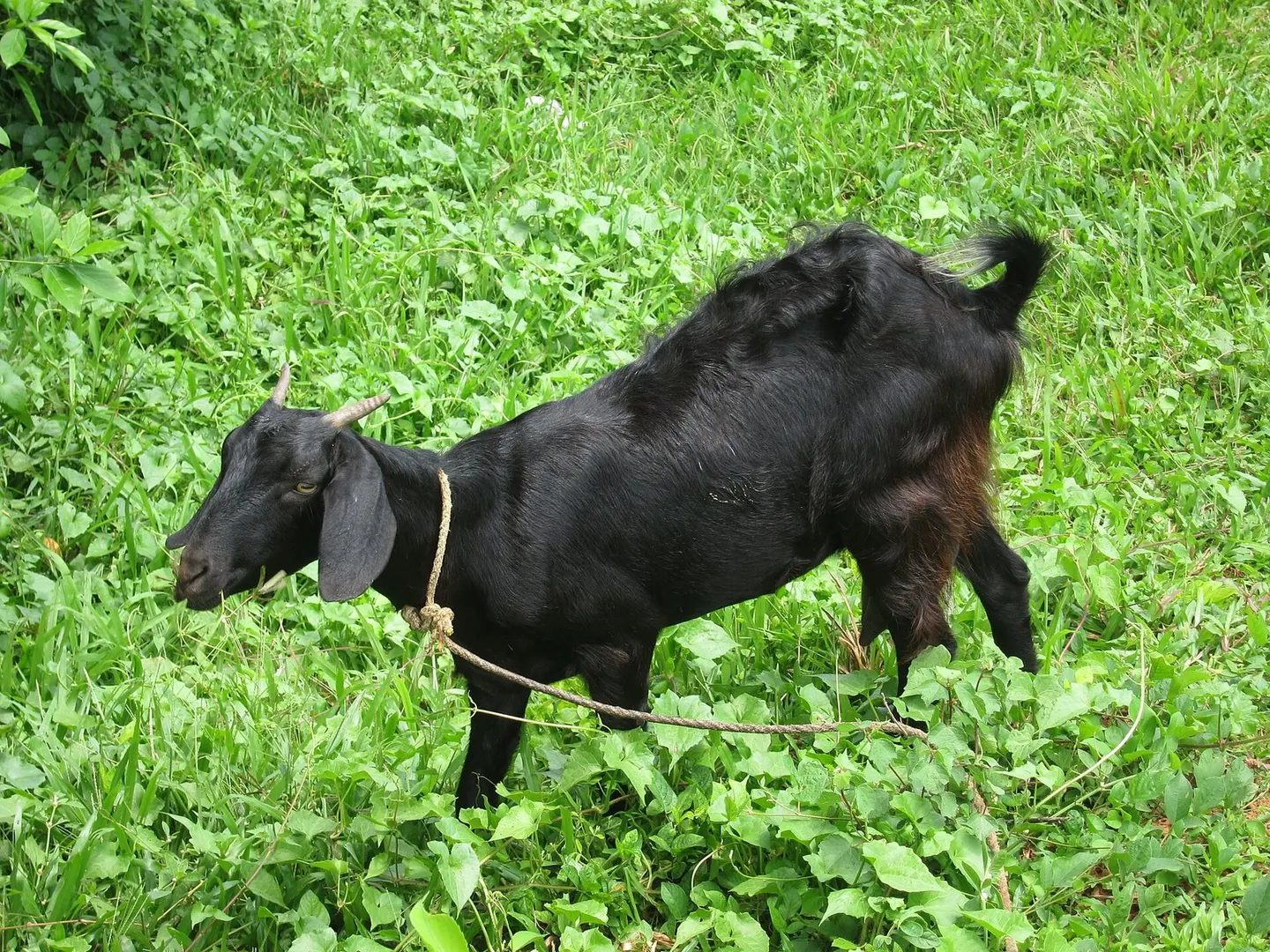
Tellicherry is the market name of the Malabari goat of north Kerala: a medium-sized goat kept mainly for meat and known for twins and triplets. ICAR-NBAGR registers the breed as Malabari (ICAR-NBAGR) and lists Tellicherry, Thalassery and Malabar among its other names (ICAR-NBAGR).
How to recognise it
- Colour varies. Most Malabari goats are fully white, but some are black, brown or a mix (ICAR-NBAGR); a breed study found every shade from white through mixed colours to black (breed study). Colour alone does not tell you the breed.
- Horns: small and slightly twisted, pointing outward and upward; in some goats they curve back and down (ICAR-NBAGR).
- Ears: medium-sized, held outward and downward, reaching about to the nose (ICAR-NBAGR).
- Weight: adult bucks weigh about 39–41 kg and does about 31 kg (ICAR-NBAGR, breed study).
- Kids: about 2 kg at birth, 9 kg at 6 months and 21 kg at 1 year (ICAR-NBAGR, breed study).
What it is good for
- Meat first, some milk. NBAGR records it as a milk and meat breed (ICAR-NBAGR), but goat keepers rear it mainly for meat. Does give about 0.5–1.5 litres of milk a day (breed study), or about 44 kg in a lactation (ICAR-NBAGR).
- Many kids. NBAGR calls the breed highly prolific (ICAR-NBAGR). In the breed study, half of all kiddings gave twins and a quarter gave triplets (breed study). A KVASU review puts Malabari at 1.76–1.97 kids per kidding, against 1.63 for Boer goats (KVASU review).
- Breeding: does first kid at about 20 months on average (16–23 months), and kid again about every 9 months (ICAR-NBAGR).
- Made for humid heat. The breed is adapted to Kerala's hot, humid climate (ICAR-NBAGR) and copes with it better than its crosses with exotic breeds; KVASU also notes its meat quality and low fat (KVASU review).
Where it is mainly found
NBAGR's breed record places the home tract in four districts of north Kerala: Kozhikode (Calicut), Kannur, Wayanad and Malappuram, the old Malabar region (ICAR-NBAGR).
Why so many names? "Malabari" comes from the Malabar region. Thalassery is a town in Kannur district, and Tellicherry is its old English spelling; NBAGR lists both as other names of the breed (ICAR-NBAGR), and TNAU calls it "Malabar or Tellicherry" (TNAU). Whichever name an ad uses, it is the same breed.
Kerala's 2024 goat breeding policy plans to improve Malabari goats inside their home tract with selected bucks, by natural mating and frozen semen, and to use Malabari bucks to improve non-descript goats in the rest of the state (KVASU review).

Looking for Tellicherry goats?
Search “Tellicherry” in the Kattutharai app to find Tellicherry goats for sale near you, or see all goats for sale. The seller names the breed and Kattutharai does not check it, so look at the animal yourself before you pay.


Rearing tips
- Grazing plus concentrate. The usual system is semi-intensive: grazing by day, with some concentrate feed (ICAR-NBAGR). See Goat feeding: fodder, concentrate mix and water.
- Keep them dry. In heavy rain, a raised-platform shed keeps goats off wet ground; see raised or ground shed.
- Feed for twins. A doe carrying twins or triplets needs good feed in late pregnancy, and every kid needs colostrum soon after birth: see care in pregnancy and colostrum.
- Change the buck. The breed study linked signs of inbreeding to a shortage of good bucks and to unplanned mating (breed study). Use an unrelated buck and replace him in time: avoid inbreeding.
- Health: follow the vaccination and deworming advice in Goat health: vaccination schedule and deworming.
Buying tips
- Colour is not proof. Look at the size, the small horns and the ears described above, and ask how many kids the mother had each time: twins and triplets are typical.
- Crosses are common in Kerala. Malabari does have long been crossed with Saanen and Alpine bucks for milk, and with Boer bucks for meat (KVASU review). Boer × Malabari kids grew faster on good feed, but the crossbred goats studied, Boer crosses among them, had more deaths and more breathing problems than Malabari goats (KVASU review). Ask which buck sired the kid, and see the mother.
- Buy from the home tract or a known breeder. KVASU's University Goat and Sheep Farm at Mannuthy keeps Malabari goats as elite native stock (KVASU). Ask your nearest veterinary hospital which government or university farms sell breeding goats.
- The breed name in an ad is the seller's word. Kattutharai does not check it, so see the goat yourself, check its teeth and follow How to buy goats safely: health, age and fraud checks.
Frequently asked questions
Are Tellicherry and Malabari the same?
Yes. Malabari is the registered breed name; Tellicherry and Thalassery are other names for the same goat (ICAR-NBAGR).
How many kids does a Tellicherry doe have?
Often two or three. In the breed study, half of all kiddings gave twins and a quarter gave triplets (breed study).
Is Tellicherry good for a beginner?
It can be, on a small farm with grazing and some concentrate feed. Start with a few does and an unrelated buck from a known flock; see Goat farming for beginners: is it right for you?.
Is Tellicherry a milk breed?
Not mainly. Does give about 0.5–1.5 litres of milk a day, but the breed is reared mainly for meat (breed study).
Next
Kerala's other registered goat breed is Attappady Black. Compare Salem Black from Tamil Nadu, and read about Boer goats before you try crosses. Then see How to buy goats safely: health, age and fraud checks, all breed guides and goats for sale.