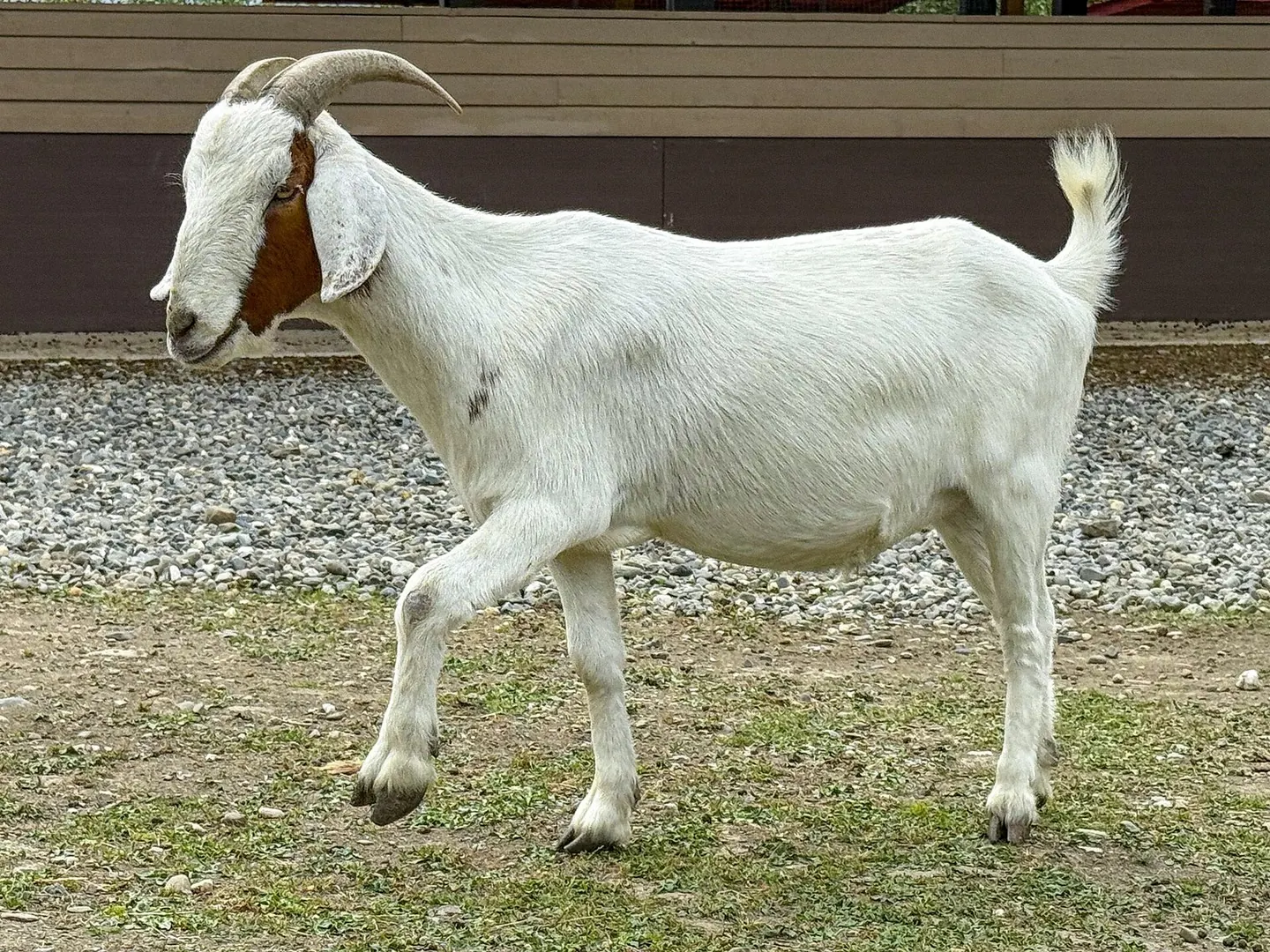
Boer is a large meat goat developed in South Africa: white, with a red-brown head and neck. In India it is used mostly for crossing with local goats. The crosses can grow faster on good feed, but in Indian studies more of them died and they needed closer care, so Boer suits well-managed farms rather than low-cost grazing (ICAR-CIRG, KVASU review).
How to recognise a Boer goat
- Colour: a white body with a red-brown head and part of the neck; in improved Boer goats a broad white blaze down the face is preferred (FAO).
- Ears: fairly long, broad and hanging.
- Horns: usually present in both sexes; bucks carry strong horns that curve back and out, and some goats are hornless.
- Body: large, with a short coat; the breed is known for fast growth and heavy muscling (FAO, OUAT study).
- Weight: in South Africa, adult males weigh about 120–140 kg and females about 70–90 kg. FAO notes that Boer goats outside South Africa usually perform well below those figures (FAO).
What Boer goats are kept for
- Meat. Farmers in South Africa's Eastern Cape bred the improved Boer for meat from the 1920s on, and its breed society was formed in 1959 (FAO, Boer review).
- Twins in South Africa. About half of kiddings give twins, and 7% triplets (FAO).
- Crossing in India. In a trial at a state breeding farm in Odisha, Boer-cross kids weighed about 15 kg at 9 months, against about 12.5 kg for local kids, with 8 hours of grazing and concentrate every day (OUAT study).
- More deaths. In the same trial more cross kids died: in the first 3 months, 19% of male cross kids against 11% of local male kids (OUAT study). In Kerala, Boer × Malabari crosses grew better under good management, but the crossbred goats studied there had more deaths and more breathing problems than Malabari goats (KVASU review).
Where Boer goats come from
Boer goats were developed in the Eastern Cape of South Africa, around Somerset East, from local South African goats (Boer review, FAO). The breed has since been exported to many countries (Boer review). In India, missionaries and voluntary groups brought in Boer goats before independence and later crossed local goats with Boer and other exotic breeds (ICAR-CIRG). State farms have tested Boer crosses — in Kerala with Malabari goats (KVASU review) and in Odisha (OUAT study) — and TANUVAS keeps Boer among the breeds on its research farm in Chennai (TANUVAS). Boer is not one of India's registered breeds, so it has no home district here (NBAGR register).

Looking for Boer goats?
Kattutharai works across India. Search “Boer” in the app to look for Boer goats, or browse goats for sale near you. The seller names the breed and Kattutharai does not check it, so look at the animal yourself before you pay.


Rearing Boer goats and crosses
- Good feed every day. The faster growth of crosses depends on feed: the Odisha kids got concentrate every day on top of grazing (OUAT study). Without it, do not expect the same weights. See Goat feeding: fodder, concentrate mix and water.
- Heat and humidity. FAO notes that the Boer does best in dry areas (FAO). In Kerala, Malabari goats adapted better to the hot, humid climate than crossbred goats, Boer crosses among them (KVASU review). Keep the shed dry and airy — see roof and airflow.
- Watch the kids closely. In the Odisha trial, deaths were highest in the first 3 months (OUAT study). Follow Goat kid care: colostrum, creep feed and weaning and the vaccination calendar.
- Check your state's rules. ICAR-CIRG's 2024 policy paper says that unplanned crossing with exotic breeds — used without clear breeding plans in Maharashtra, Kerala and other southern states — gave limited gains and high death rates among crosses, and that such crossing should be done only as research (ICAR-CIRG). Kerala's 2024 breeding policy proposes Boer for controlled crossing trials with non-descript goats, and bucks of their own breed for Malabari and Attappady Black goats (KVASU review). Ask your animal husbandry office what your state allows.
Buying Boer goats or crosses
- Ask what "Boer" means. An animal sold as Boer may be pure, a first cross (half Boer) or a goat with little Boer blood. Ask how many generations of Boer bucks were used, and see the parents.
- Look for the signs: a white body, a red-brown head, broad hanging ears and a large, muscular body. Colour alone does not prove Boer blood.
- Ask how it was raised. A cross raised on concentrate in a shed may lose condition on grazing; buy from a farm that feeds the way you will (see questions to ask).
- Ask for records, not promises: weights at known ages from the seller's own flock. Growth depends on feed and care, so never pay extra for a promise of fast growth.
- The breed in an ad is the seller's word. Kattutharai does not check it. Check the goat yourself with How to buy goats safely: health, age and fraud checks.
Frequently asked questions
Is Boer good for a beginner?
Usually not as a first step. Boer crosses can grow fast, but they need better feed, housing and care, and in Indian studies more of them died than local goats. Learn with a local breed first — see How to choose a goat breed: South Indian breeds compared.
Should I cross my native does with a Boer buck?
Ask your veterinary hospital first. ICAR-CIRG recommends crossing with exotic breeds only as planned research (ICAR-CIRG), and Kerala improves its native breeds with bucks of their own breed (KVASU review). If you go ahead, never mate a cross doe with her own father — see avoid inbreeding.
Can Boer goats live in hot, humid areas?
They can, but they need better management: in Kerala's hot, humid climate, crossbred goats, Boer crosses among them, had more deaths and breathing problems than local Malabari goats (KVASU review).
Next
Compare Boer with India's own breeds — for example Kanni Adu, Salem Black and Tellicherry (Malabari) — and read about pure breeds and crosses and Jamunapari. When you are ready, browse goats for sale and take How to buy goats safely: health, age and fraud checks with you.