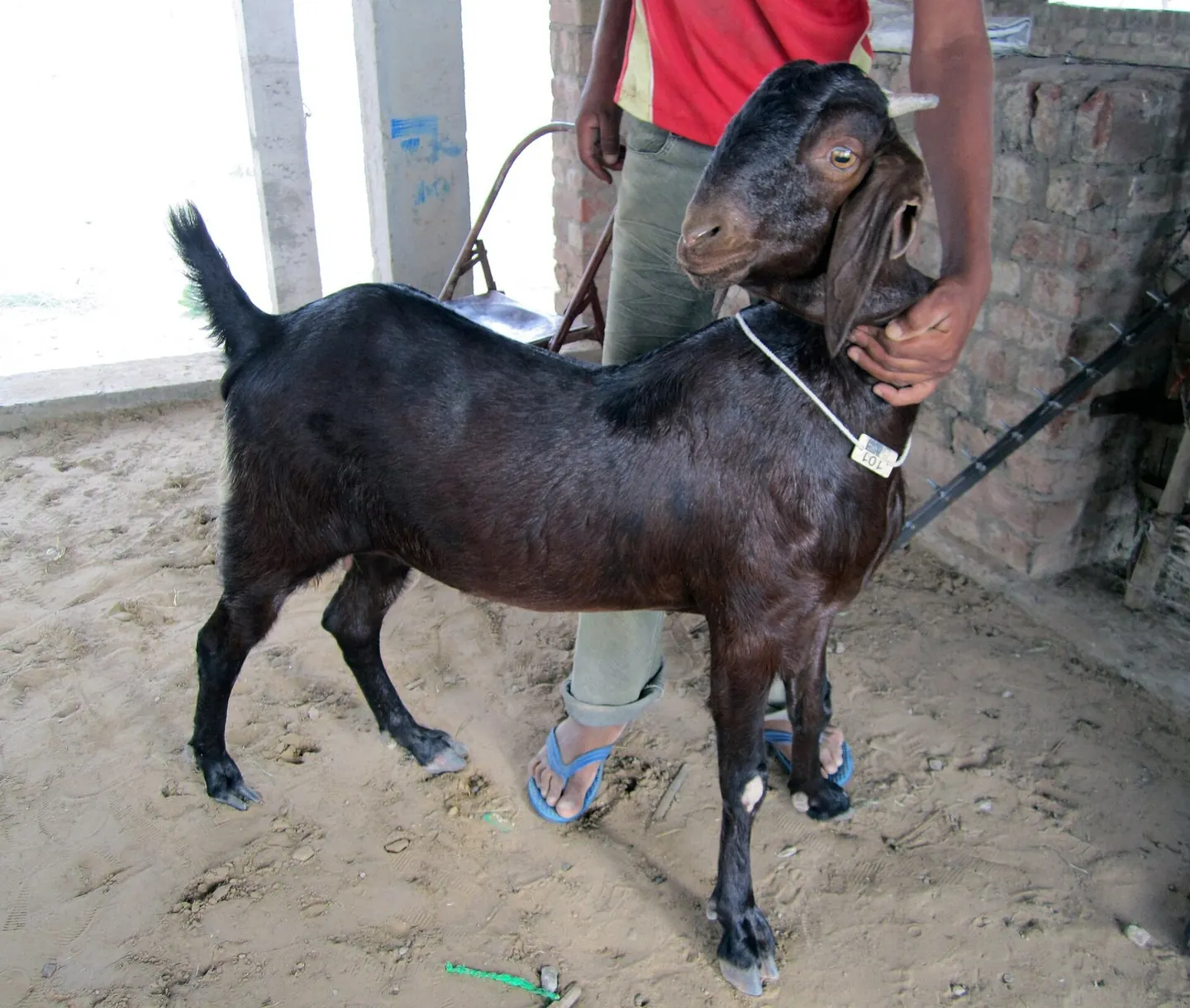
Sirohi is a medium-to-large, mostly brown goat from the Aravalli hills of southern Rajasthan, kept for meat and milk. It is hardy in dry, harsh country, but usually has one kid at a time, and ICAR-CIRG lists it among the breeds that need open space to walk and graze (NBAGR breed record, ICAR-CIRG).
How to recognise a Sirohi goat
- Colour: mostly brown, with light or dark brown patches; very few are completely white (NBAGR breed record, FAO).
- Ears: flat, leaf-shaped and drooping, of medium length.
- Horns: small, slightly twisted, curving up and back; both bucks and does usually have them.
- Body: compact and well built; most have wattles, the two tassels of skin under the neck (FAO).
- Weight: adults average about 43 kg (bucks) and 35 kg (does) (NBAGR breed record).
- Other names: in Rajasthan it is also called Majithi, Parbatsari or Devgarhi.
What Sirohi goats are kept for
- Meat and milk. In village flocks a doe gives about 70–90 litres of milk in a lactation of 5–6 months (NBAGR breed record, FAO, ICAR-CIRG); on ICAR-CSWRI's farm at Avikanagar the average was about 130 litres in 2024–25 (ICAR-CIRG).
- Growth. In village flocks of ICAR's goat-improvement project, kids weighed about 15 kg at 6 months and 24 kg at 12 months; on the Avikanagar farm, about 20 kg and 31 kg (ICAR-CIRG). Under intensive feeding at the same institute, male kids reached about 26 kg at 6 months (ICAR-CIRG).
- Usually one kid. NBAGR records an average of 1.0 kids per kidding, and on the Avikanagar farm only 17 of the 105 does that kidded from the 2024 breeding season had twins (NBAGR breed record, ICAR-CIRG).
- Slow to mature. Does first kid at a little over 2 years on average, with about 10 months between kiddings (NBAGR breed record).
- An improver breed. ICAR-CIRG names Sirohi as an improver breed for harsh, semi-arid areas (ICAR-CIRG).
Where Sirohi goats come from
The breed is named after Sirohi district in Rajasthan. NBAGR's register lists its home as Rajasthan and Gujarat (NBAGR register); its breed record names Sirohi, Udaipur, Rajsamand, Chittorgarh, Bhilwara and Ajmer districts — dry and semi-dry country across the Aravalli hills of central and southern Rajasthan (NBAGR breed record). An older FAO survey notes that the breed reaches Palanpur in Gujarat (FAO). The 2013 national breed survey recorded about 18.2 lakh Sirohi goats (NBAGR breed record). Under ICAR's goat-improvement project, ICAR-CSWRI at Avikanagar keeps a Sirohi herd that supplies goats to farmers and agencies, and a second unit works with village flocks around Vallabhnagar, near Udaipur (ICAR-CIRG). In Tamil Nadu, TANUVAS keeps Sirohi among the breeds on its research farm in Chennai (TANUVAS).

Looking for Sirohi goats?
Kattutharai works across India. Search “Sirohi” in the app to look for Sirohi goats, or browse goats for sale near you. The seller names the breed and Kattutharai does not check it, so look at the animal yourself before you pay.


Rearing Sirohi goats
- Give it room to walk. ICAR-CIRG names Sirohi among the breeds that need open space to walk and graze, unlike breeds such as Barbari that do well stall-fed (ICAR-CIRG). At home it is kept on grazing, in extensive or semi-intensive systems (NBAGR breed record), and ICAR keeps its own Sirohi herd semi-intensively (ICAR-CIRG).
- If you plan a stall-fed farm, add an open paddock next to the shed, as ICAR-CIRG's shed plans do (ICAR-CIRG), and grow enough fodder. With good feed Sirohi kids grow well (see the growth figures above); see feeding systems and space per goat.
- Climate. ICAR-CIRG groups Sirohi with the breeds of India's north-west (ICAR-CIRG) and warns that such breeds perform and survive worse in the hot, humid south and east (ICAR-CIRG). Its home is arid and semi-arid, so it is used to dry heat (NBAGR breed record).
- Plan for fewer kids. Because most does have one kid at a time and kid for the first time late, a Sirohi herd grows more slowly than a herd of a breed that often has twins. Count this when you plan — see Goat farming costs and income: a worked example.
Buying a Sirohi goat
- Check all the signs: brown with light or dark patches, flat drooping ears, small horns curving up and back, and a compact body, often with wattles. A brown colour alone does not make a goat Sirohi.
- Ask where the parents came from, and how the goat was fed. A goat raised on grazing may struggle if it is suddenly kept in a shed all day, so start it on the same feed (see questions to ask).
- Expect crosses. A cross can be sold under a famous breed name. The breed in an ad is the seller's word; Kattutharai does not check it. See the goat, and its mother if you can.
- For breeding stock, choose animals true to the breed's looks, from a flock not related to yours (ICAR-CIRG).
Then use How to buy goats safely: health, age and fraud checks to check health and age, and to pay safely.
Frequently asked questions
Is Sirohi good for stall feeding?
It can be kept in a shed with good feed — male kids grew well under intensive feeding at ICAR-CSWRI (ICAR-CIRG) — but ICAR-CIRG lists Sirohi among the breeds that need open space to walk and graze (ICAR-CIRG). Give your goats an open paddock or a daily walk.
How many kids does a Sirohi doe have?
Usually one at a time (NBAGR breed record).
How much milk does a Sirohi give?
About 70–90 litres in a lactation in village flocks, and more on well-run farms — about 130 litres on ICAR-CSWRI's farm (ICAR-CIRG).
Will Sirohi do well in the hot, humid South?
It is hardy in dry heat, but ICAR-CIRG warns that north-western breeds perform and survive worse in hot, humid areas (ICAR-CIRG). In a humid district, compare it with local breeds first — see How to choose a goat breed: South Indian breeds compared.
Next
Compare Sirohi with Jamunapari and Osmanabadi, or with South Indian breeds in How to choose a goat breed: South Indian breeds compared. Plan your feed with Goat feeding: fodder, concentrate mix and water, browse goats for sale, and take How to buy goats safely: health, age and fraud checks with you.