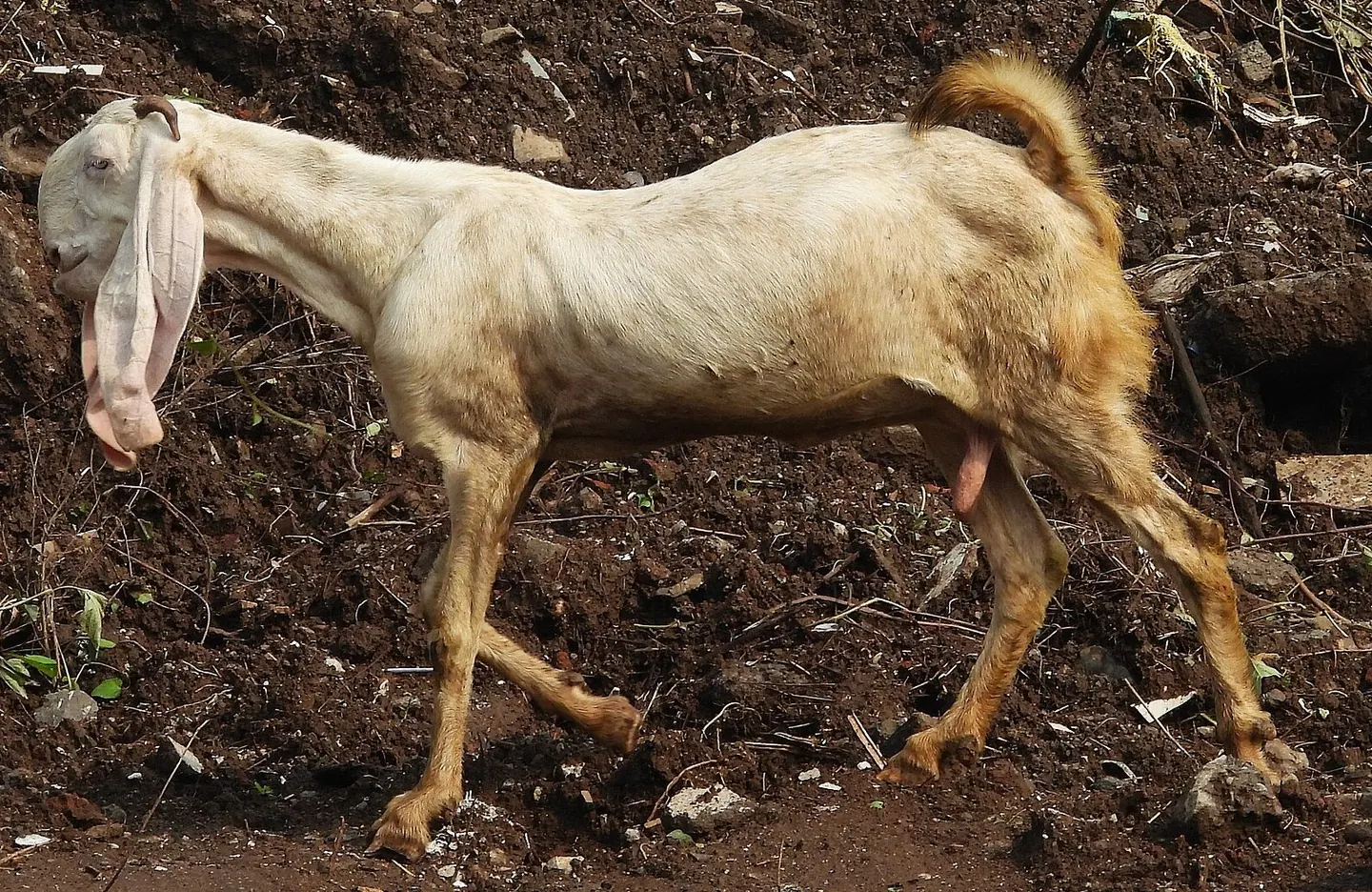
Jamunapari is a large milk-and-meat goat from the ravines of Etawah district in Uttar Pradesh: mostly white, with a strongly arched nose and very long, drooping ears. NBAGR describes it as India's tallest goat breed (NBAGR descriptor). Pure animals are scarce, and the breed comes from a dry, bushy region, so in the hot, humid South it needs good feed and close care.
How to recognise a Jamunapari goat
- Build: very tall, long-legged and large.
- Colour: mostly white, often with small tan patches on the head and neck (NBAGR descriptor).
- Head: a strongly convex ("Roman") nose with a tuft of hair, and long, flat, drooping ears — about 30 cm (NBAGR breed record).
- Horns: small and flat, pointing back and up. A beard is common.
- Weight: adults weigh about 45 kg (bucks) and 38 kg (does). Kids weigh about 4 kg at birth and about 30 kg at 1 year (NBAGR descriptor).
What Jamunapari goats are kept for
- Milk and meat. NBAGR records about 1.75 kg of milk a day and about 200 kg in a lactation of about 8 months (NBAGR descriptor). Yields vary a lot: at ICAR-CIRG's farm in 2024, does gave about 90 litres in the first 3 months on average, and 23 does gave more than 250 litres in a lactation (ICAR-CIRG).
- Twins. About 4 in 10 kiddings bring twins (NBAGR descriptor).
- Slow to mature. Does usually kid for the first time at about 2 years (NBAGR descriptor).
- Breed improvement. Jamunapari bucks have long been used to improve local goats in India and abroad (ICAR-CIRG).
Where Jamunapari goats come from
The breed is named after the Yamuna (Jamuna) river, and NBAGR's register lists it as a breed of Uttar Pradesh (NBAGR register). Its home is the ravine country of the Chakarnagar block of Etawah district and neighbouring Auraiya district — semi-arid land rich in shrubs and trees (ICAR-CIRG). NBAGR estimated fewer than 5,000 pure animals in this home area (NBAGR descriptor), and ICAR-CIRG counts Jamunapari among the breeds that have declined (ICAR-CIRG). ICAR-CIRG at Makhdoom, near Mathura, has run a breeding programme for Jamunapari since 1985, adds goats bought in the home tract, and supplies animals to farmers (ICAR-CIRG). In Tamil Nadu, TANUVAS keeps Jamunapari among the breeds on its research farm in Chennai (TANUVAS).

Looking for Jamunapari goats?
Kattutharai works across India. Search “Jamunapari” in the app to look for Jamunapari goats, or browse goats for sale near you. The seller names the breed and Kattutharai does not check it, so look at the animal yourself before you pay.


Rearing Jamunapari goats
- Climate. ICAR-CIRG groups Jamunapari with the breeds of India's north-west (ICAR-CIRG) and warns that such breeds perform and survive worse in the hot, humid south and east (ICAR-CIRG). It also finds Jamunapari relatively sensitive to changes in the weather (ICAR-CIRG).
- Grazing or stall feeding. At home the goats eat tree loppings, acacia pods and crop stubble, and does in milk get grain; NBAGR notes that the breed suits grazing better than stall feeding (NBAGR breed record). Yet in an ICAR-CIRG trial, kids on a good stall-fed ration grew faster than kids on part-time grazing — about 32 kg against about 25 kg for males at 11 months (ICAR-CIRG). Stall feeding works only with plenty of good fodder and concentrate; see feeding systems.
- A big goat needs more. Plan more feed and more floor space than for a small local breed — see feeding by stage and space per goat.
- First mating. ICAR-CIRG finds does ready for their first mating at more than 22 kg and more than 12 months of age (ICAR-CIRG); see first breeding.
Buying a Jamunapari goat
- The name is used widely. The 2013 national breed survey recorded about 16 lakh goats as Jamunapari across India (NBAGR breed record) — far more than the pure animals NBAGR estimated in the home area. ICAR-CIRG itself lists "Jamunapari breed" and "Jamunapari type" goats separately when it supplies animals (ICAR-CIRG).
- Check every sign: great height, a white coat (small tan patches on the head and neck are normal), a strongly arched nose, very long flat ears and small flat horns. A goat that lacks these is unlikely to be pure.
- Ask to see the mother milked, and ask where the parents came from — the home tract, ICAR-CIRG or a breeder with records.
- The breed in an ad is the seller's word. Kattutharai does not check it. Check the goat yourself with How to buy goats safely: health, age and fraud checks.
Frequently asked questions
Is Jamunapari good for milk in South India?
It can give more milk than South Indian meat breeds, but only with good feed and care, and ICAR-CIRG warns that north-western breeds do worse in the hot, humid south (ICAR-CIRG). See the doe milked before you buy.
How heavy does a Jamunapari grow?
Adult bucks weigh about 45 kg and does about 38 kg (NBAGR descriptor).
Why are pure Jamunapari goats hard to find?
NBAGR estimated fewer than 5,000 pure animals in the home area, and ICAR-CIRG says the breed has declined because breeding and conservation programmes were weak (ICAR-CIRG).
Can I use a Jamunapari buck on my local goats?
Jamunapari bucks have long been used to improve non-descript goats, mainly in arid and semi-arid areas (ICAR-CIRG). ICAR-CIRG's advice is to use bucks of a breed suited to your agro-climatic zone (ICAR-CIRG), so in the hot, humid South ask your veterinary hospital first.
Next
Compare Jamunapari with Sirohi, another breed from the north-west, and read about the exotic Boer. See how breeds compare in How to choose a goat breed: South Indian breeds compared, then browse goats for sale and take How to buy goats safely: health, age and fraud checks with you.