Deccani is a hardy black sheep of the Deccan plateau, kept mainly for meat and also shorn for coarse wool. Its home tract lies mostly in south-eastern Maharashtra and reaches into the neighbouring parts of Karnataka and Andhra Pradesh (ICAR-NBAGR); the breed register lists it under Andhra Pradesh and Maharashtra (ICAR-NBAGR).
How to recognise it
- Colour: mostly black, or black with white marks; white, brown and fawn sheep also occur (ICAR-NBAGR).
- Fleece: very coarse, hairy and open. The head and face are bare, and the belly is covered (ICAR-NBAGR).
- Head: a narrow face with a Roman nose, flat drooping ears of medium size (about 16–17 cm), and no wattles (ICAR-NBAGR).
- Horns: rams have horns; ewes do not (FAO).
- Weight: rams weigh about 38 kg and ewes about 31 kg; lambs are about 2.75 kg at birth (ICAR-NBAGR).
What it is good for
- Meat first, then wool. NBAGR lists meat and wool, and calls it a meat breed (ICAR-NBAGR); an NBAGR study describes it as a medium-sized, coarse-wool sheep reared mainly for mutton (NBAGR study).
- Coarse wool: about 0.74 kg of fleece per sheep a year (ICAR-NBAGR).
- Lambs: usually one, about 1.04 per lambing on average. Ewes have their first lamb at about 16 months, with about 9.5 months between lambings (ICAR-NBAGR).
- Hardy: it copes with long migrations, poor feed, drought and tropical diseases (NBAGR study).
Where it is mainly found
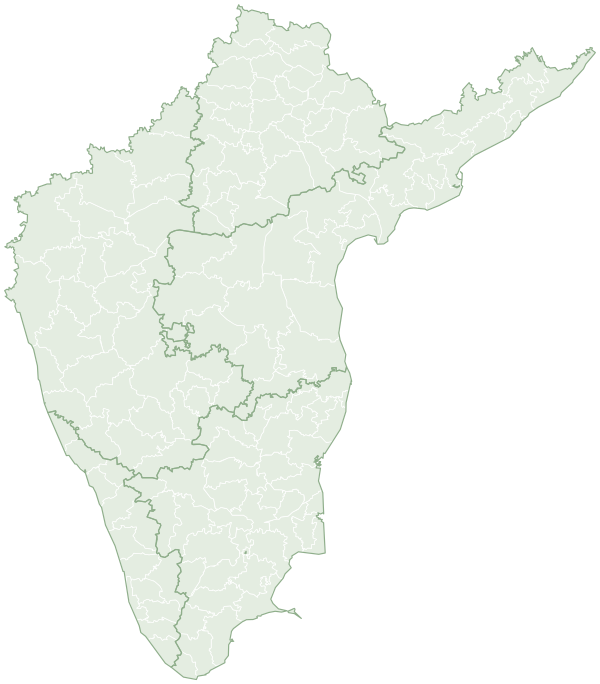
NBAGR's breed record places Deccani mainly in south-eastern Maharashtra (Pune, Satara, Solapur, Sangli, Kolhapur, Ahmednagar, Beed and Nashik) and in the neighbouring areas of Andhra Pradesh and Karnataka; in Karnataka it names Belagavi (Belgaum). The soils there range from light soil to deep black cotton soil (ICAR-NBAGR).
In Telangana, a study from the state's agricultural university calls Mahabubnagar district part of the breed's native tract (university study). PVNRTVU's Livestock Research Station at Mahabubnagar works to improve and conserve Deccani sheep, and it supplied more than 350 Deccani rams to farmers between 2010 and 2024 (PVNRTVU).
Older descriptions place Deccani flocks over a wider area, including Bidar, Vijayapura, Kalaburagi and Raichur in Karnataka and several districts of today's Telangana and Andhra Pradesh (FAO). In Maharashtra, scientists have described five local types of Deccani: Kolhapuri, Lonand, Madgyal, Solapuri and Sangamneri (NBAGR study). Madgyal is now registered as a breed of its own (ICAR-NBAGR).

Looking for Deccani sheep?
Search “Deccani” in the Kattutharai app to find Deccani sheep for sale near you (on Kattutharai, sheep are in the goat section). The seller names the breed and Kattutharai does not check it, so look at the animal yourself before you pay.


Rearing tips
- Grazing through the year. In the monsoon, flocks graze on grassland; for the rest of the year, on fallow and harvested fields. Few farmers grow fodder, and the sheep are housed only at night (ICAR-NBAGR). Growing some fodder helps in the dry months: grow your own fodder.
- Migration. Many flocks move with the seasons in search of grazing (ICAR-NBAGR). A settled farm needs enough grazing or cut fodder all year; see Goat feeding: fodder, concentrate mix and water.
- Night pen: keep it dry and well fenced; see Goat shed and housing: space, floor and roof.
- Rams: buy rams from known flocks and change them in time to avoid inbreeding. PVNRTVU's Mahabubnagar station supplies Deccani rams to farmers (PVNRTVU).
- Health: sheep need the same daily checks, vaccinations and deworming as goats. Follow Goat health: vaccination schedule and deworming, and ask your vet which vaccines sheep need in your area.
Buying tips
- Check the breed signs: a black or black-and-white sheep with a coarse, open fleece, a bare face, a Roman nose, flat drooping ears and no wattles (ICAR-NBAGR). A smooth, short-haired coat with wattles does not fit the breed.
- Crosses are common. In an NBAGR survey of the Lonand type in Satara district, farmers had been bringing in Madgyal rams, and only about 15% of the sheep were pure (NBAGR study). Ask to see the flock and the ram it uses.
- The breed name in an ad is the seller's word. Kattutharai does not check it, so see the sheep yourself before you pay.
- Age and health: count the large front teeth as you would for goats (the teeth table), treating the ages as a rough guide, and follow How to buy goats safely: health, age and fraud checks.
Frequently asked questions
Is Deccani the same as Bellary sheep?
No, though they are close. An FAO survey noted that the two are not very different: sheep north of the Tungabhadra river are called Deccani, and those south of it Bellary (FAO). NBAGR registers them as separate breeds (ICAR-NBAGR).
How much wool does a Deccani sheep give?
About 0.74 kg of coarse fleece a year (ICAR-NBAGR).
How heavy does a Deccani sheep get?
Rams weigh about 38 kg and ewes about 31 kg.
Is Deccani good for a beginner?
It is hardy and lives on grazing, so it suits dry areas with grazing land. Buy from a known flock, because crosses are common.
Next
Compare Nellore sheep and Bandur (Mandya) sheep, or the Osmanabadi goat from the same Deccan plateau. Read Goat feeding: fodder, concentrate mix and water, see all breed guides, and browse goats and sheep for sale.