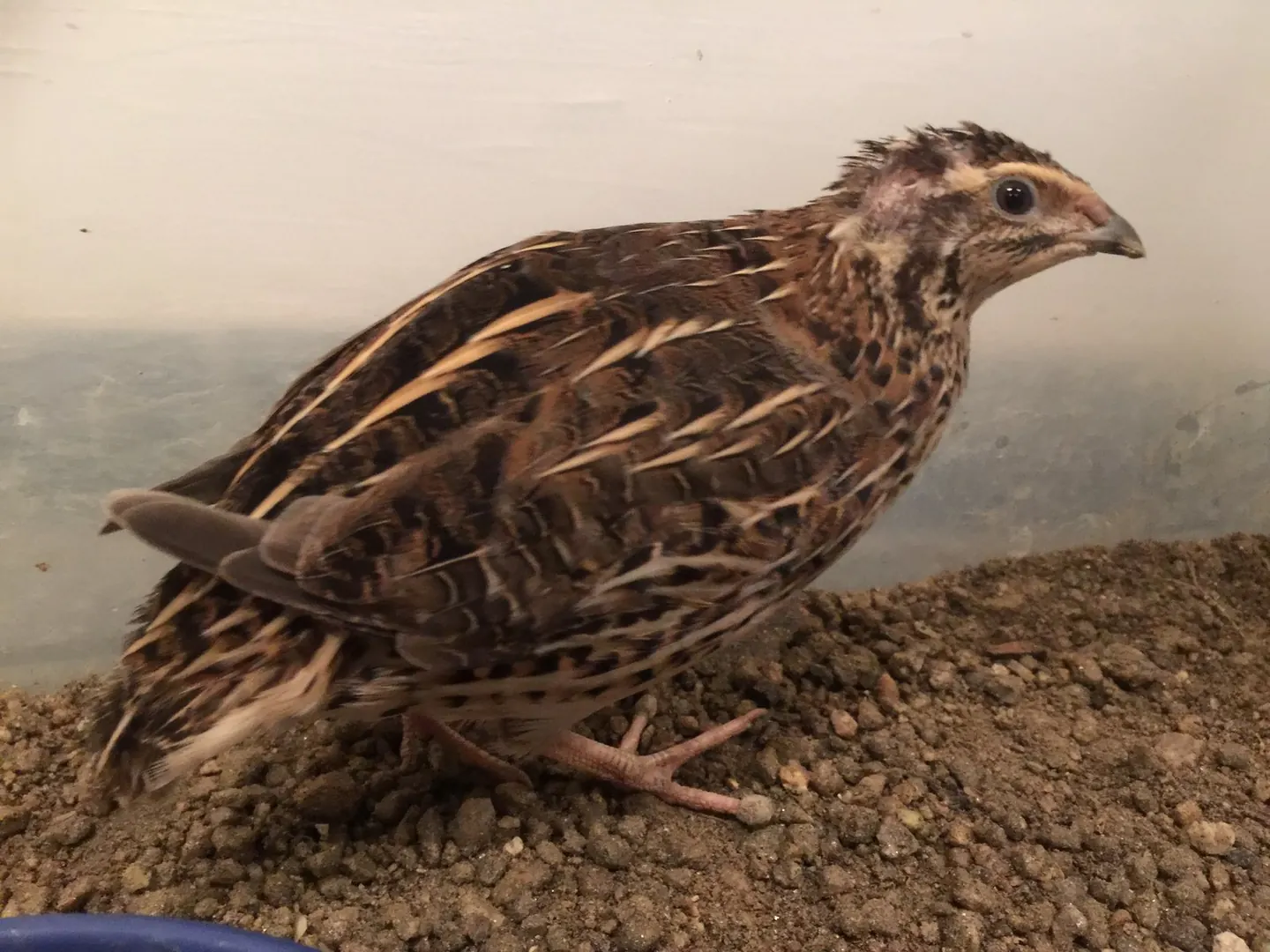
Japanese quail are small farm birds raised indoors, in cages or on litter, for meat and eggs. Meat birds are ready for sale in about 5–6 weeks, and hens start laying at about 6 weeks old (TNAU, KVK Namakkal). Only farm-bred Japanese quail may be kept and sold: wild quail and partridges are protected by law.
What quail are kept for
- Meat. Meat-type quail are sold at about 5–6 weeks, and each bird eats only about 500 g of feed up to 5 weeks of age (TNAU). Hens grow slightly heavier than cocks (KVK Namakkal).
- Eggs. Hens start laying at about 6 weeks, and most eggs are laid in the evening. An egg weighs about 10 g, with a thin shell mottled brown, blue, white or buff. A hen lays far fewer eggs in her second year than in her first (KVK Namakkal). Egg-type lines lay about 257–300 eggs a year: see the varieties.
- Chicks for other farms. Quail eggs hatch in 18 days (KVK Namakkal). A 2017 TANUVAS review estimated that over 4 lakh quail chicks hatch every week in Tamil Nadu, and many quail farmers run a small hatchery on the farm for their own chicks (TANUVAS review).
- Little space. A cage of about 4 × 2.5 feet holds up to 50 growing quail from 3 to 6 weeks of age (TNAU).
How quail are raised
Quail are kept in sheds, either in cages or on a litter floor (TNAU).
- Cages after the first weeks. Brooding chicks in cages up to 3 weeks of age cuts early deaths (KVK Namakkal). Farmers who start chicks on litter move them to cages after 2 weeks: quail left longer on litter run about, waste the energy from their feed and grow less (TNAU).
- Tiered cages with trays. Cages can be built 4 or 5 tiers high, with a tray under each wire floor so that droppings do not fall on the birds below and can be cleared every day (TNAU).
- Space per bird. Chicks need about 75 cm² each under the brooder and 75 cm² of run (KVK Namakkal); growing birds from 2 weeks to sale about 125–150 cm² (TNAU); laying hens about 150–180 cm² each in a laying cage (KVK Namakkal).
- Warmth for chicks. Start the brooder at about 37°C and lower it by about 2.7°C a week until the chicks are 4 weeks old and well feathered. The first 2 weeks need the most care (KVK Namakkal).
- Water without drowning. Give water in shallow dishes filled with pebbles or marbles so that chicks cannot drown, and take the pebbles out at about 2 weeks (KVK Namakkal).
- Feed. Quail need a protein-rich mash: about 27% protein for chicks up to 3 weeks, 24% from the 4th week, and about 22% for laying hens (KVK Namakkal). Some companies make ready quail feed (TNAU); ask your feed supplier or vet before you mix your own.
- Light for layers. A laying flock lays best with about 16 hours of light a day (KVK Namakkal).
- Cocks and hens. At 4–5 weeks you can tell them apart: cocks have even, rusty-brown breast feathers, while hens have grey breast feathers speckled with black (KVK Namakkal).
- Breeding. One cock to two hens gives good fertility, and fertile eggs can be collected from the 4th day after the cocks join. Fertility is best while the breeding birds are 8 months old or younger (KVK Namakkal).
Quail varieties
ICAR's Central Avian Research Institute (CARI) brought Japanese quail to India in 1974 and keeps pure meat and egg lines, which it supplies to farms (ICAR-CARI). TANUVAS's poultry research station began improving CARI stock in the early 1980s (TANUVAS review), and its Namakkal college bred the Namakkal lines by crossing several strains (TANUVAS Namakkal). All of them are lines of the same farm species, not separate breeds:
| Variety | Bred by | Key figures | Source |
|---|---|---|---|
| CARI-Uttam (meat) | ICAR-CARI, Izatnagar | 150–155 g at 4 weeks, 250 g at 5 weeks; eggs 12–13 g | ICAR-CARI |
| CARI-Ujjwal (white breast) | ICAR-CARI, Izatnagar | 140 g at 4 weeks, 175 g at 5 weeks; eggs 11 g | ICAR-CARI |
| CARI-Sweta (all white) | ICAR-CARI, Izatnagar | 150 g at 4 weeks, 160–170 g at 5 weeks; eggs 10–11 g | ICAR-CARI |
| CARI-Brown (all brown) | ICAR-CARI, Izatnagar | 160 g at 4 weeks, 180–185 g at 5 weeks; lays from 40 days; eggs 11 g | ICAR-CARI |
| CARI-Pearl (egg type) | ICAR-CARI, Izatnagar | 140 g at 5 weeks; half the hens laying at 8 weeks; 285–300 eggs per hen a year; eggs 9 g | ICAR-CARI |
| TANUVAS Namakkal Quail-1 (meat) | TANUVAS, Namakkal | At 30 days: cocks 228 g, hens 247 g | TANUVAS review |
| TANUVAS Namakkal Gold (egg type) | TANUVAS, Namakkal | Lays from 40 days; 257 eggs a year; eggs 13.2 g | TANUVAS review |
| Nandanam Quail-III (meat) | TANUVAS, Madhavaram (2004) | At 6 weeks: cocks 200 g, hens 247 g | TANUVAS |
These figures come from the institutes' own flocks; results on your farm depend on the stock, feed and care. TANUVAS's older Nandanam Quail II is popularly called "desi quail" (TANUVAS). It is still a farm-bred Japanese quail: a "desi" or "country" quail in an ad should be a farm line like this, never a bird caught in the wild.
Buying quail
- From a known hatchery. Government farms supply quail: TANUVAS's poultry college at Hosur had supplied 6,89,087 Japanese quail to farmers by March 2022 (TANUVAS), and KVASU's poultry farm at Mannuthy supplies Japanese quail (KVASU). Ask the seller which line the birds are.
- Age. Meat birds sell at about 5–6 weeks. For eggs, buy young hens about to start laying, since a hen lays far fewer eggs in her second year; for breeding, use birds no older than about 8 months (KVK Namakkal).
- Healthy birds only. Do not buy birds that are weak or sit still with drooping wings, or that have swelling around the eyes or head or a runny nose; a sudden fall in eggs or sudden deaths are also warning signs (bird flu action plan). Ask the hatch date and which vaccines, if any, the birds have had.
- Not from a bird-flu zone. When bird flu is confirmed, all poultry within 1 km is culled and poultry movement is stopped across the surrounding 10 km zone (bird flu action plan). Do not buy or move birds from a notified area: check your district's notices first.
- Moving quail. The transport rules count quail as poultry. Do not move them when it is hotter than 25°C or colder than 15°C. Clean and disinfect the containers first. Birds older than day-old chicks need a vet's certificate that they are free of infectious disease and fit to travel. Put one species and one age group in each container, with cocks and hens apart, and give water every 6 hours in hot weather. Do not stack containers on top of each other; cover them against sun and rain, and label them with the names, addresses and phone numbers of sender and receiver (AWBI).
- Day-old chicks. Send chicks straight after hatching, without feed or water, in boxes kept level. Chicks should not travel for more than 6 hours at a stretch, and stops should last no more than 30 minutes, in the shade (AWBI).
- Pay safely. Never pay an advance for birds you have not seen: see paying safely.
Keep quail healthy
- Hardy, but not disease-free. Japanese quail seldom have disease problems and, unlike chickens, are not usually given a routine vaccination programme; the main disease is quail enteritis (KVK Namakkal). Ask your vet which vaccines, if any, your flock needs.
- Keep the farm closed. Only the people who look after the birds should go near them. Keep visitors out, wash and disinfect shoes, clothes and hands before and after handling birds, and clean any borrowed equipment (bird flu action plan).
- Clean every day. Clean the cages and change the feed and water daily. Keep newly bought birds apart from your flock for at least 30 days, and if you can, keep one age group at a time ("all in, all out") (bird flu action plan).
- Wild birds out. Do not let wild birds or neighbours' birds mix with yours, never catch or keep wild birds, and bury dead birds properly; never throw them into drains or open ground (bird flu action plan).
- Sudden deaths: report within 24 hours. Report unusual sickness or deaths in your birds, or in wild birds, to the nearest veterinary hospital immediately, and in any case within 24 hours (bird flu action plan). You can also dial the toll-free number 1962 for a mobile veterinary unit (PIB).
- If bird flu is confirmed. Officials cull the poultry in the infected zone, and birds hidden from culling and found later are culled without compensation (bird flu action plan). The government compensates farmers for culled birds, destroyed eggs and feed, with the cost shared equally by the Centre and the State (PIB). Ask your veterinary hospital about the current rates.
Rules for quail farms
- No wildlife licence for farm-bred Japanese quail. The Wild Life (Protection) Act's Schedule II lists the Japanese quail "excluding birds of the farm bred variety" (entry 704), so farm-bred Japanese quail need no wildlife licence (India Code). The exemption goes back to a 2013 government notification (MoEF notification).
- Wild quail and partridges are protected. Wild quail such as the common quail, rain quail and bush quails, and partridges such as the grey and painted francolins, are listed in the Act with no exception. Catching, keeping or selling wild quail or partridges is an offence: for most of these birds, jail of up to 3 years, a fine of up to ₹1 lakh, or both, and more for the rare species in Schedule I (India Code).
- Old advice. Some guides written before 2013 still say a licence is needed. If anyone asks you for one, check with your nearest veterinary hospital or forest office.
- Register your farm. In April 2025 the Government of India told all poultry farms to register with their state animal husbandry department (PIB). Ask your nearest veterinary hospital how to register.
- Pollution board. Poultry farms are in the pollution boards' "Green" category, and larger farms need the State Pollution Control Board's consent to establish and operate. CPCB's guidelines on manure, dead birds, waste water and flies apply to every farm, whatever its size (CPCB). Ask your board's district office whether your farm needs consent.
Rules change — confirm with your nearest veterinary hospital or animal husbandry office.
Frequently asked questions
Do I need a licence to rear Japanese quail?
No wildlife licence is needed for farm-bred Japanese quail: the Wild Life (Protection) Act excludes them from Schedule II (entry 704) (India Code). Register the farm with your state animal husbandry department (PIB).
How soon are quail ready for sale?
Meat quail are ready at about 5–6 weeks (TNAU). Laying hens start at about 6 weeks (KVK Namakkal).
How many eggs does a quail lay?
Egg-type lines lay about 257 eggs a year (TANUVAS Namakkal Gold) to 285–300 (CARI-Pearl), each egg weighing about 9–13 g (TANUVAS review, ICAR-CARI).
Should quail be let out to forage like country chickens?
No. Quail are raised in sheds, in cages or on litter, and moving them to cages after 2 weeks gives better growth (TNAU). The bird flu action plan also advises keeping poultry indoors, away from wild birds (bird flu action plan).
Can I sell quail or partridges caught in the fields?
No. Wild quail and partridges are protected under the Wild Life (Protection) Act; only farm-bred Japanese quail may be sold (India Code).
Next
Read about Country chicken in South India: breeds, buying and care, Duck rearing in South India: breeds, buying and health and Turkey farming: varieties, rearing, buying and health. To see what farmers near you are selling, browse quail for sale, or post a free ad for your farm-bred quail.

Find quail near you on Kattutharai
See farm-bred quail and chicks for sale direct from farmers near your village, with photos, the village name and the distance. No middlemen. Call or chat with the farmer, then see the birds and check them yourself before you pay.
Only farm-bred Japanese quail may be sold. Never buy or sell wild quail or partridges.

