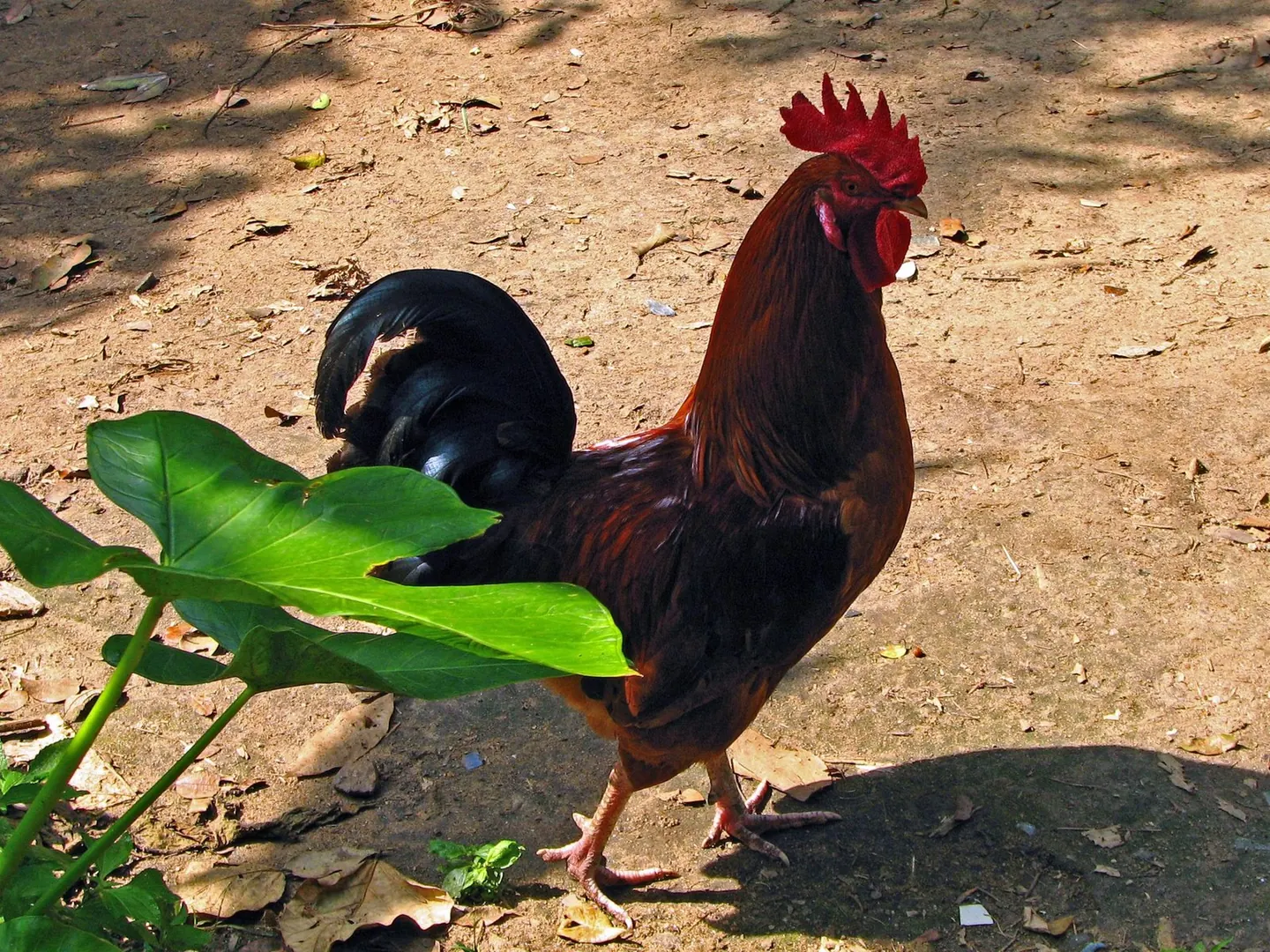
Country chicken (nattu kozhi) is raised across South India for meat, eggs and chicks to sell. Most village birds are local mixes rather than one breed, as TANUVAS notes for Tamil Nadu (TANUVAS); farmers also keep native breeds such as Aseel and improved varieties from research institutes. Below: raising, breeds, buying, health and bird flu, the rules and Tamil Nadu's 2026-27 subsidy.
What country chickens are kept for
- Meat. Raised for meat in a shed on full feed, birds reach 1.1–1.3 kg on 3.5–4 kg of feed and are sold between 3 and 4 months of age (TANUVAS).
- Eggs. Country hens lay few eggs: 60–70 brown eggs of 40–45 g a year, starting at about 22 weeks of age (TANUVAS).
- Chicks. Hens sit on their eggs and raise the chicks. Eggs hatch in 21 days, under a hen or in an incubator, and a day-old chick weighs 30–32 g (TANUVAS).
How country chickens are raised
TANUVAS describes four ways of raising country chickens (TANUVAS):
| System | How it works | Flock size |
|---|---|---|
| Backyard | Birds forage round the house; low cost, low return | 10–20 birds |
| Semi-intensive | Out in a coconut grove or garden by day, in a shed at night | 50–100 birds |
| Intensive (deep litter) | In a shed on litter, fully fed and vaccinated, sold in batches | 1,000–5,000 birds |
| Cages | For producing hatching eggs, with artificial insemination | — |
- Brood the chicks first. Chicks need warmth, balanced feed and protection from predators: keep them inside a brooder guard with a heat source, on 2–3 inches of rice husk, sawdust or clean sand covered with old newspaper (ICAR-DPR).
- Out to forage from 6 weeks. At 6 weeks, improved birds weigh about 650–750 g and can range. Keep 10–20 birds per household, as space and natural food allow; shut them in a night shelter against predators, and give 20–30 g of grain each evening and clean water each morning (ICAR-DPR).
- Space in a shed. Allow about 1 square foot per meat bird and 2 per laying bird, in a shed that snakes, mongooses and cats cannot enter (TANUVAS).
Tamil Nadu's country chicken types
No Tamil Nadu chicken breed is on NBAGR's register (ICAR-NBAGR); TANUVAS says the state's country chickens are types, not distinct breeds (TANUVAS). The types farmers name:
- Peruvidai (Aseel). TANUVAS says the Aseel is the Peruvidai, a big, heavy meat bird. The most popular type is the kili mooku – visiri vaal (parrot beak, fan tail); colour types such as mayil karuppu, sengaruppu and sevalai are looks within the breed, not separate breeds (TANUVAS). See Aseel.
- Siruvidai. A smaller country chicken kept for eggs and as a good mother hen; TANUVAS has studied it in Ariyalur, Perambalur, Tiruvannamalai and Dharmapuri districts (TANUVAS study). In a Ramanathapuram trial, its chicks gained about 0.74 kg in 20 weeks, half as much as Aseel chicks (TANUVAS study).
- Naked neck and frizzle. TANUVAS lists the naked-neck type (kazhugu kozhi) and the frizzle (silpa kozhi), whose feathers curl outwards (TANUVAS).
- Karungozhi. The black Kadaknath from Madhya Pradesh is kept here too, under this name (TANUVAS). See Kadaknath.
Registered breeds from South India
NBAGR registers 21 chicken breeds (ICAR-NBAGR); these four have their home tracts in South India (ICAR-NBAGR):
Chicken
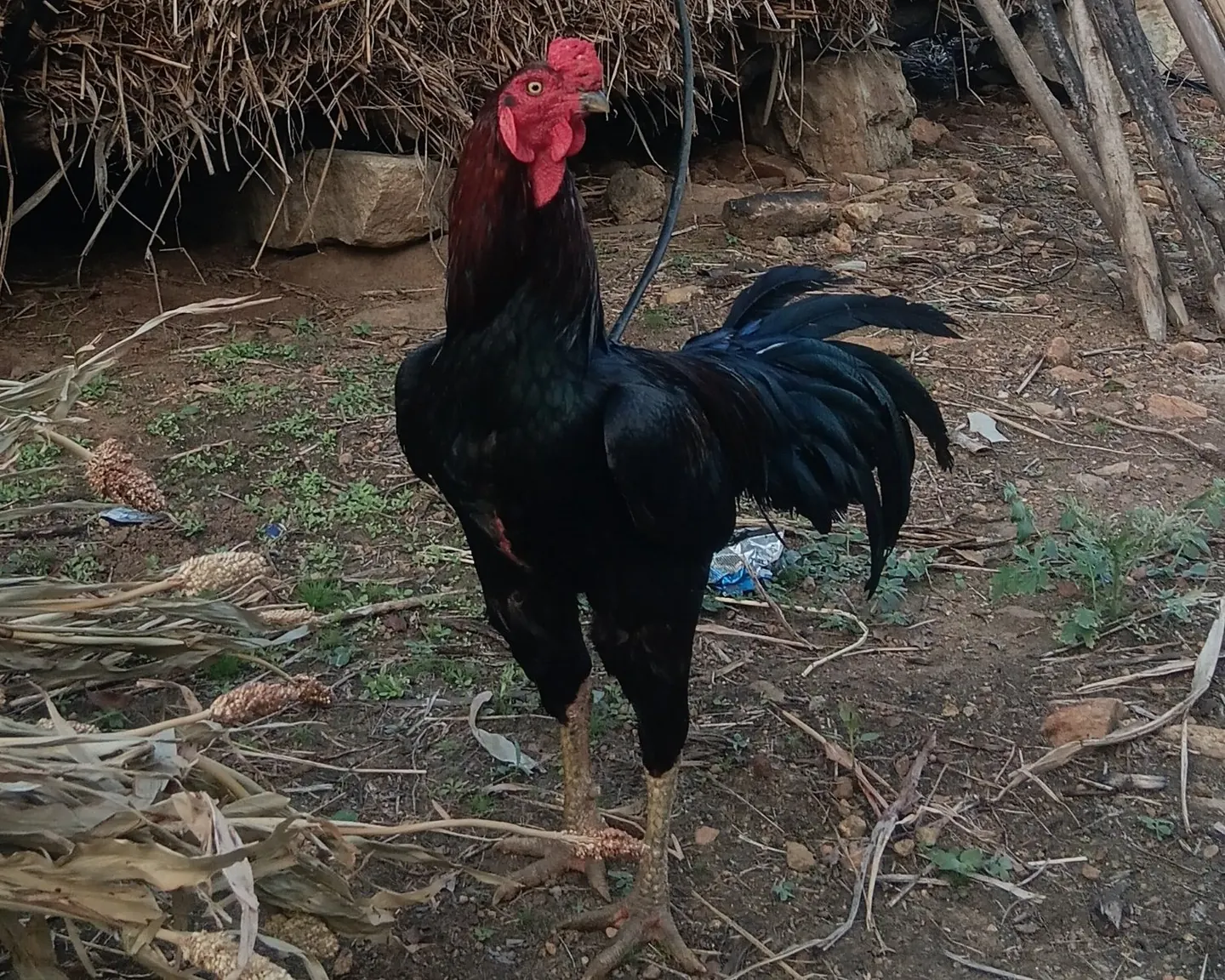
Aseel
a tall, heavy meat bird whose home tract includes Khammam in Telangana; Tamil Nadu's Peruvidai.
Cock 4 kg · Hen 2.6 kg
Chicken
Ghagus
a lighter bird kept for meat and eggs, from Kolar and Bengaluru in Karnataka and Chittoor and Anantapur in Andhra Pradesh.
Cock 2.2 kg · Hen 1.4 kg
Chicken
Kalasthi
a bluish-black or brown meat bird of the old Chittoor, Kadapa and Nellore districts, named after Srikalahasti.
Cock 2.5 kg · Hen 1.9 kg
Chicken
Tellichery
a black bird with a bluish sheen, kept mainly for meat, from Kozhikode, Kannur and Malappuram in Kerala, and Mahe.
Cock 1.62 kg · Hen 1.24 kg
Breeds from elsewhere in India
Two registered breeds from other parts of India are also raised in the South; TANUVAS's Hosur college supplies both to farmers in Tamil Nadu, Karnataka and Andhra Pradesh (TANUVAS):
Chicken
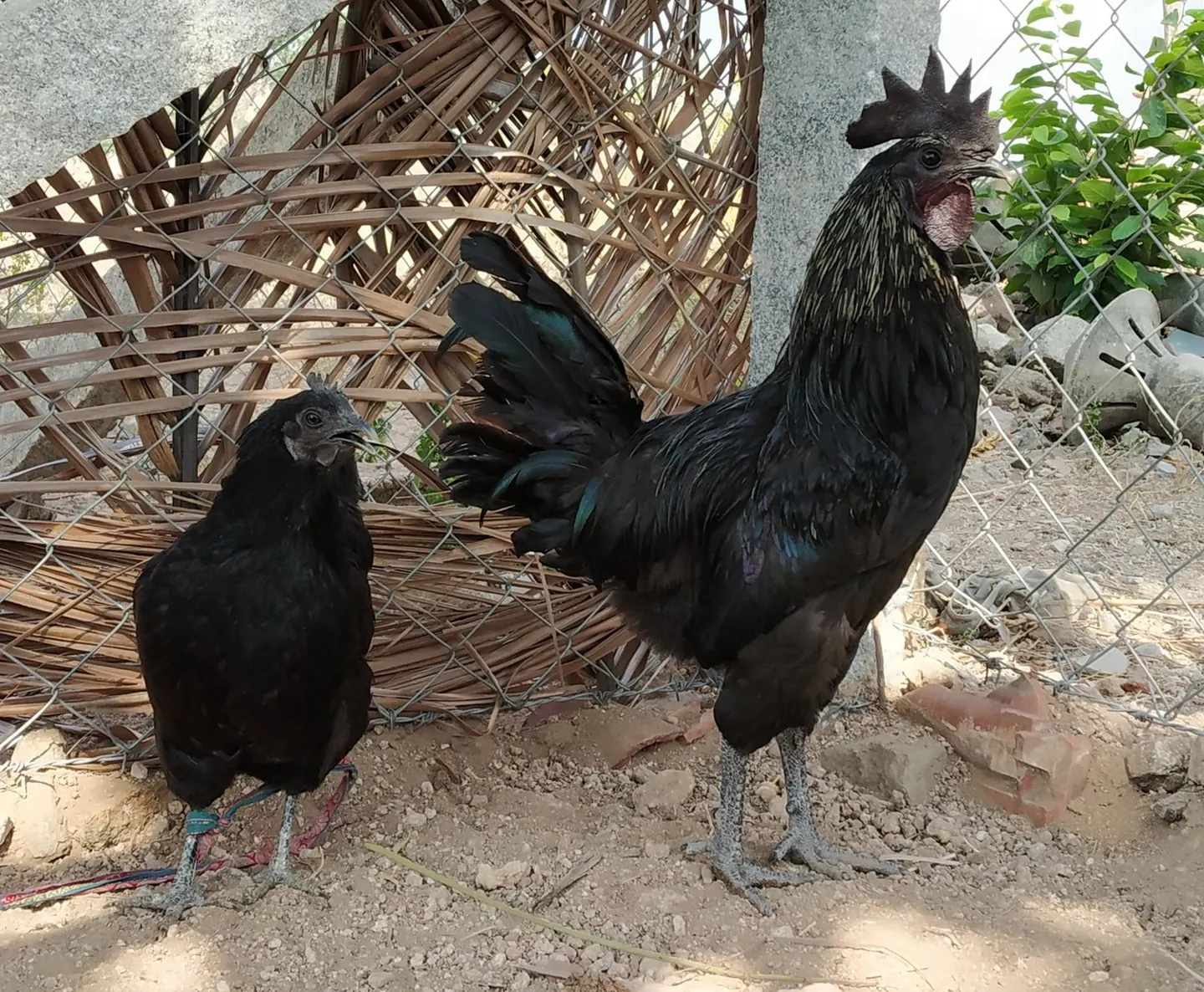
Kadaknath
a small black chicken with black flesh, kept for meat, from Jhabua and Dhar in Madhya Pradesh.
Cock 1.6 kg · Hen 1.1 kg
Chicken
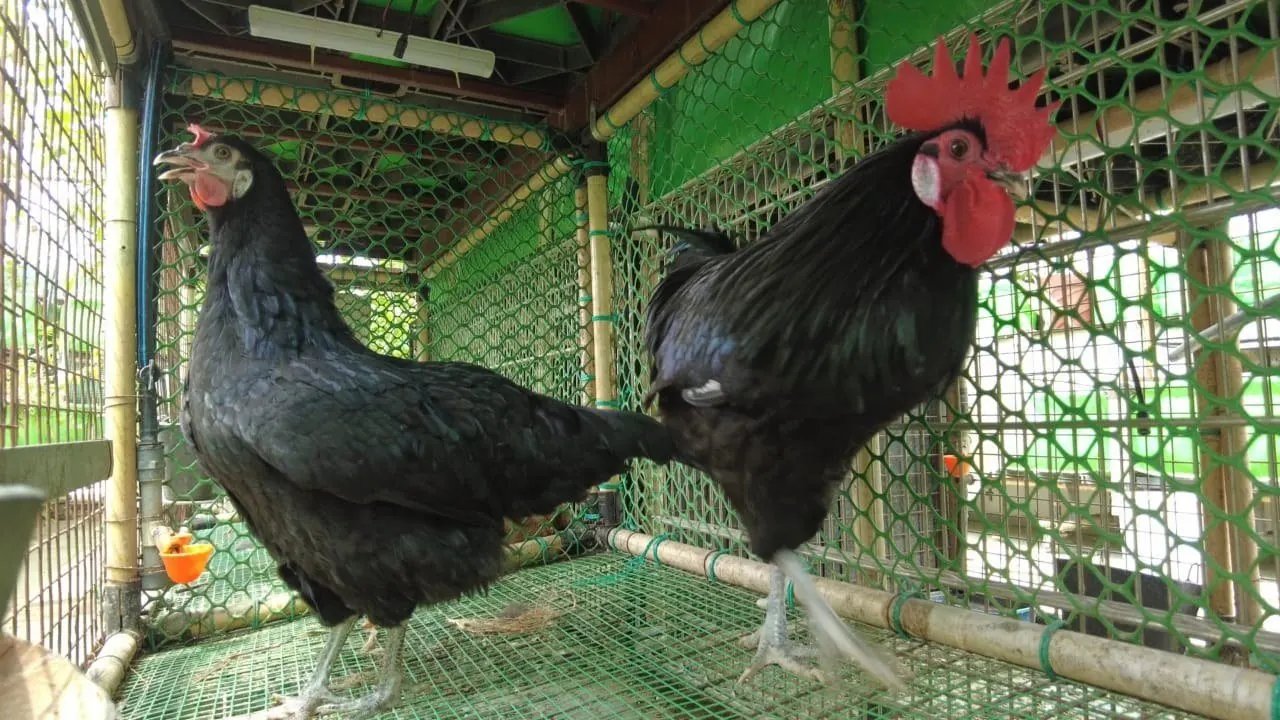
Nicobari
a short-legged bird of the Nicobar Islands, kept for eggs and meat; NBAGR says it lays more eggs than any other native breed.
Cock 1.8 kg · Hen 1.3 kg
Improved varieties
Research institutes have bred birds for backyards. They are improved varieties, not registered breeds: none is on NBAGR's register (ICAR-NBAGR).
Chicken
Vanaraja
ICAR-DPR's multicoloured bird for meat and eggs, laying 100–110 eggs a year in backyards.
Cock 2.2–2.5 kg · Hen 1.8–2.0 kg
Chicken
Srinidhi
ICAR-DPR's many-coloured bird for meat and eggs, laying 140–150 eggs a year in backyards.
Cock 2.2–2.8 kg · Hen 2.0–2.4 kg
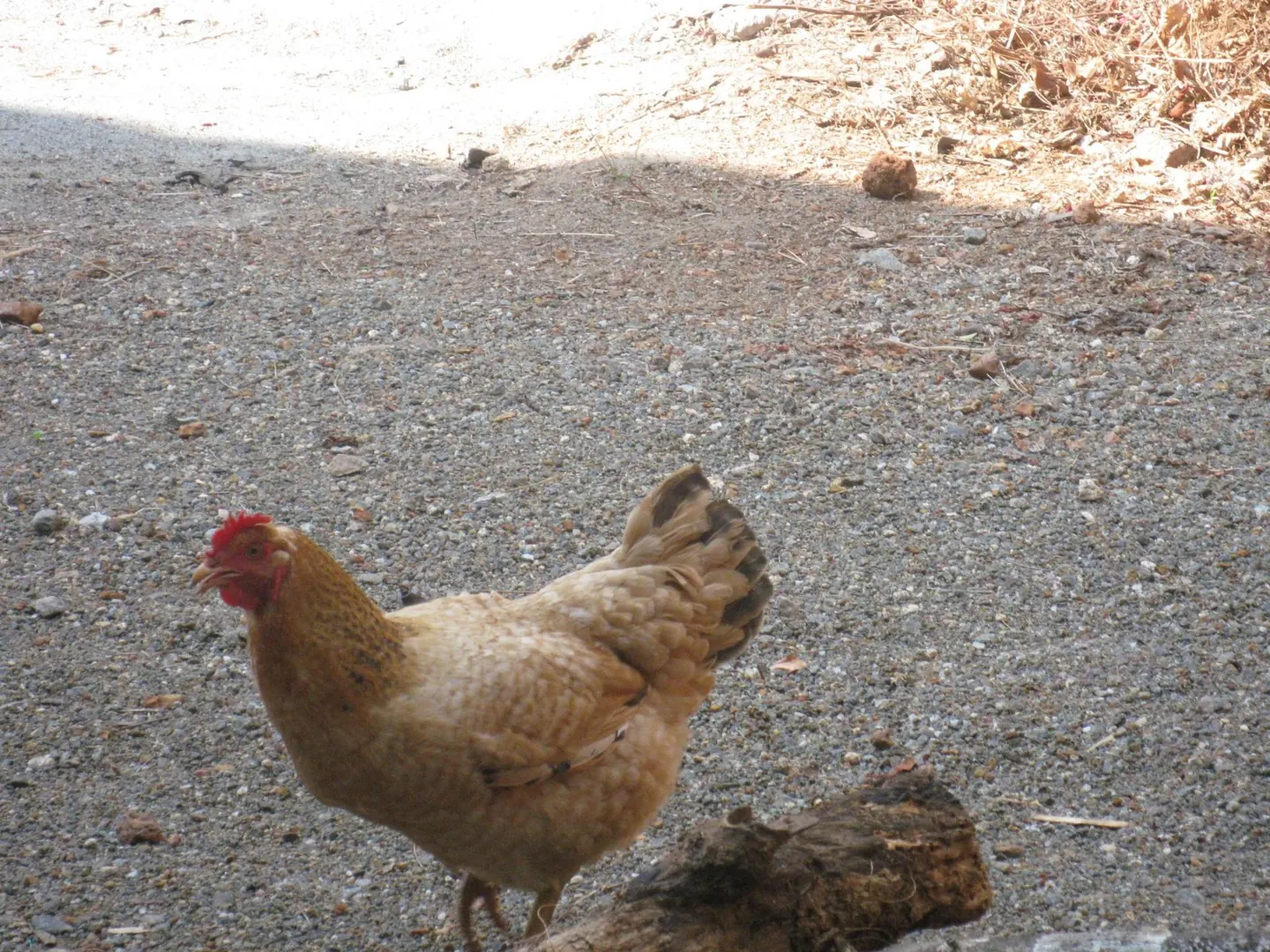
Chicken
Giriraja
a coloured bird for meat and eggs, released by KVAFSU, Bengaluru, in 1989.
Cock 4–5 kg · Hen 3.5–3.75 kg
Sources: ICAR-DPR (ICAR-DPR, ICAR-DPR) and KVAFSU (KVAFSU). Other improved lines have less published data:
| Variety | Bred by | What the source says |
|---|---|---|
| Vanashree | ICAR-DPR, Hyderabad, from Aseel | 170–180 eggs a year and 1.8–2.2 kg at 5 months on the farm (ICAR-DPR) |
| TANUVAS Aseel | TANUVAS | About 160 eggs a year with good care, nearly double the Aseel (TANUVAS review) |
| Nandanam Chicken I | TANUVAS, Chennai | Red, for meat and eggs; 1 kg at 12 weeks; 180 eggs a year per hen housed (TANUVAS) |
| Nandanam Chicken IV | TANUVAS, Chennai | Many colours; about 140 eggs a year in backyards with a little feed, 225 at best (TANUVAS review, TANUVAS) |
| TANUVAS Namakkal Chicken-1 | TANUVAS, Namakkal | Many colours; about 150 eggs a year; hens hardly ever go broody (TANUVAS review) |
| Rajasri | PVNRTVU, Hyderabad | Up to 165 eggs a year in sheds, 110–120 free-range (PVNRTVU) |
| Swarnadhara | KVAFSU, Bengaluru, 2005 | A coloured bird for meat and eggs (KVAFSU); about 180–200 eggs a year, and adults weigh about 3–3.5 kg (UAS Bangalore) |
| Gramasree | KVASU, Mannuthy, 2005 | Kerala's most popular backyard variety, says KVASU; cockerels are best sold for meat at 12 weeks (KVASU) |
Buying country chickens
- Buy chicks from known hatcheries. TANUVAS's college at Hosur supplies Aseel, Kadaknath, Nicobari, Vanaraja and Gramapriya (TANUVAS); ICAR-DPR in Hyderabad sells chicks of its varieties and of Aseel, Ghagus, Kadaknath and Nicobari (ICAR-DPR); KVASU's Mannuthy farm sells day-old chicks on Thursdays (booked) and Fridays (KVASU); KVAFSU in Bengaluru supplies Giriraja and Swarnadhara chicks (KVAFSU).
- Avoid sick birds. Do not buy from a flock with recent sudden deaths, or birds with swelling around the eyes, head or neck, a runny nose, a discoloured comb, wattles or legs, drooping wings or weakness: the bird-flu plan lists these as warning signs (Bird flu plan).
- Ask the age and the vaccinations. Ask when the birds hatched and which vaccinations they have had, and when (see the schedule below).
- Buy only from areas free of bird flu. Poultry may not move in or out of the 10 km zone round an outbreak, and new birds, chicks and eggs must come only from areas known to be free of bird flu (Bird flu plan); check your district's notices before you buy.
- Moving birds. Birds other than day-old chicks need a vet's certificate that they are healthy and fit to travel. Do not move poultry when it is hotter than 25°C or colder than 15°C, so travel in the cool hours. Use clean containers, not stacked, with one kind and age of bird in each and cocks apart from hens, labelled with both sides' names, addresses and phone numbers, and give water every 6 hours in hot weather. Day-old chicks go straight from the hatchery without feed or water on the way, up to 80 in a 60 × 45 × 12 cm box, with no more than 6 hours' travel at a stretch and stops of no more than 30 minutes, in shade (AWBI).
- Keep new birds apart. Keep newly bought birds away from your flock for at least 30 days (Bird flu plan).
- Pay safely. Never pay in advance for birds you have not seen: see paying safely.
Keep chickens healthy
- Keep your flock apart from other birds. As the national bird-flu plan advises, keep your birds in, away from wild birds and your neighbours' birds; keep the yard clean and bury or burn the waste; never catch or keep wild or migratory birds; and bury dead birds properly, never in a drain or on open ground (Bird flu plan).
- Vaccinate as your vet advises. ICAR-DPR's schedule for backyard birds (ICAR-DPR):
| Disease | Age |
|---|---|
| Marek's disease | Day 1 |
| Ranikhet (Newcastle disease) | 5–7 days, 30 days and 9 weeks; then every 6 months |
| Gumboro (infectious bursal disease) | 14 days and 24 days |
| Fowl pox | 6 weeks; then every 6 months |
- Before summer and winter. Give the six-monthly Ranikhet and fowl pox vaccines before summer (February–March) and before winter (September–October). Your vet may change the schedule for your area (ICAR-DPR).
- Where to vaccinate. Salem district, for example, lists Ranikhet vaccination at its veterinary institutions every Saturday (Salem district); in Kerala, government veterinary institutions give farmers Ranikhet and fowl pox vaccines, made at the state's Palode institute, free (Kerala AHD). Ask at your nearest veterinary dispensary.
- Worms and cleaning. Clean the night shelter regularly, and deworm every 2–3 months as your vet advises (ICAR-DPR).
- Sudden deaths: report within 24 hours. If birds sicken or die suddenly, or you find dead wild birds, report it at once, within 24 hours at most, to the nearest veterinary institution or government office (Bird flu plan), or call 1962, the government's mobile veterinary service (PIB).
- If bird flu is confirmed. All poultry within 1 km of the site, backyard birds included, is culled, and poultry movement stops within 10 km. Owners are compensated for culled birds, destroyed eggs and feed, with the Centre and the state sharing the cost equally (PIB). Birds hidden from the culling teams are culled later without any compensation, and restocking is allowed only 90 days after the area is certified clean (Bird flu plan).
Rules for poultry keepers
- Register your farm. In April 2025 the central Department of Animal Husbandry and Dairying directed all poultry farms to register with their state animal husbandry department (PIB); ask your veterinary dispensary how.
- Pollution control board. Larger poultry farms need the state pollution control board's consent to set up and to run. The bird count from which this applies has changed and is partly before the Supreme Court (CPCB), so ask your district board office before you build a big shed. In Kerala, the state board says farms with more than 100 birds need its consent (Kerala PCB).
- Wild birds are protected. The Wild Life (Protection) Act protects the red and grey junglefowl, the grey francolin (partridge), wild quails, mynas and parakeets (Wild Life Act). Do not catch, keep or sell them, or put them with your flock.
Rules change — confirm with your nearest veterinary hospital or animal husbandry office.
Government support
Tamil Nadu, 2026-27: 50% subsidy for small country chicken farms (Tenkasi district):
- Official name: Scheme for providing 50% subsidy for establishing small-scale (250 birds/unit) country chicken farm units in rural areas.
- Run by: the Tamil Nadu Animal Husbandry Department, through the districts.
- What it gives: a 50% subsidy to set up a country chicken unit of 250 birds, as the Tenkasi district press release of 22 September 2026 states (checked on 24 October 2026).
- Who can apply: rural people interested and skilled in country chicken rearing who live permanently in the village and own at least 625 square feet of land for the shed, away from homes and water. Widows, destitute people, transgender persons and persons with disabilities get priority. Those who benefited in 2023-24, 2024-25 or 2025-26 cannot apply. You must promise to run the farm for at least 3 years, and show that a bank will lend you the rest or that you can pay it yourself.
- How to apply: at your government veterinary dispensary: meet the Veterinary Assistant Surgeon, get the form and hand it in with the documents asked for.
- Official page: https://tenkasi.nic.in/scheme-for-providing-50-subsidy-for-establishing-a-country-chicken-farm-unit-press-release/
The press release is Tenkasi district's; ask your own dispensary whether the scheme is open in your district. For the National Livestock Mission and the Kisan Credit Card, see loans and subsidies and Kisan Credit Card in our country chicken farming guide. No one can promise you a subsidy.
Rules change — confirm with your nearest veterinary hospital or animal husbandry office.
Frequently asked questions
Is Peruvidai the same as Aseel?
Yes. TANUVAS writes that the Aseel breed is the Peruvidai (TANUVAS). See Aseel.
How many eggs does a country hen lay?
About 60–70 a year (TANUVAS). Improved varieties lay more: Gramapriya, for example, lays 160–180 a year in backyards (ICAR-DPR).
What should I do if my chickens die suddenly?
Report it within 24 hours to the nearest veterinary institution or government office, or call 1962 (Bird flu plan, PIB). Bury dead birds properly; never throw them in a drain or on open ground.
Next
Open a breed page above, or read about ducks, quail and turkeys. To see what farmers near you are selling, browse chickens for sale; to sell your own birds, post a free ad.

Find country chickens near you on Kattutharai
See country hens, roosters and chicks for sale direct from farmers near your village, with photos, the village name and the distance. No middlemen. Call or chat with the farmer, then see the birds and check them yourself before you pay.
Looking for a particular breed? Search its name in the Kattutharai app, for example Aseel (Peruvidai), Kadaknath or Giriraja.

