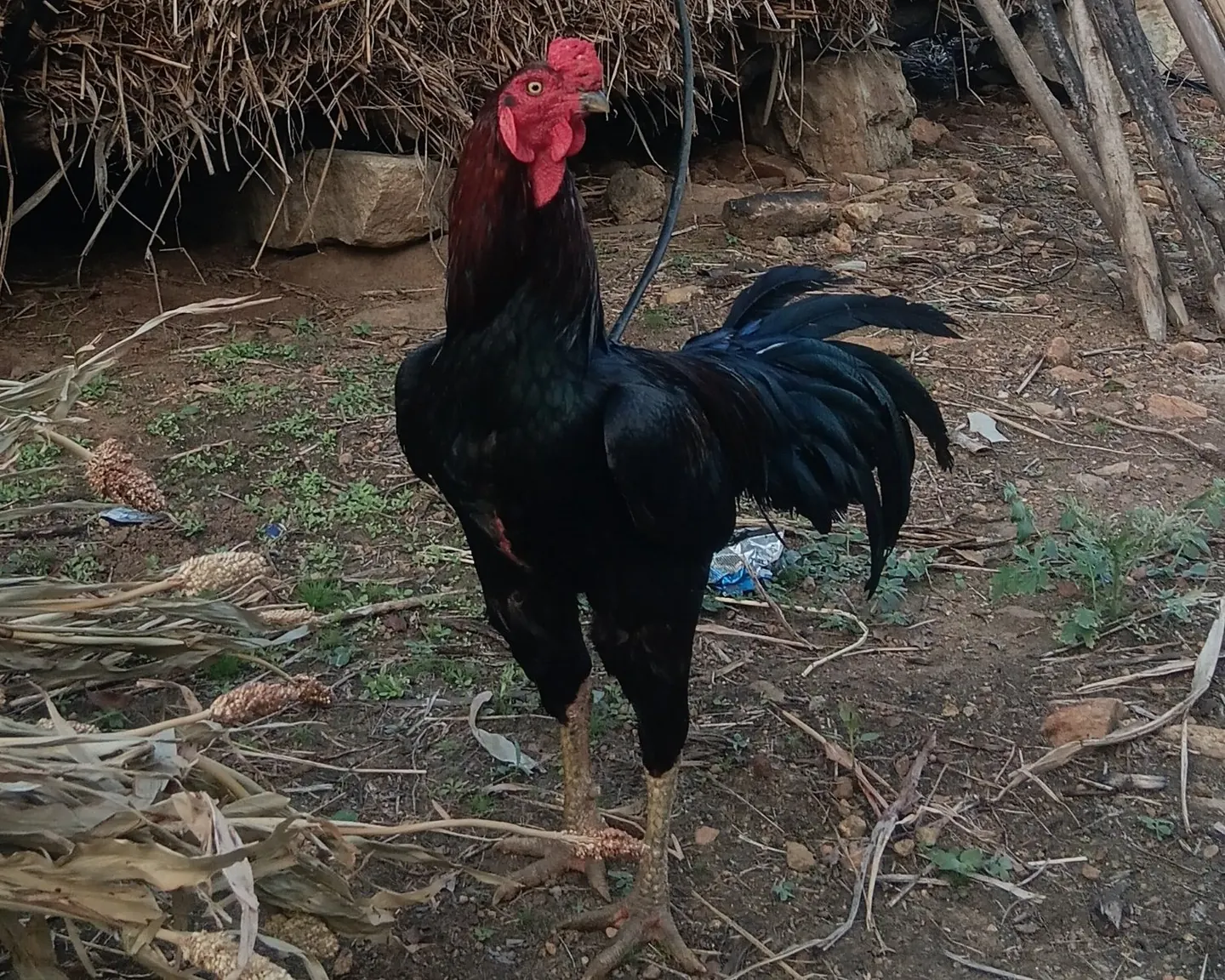
Aseel is a tall, heavy country chicken kept for meat. TANUVAS confirms that it is Tamil Nadu's Peruvidai (TANUVAS). NBAGR registers Aseel as a chicken breed of Chhattisgarh, Odisha and Andhra Pradesh (ICAR-NBAGR); its home tract includes Khammam, which is now in Telangana.
How to recognise it
- Build: a big, upright bird with a broad breast, a long neck, a small head and long, strong legs (TANUVAS).
- Weight: adult cocks weigh about 4 kg and hens about 2.6 kg in NBAGR's breed record (ICAR-NBAGR).
- Comb and face: a small pea comb set close to the head (a few birds have a single or rose comb), bright red wattles and ear lobes, and a long, lean face with almost no feathers (ICAR-NBAGR). The beak is short, strong and yellow (TANUVAS).
- Feathers: tight and hard, with almost no fluff and very few on the breast. Most are red or brown with black, but NBAGR lists many colour varieties, such as Peela (golden red), Noorie (white), Kagar (black) and Java (black laced) (ICAR-NBAGR).
- Skin and legs: white or yellow (ICAR-NBAGR).
- Tamil Nadu types: the most popular is the kili mooku – visiri vaal type, named for its parrot-like beak and a tail spread like a fan. Sellers also name colour types: mayil karuppu (peacock black), sengaruppu, sevalai, saambal (grey), karungeeri, sengeeri, vellai (white) and ponniram (golden) (TANUVAS). These are looks, not separate breeds.
What it is kept for
- Meat. Aseel has a strong, heavy body, and NBAGR's record notes that its meat is well liked (ICAR-NBAGR). Its cocks were the father line of the Cornish, the English meat breed behind modern broilers (TANUVAS).
- Cocks for country chicken farms. In Tamil Nadu's farm-based country chicken rearing, most farmers prefer Aseel and Aseel crosses, and most parent farms use Aseel cocks (TANUVAS).
- Few eggs, good mothers. Hens lay little: about 40 eggs a year in backyards (TANUVAS) and 65–70 in NBAGR's breed record, with eggs of about 41 g and the first egg at about 6.7 months (ICAR-NBAGR); selected hens on ICAR-DPR's farm in Hyderabad also lay 60–70 (ICAR-DPR). Hens sit on eggs readily and raise chicks well, and in the home tract the eggs are mostly kept for hatching (TANUVAS, ICAR-NBAGR).
- Growth. On ICAR-DPR's farm, Aseel reach 1.8–2.0 kg at 5 months (ICAR-DPR). In a TANUVAS trial on five farms in Ramanathapuram district, Aseel chicks gained about 1.44 kg in 20 weeks, more than Kadaknath or Siruvidai chicks on the same feed (TANUVAS study).
- Improved lines. TANUVAS has released a TANUVAS Aseel line that lays about 160 eggs under good management, nearly double the Aseel (TANUVAS review), and ICAR-DPR bred its Vanashree variety from Aseel (ICAR-DPR).
Where it is mainly found
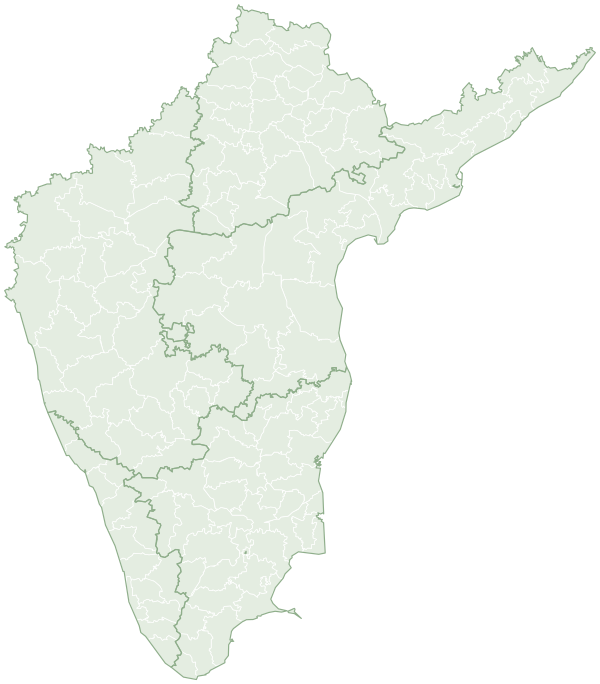
NBAGR's breed record names Khammam district, then in Andhra Pradesh; it is now in Telangana and split into Khammam and Bhadradri Kothagudem. The rest of the home tract lies outside South India: Koraput and Malkangiri districts of Odisha, and Bastar and Dantewada of Chhattisgarh. NBAGR credits the tribes of Bastar and Andhra Pradesh with developing the breed (ICAR-NBAGR).
Aseel is kept far more widely: TANUVAS finds pure Aseel in eight states, including every southern state except Kerala, and the Godavari area of Andhra Pradesh is known for good birds. In Tamil Nadu, groups of breeders keep the parrot-beak type in Dindigul, Madurai, Coimbatore, Salem and Tiruppur districts (TANUVAS). By March 2022, TANUVAS's Hosur college had supplied 71,665 Aseel to farmers in Tamil Nadu, Karnataka and Andhra Pradesh (TANUVAS).

Looking for Aseel chickens?
Search “Aseel” in the Kattutharai app to find Aseel chickens for sale near you, or see all chickens for sale. The seller names the breed and Kattutharai does not check it, so look at the birds yourself before you pay.


Rearing tips
- Foraging by day, a shelter at night. Aseel suit a backyard or semi-intensive flock that forages by day and sleeps in a safe shelter: see how country chickens are raised.
- Keep grown cocks apart. TANUVAS notes that Aseel can be short-tempered birds, though they are tame with their keepers (TANUVAS). Grown cocks peck and injure each other, so give each one its own pen or keep them apart.
- Health. Vaccinate as your vet advises, keep the night shelter clean, and keep newly bought birds away from your flock for a month: see keep chickens healthy.
Buying tips
- Check the signs: a tall, upright bird with a broad breast, tight, hard feathers that are thin on the breast, a small comb close to the head, a short, strong beak and long, strong legs. Soft, fluffy feathering does not fit NBAGR's description of the breed (ICAR-NBAGR).
- Crosses are common. Farmers raise both Aseel and Aseel crosses (TANUVAS). The breed name in an ad is the seller's word, and Kattutharai does not check it. See the parent birds if you can, and check the signs yourself.
- Chicks from known hatcheries. TANUVAS's Hosur college and ICAR-DPR in Hyderabad supply Aseel (TANUVAS, ICAR-DPR). Buy chicks from a government or registered hatchery where you can.
- Health and papers: ask which vaccinations the birds have had, and look for signs of sickness before you pay: see buying country chickens.
Frequently asked questions
Is Peruvidai the same as Aseel?
Yes. TANUVAS writes that the Aseel breed is the Peruvidai (TANUVAS). The smaller Siruvidai is a different country chicken: see Tamil Nadu's country chicken types.
How many eggs does an Aseel hen lay?
Few: about 40 a year in backyards and 65–70 in NBAGR's record (TANUVAS, ICAR-NBAGR). For eggs, an improved variety such as Gramapriya lays far more: 160–180 a year in backyards (ICAR-DPR).
Is Aseel good for a beginner?
For a small backyard flock kept for meat and chicks, yes: it forages, hatches its own chicks and is tame with its keeper. But it lays few eggs, and grown cocks must be kept apart.
Next
Compare Aseel with two other native birds of South India, Kalasthi and Ghagus. Read Country chicken in South India: breeds, buying and care for buying, care and bird flu, and browse chickens for sale.