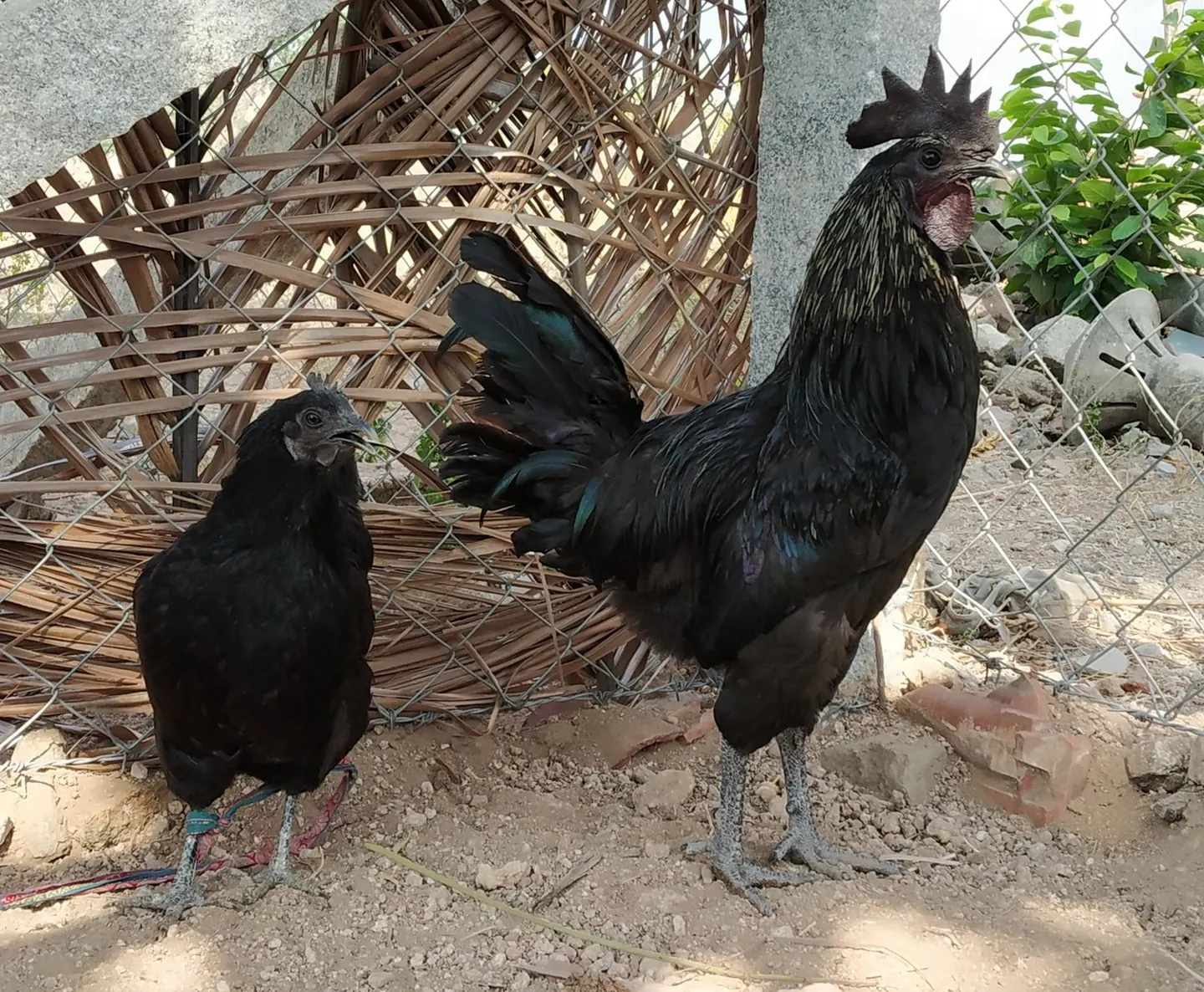
Kadaknath is a small black chicken from western Madhya Pradesh, kept for its black meat. Its feathers, skin, shanks and flesh are all dark, and in its home tract it is called Kalamasi, "black flesh" (ICAR-NBAGR). In Tamil Nadu it is known as karungozhi (TANUVAS). NBAGR registers it as a breed of Madhya Pradesh (ICAR-NBAGR), and hatcheries in the south, including TANUVAS, supply its chicks to farmers there.
How to recognise it
- Feathers: jet black, pencilled or golden. NBAGR describes a range from silver- or gold-spangled birds to bluish-black ones with no spangles (ICAR-NBAGR).
- Skin, legs and head: dark grey skin, grey shanks, bluish ear lobes and a black ring round the eye. The comb, wattles and tongue are purple, and NBAGR also records black and pinkish combs. The comb is single, large in cocks and small in hens (ICAR-NBAGR).
- Black inside too: the colour comes from a pigment, melanin, laid down in the flesh and in most internal organs; NBAGR calls this fibromelanosis (ICAR-NBAGR).
- Chicks: day-old chicks are bluish to black, with irregular dark stripes on the back (ICAR-NBAGR).
- Weight: a small bird. Adult cocks weigh about 1.6 kg and hens about 1.1 kg in NBAGR's breed record (ICAR-NBAGR).
What it is kept for
- Meat. It is kept mainly for its black meat, and in its home tract it is also used in religious ceremonies (ICAR-NBAGR).
- Eggs. NBAGR's breed record gives 85–90 eggs a year, of about 40 g with brown shells, the first at about 6 months of age (ICAR-NBAGR). A selected flock on ICAR-DPR's farm in Hyderabad lays more, 150–170 eggs a year (ICAR-DPR).
- Slow growth. On ICAR-DPR's farm, birds weigh 1.4–1.6 kg at 5 months (ICAR-DPR). In a TANUVAS trial on five farms in Ramanathapuram district, Kadaknath chicks on commercial chick feed gained about 0.89 kg in 20 weeks, against about 1.44 kg for Aseel chicks; all the birds coped well with the district's hot, humid climate (TANUVAS study).
Where it comes from
Kadaknath's home tract is Jhabua and Dhar districts in western Madhya Pradesh. There, Bhil and Bhilala tribal families, other adivasis and poor rural households keep it in flocks of 5–30 birds (ICAR-NBAGR).
It is not native to South India, but farmers there raise it. By March 2022, TANUVAS's poultry college at Hosur had supplied 57,394 Kadaknath to farmers in Tamil Nadu, Karnataka and Andhra Pradesh (TANUVAS), and ICAR-DPR in Hyderabad also sells its chicks (ICAR-DPR).
Kadaknath meat from its home area has a geographical indication (GI): "Jhabua Kadaknath Black Chicken Meat", registered in 2018 for meat from the area around Jhabua, Dhar and Barwani districts of Madhya Pradesh (GI Registry). The tag covers that meat only. It does not cover Kadaknath raised in South India, or their meat.

Looking for Kadaknath chickens?
Kattutharai works across India. Search “Kadaknath” in the app to look for Kadaknath chickens, or browse chickens for sale near you. The seller names the breed and Kattutharai does not check it, so look at the birds yourself before you pay.


Rearing tips
- Raise it like other country chickens. In its home tract it lives in small flocks with tribal families (ICAR-NBAGR). Here, keep it in a backyard or semi-intensive flock with a safe night shelter: see how country chickens are raised.
- Plan for slow growth. On ICAR-DPR's figures, its improved variety Vanaraja weighs 1.8–2.0 kg at 3 months, while Kadaknath takes 5 months to reach 1.4–1.6 kg (ICAR-DPR).
- Heat. The Ramanathapuram trial found Kadaknath well suited to hot, humid weather (TANUVAS study). Still give shade and clean water all day.
- Health. Vaccinate as your vet advises, keep the shelter clean, and keep newly bought birds apart from your flock for a month: see keep chickens healthy.
Buying tips
- Check the dark points. A true Kadaknath has dark grey skin, grey shanks, and a purple to black comb, wattles and tongue (ICAR-NBAGR). Black feathers alone are not enough: a bird with a bright red comb, or with yellow or white skin and shanks, does not fit the breed record.
- Crosses are common. The breed name in an ad is the seller's word, and Kattutharai does not check it. Check the signs yourself, and look at the parent birds if you can.
- Chicks from known hatcheries. TANUVAS at Hosur and ICAR-DPR in Hyderabad supply Kadaknath (TANUVAS, ICAR-DPR). Buy from a government or registered hatchery where you can; day-old Kadaknath chicks are bluish-black with dark stripes on the back.
- Not GI birds. Birds raised outside the Jhabua area are not covered by the GI, whatever an ad says (GI Registry).
- Health and papers: ask which vaccinations the birds have had, and look for signs of sickness before you pay: see buying country chickens.
Frequently asked questions
Is karungozhi the same as Kadaknath?
In Tamil Nadu, karungozhi is the usual name for Kadaknath (TANUVAS). But not every black chicken is a Kadaknath: check for dark grey skin and shanks and a purple comb and tongue.
Does the GI tag cover Kadaknath raised in Tamil Nadu?
No. The GI is for Kadaknath meat from its home area around Jhabua, Dhar and Barwani in Madhya Pradesh (GI Registry).
How many eggs does a Kadaknath hen lay?
85–90 a year in NBAGR's record, and 150–170 in ICAR-DPR's selected farm flock (ICAR-NBAGR, ICAR-DPR).
How heavy does a Kadaknath get?
It stays small: adult cocks weigh about 1.6 kg and hens about 1.1 kg (ICAR-NBAGR). On ICAR-DPR's farm, birds reach 1.4–1.6 kg at 5 months (ICAR-DPR).
Next
Compare it with Aseel, the heavy meat bird of the south, and with Nicobari from the Andaman and Nicobar Islands. Read Country chicken in South India: breeds, buying and care for buying, care and bird flu, and browse chickens for sale.