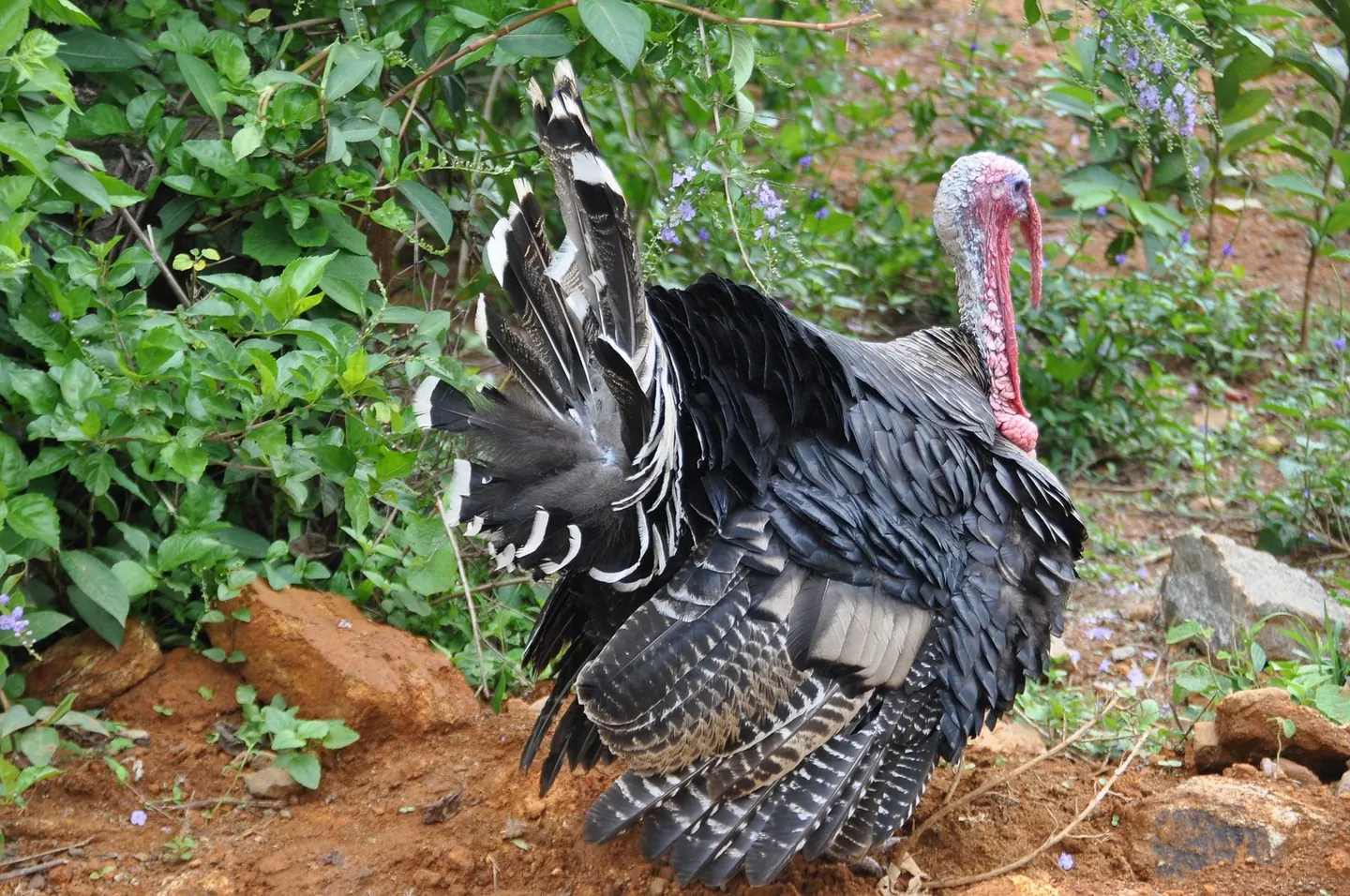
Turkeys are big farm birds kept mainly for meat, either free-range in a fenced yard with a night shelter or indoors in a shed. With proper care they reach about 4 kg in 12–14 weeks (TNAU). This page covers the turkeys sold in South India, how they are raised, what to check before you buy, and how to keep them healthy.
What turkeys are kept for
- Meat. Turkeys are kept mainly for meat (TNAU). Demand is highest at festivals such as Christmas and New Year (ICAR-CARI), but turkey meat is now sold out of season too (TANUVAS review).
- Fast growth. With proper care, turkeys weigh about 4 kg at 12–14 weeks and 8–9 kg at 20–24 weeks; they keep growing after that, but turn feed into weight less and less well (TNAU). Males grow heavier than females.
- Eggs and poults. Hens lay their first egg at about 30 weeks and about 100 eggs a year (TNAU); the Central Poultry Development Organisation gives 60–100 eggs a year with proper feeding and lighting (CPDO). An egg weighs about 70 g, is pointed at one end and has a strong shell, and it hatches in 28 days (TNAU). Turkey hens are good mothers: a broody hen can hatch 10–15 eggs (CPDO).
- Backyard flocks. Local, mixed turkeys are kept in good numbers in Kerala and Tamil Nadu (CPDO). CARI notes that turkeys suit small and marginal farmers and can be raised free-range or semi-intensively with little spent on housing and equipment (ICAR-CARI).
How turkeys are raised
- Free range. About 200–250 adult turkeys can be kept on one acre of fenced land, with a night shelter giving 3–4 square feet per bird. Guard them from predators while they forage, plant trees for shade, and move them around the range so that worms build up less (TNAU).
- Food from the range. Turkeys forage well on earthworms, insects, snails, termites and kitchen waste. You can add legume fodder such as lucerne, desmanthus and stylo, and oyster shell for calcium so the birds do not get weak legs (TNAU).
- In a shed. Turkeys can also be kept indoors on deep litter, much like chickens, but with more floor, feeder and water space for the bigger bird (TNAU). Floor space per bird:
| Age | Floor space per bird |
|---|---|
| 0–4 weeks | 1.25 sq ft |
| 5–16 weeks | 2.5 sq ft |
| 16–29 weeks | 4 sq ft |
| Breeding birds | 5 sq ft |
- Shed layout. In hot areas, run the long side of the shed from east to west. Keep sheds at least 20 metres apart, and the young birds' shed 50–100 metres from the adults (TNAU).
- Brooding poults. The first 4 weeks are the brooding period, stretched to 5–6 weeks in winter. Poults need about twice the space under the brooder that chicks need (CPDO).
- Mating. For natural mating, keep about 1 male to 5 females. Modern turkeys have been bred for fast growth and a wide breast, and under natural mating their fertility is usually low (TNAU).
- Males and females. Mature males have a black beard of bristles growing high on the breast, and a large, fleshy snood (the flap at the base of the beak); in females the snood is small and thin (TNAU).
Turkey varieties
Turkeys are not divided into breeds the way chickens are. TNAU lists seven standard turkey varieties and names three varieties as common in India: Broad Breasted Bronze, Broad Breasted White and Beltsville Small White (TNAU). Indian institutes have bred their own lines too:
| Variety | Bred by | Key points | Source |
|---|---|---|---|
| Broad Breasted Bronze | A standard heavy variety, common in India | Feathers black, not bronze; hens' black breast feathers have white tips, so hens can be picked out at 12 weeks | TNAU |
| Broad Breasted White | Cornell University, USA (Broad Breasted Bronze × White Holland) | White feathers; stands heat better and suits Indian conditions; looks clean after dressing | TNAU |
| Beltsville Small White | Agricultural research station, Beltsville, USA | Like the Broad Breasted White but smaller; lays more, with better fertility and hatching, and goes broody less than heavy varieties | TNAU |
| CARI-Virat | ICAR-CARI, Izatnagar | 2.78 kg at 12 weeks, 5.27 kg at 24 weeks, 7.1 kg at 32 weeks; fertility 94%; suits backyards | ICAR-CARI |
| Nandanam Turkey-II | TANUVAS, Madhavaram | An improved Beltsville Small White; 70 eggs between weeks 24 and 44; 95% of birds survive; suits backyards in Tamil Nadu | TANUVAS |
TANUVAS also bred Nandanam Turkey-I, a black-and-white bird for backyards, by crossing black desi turkeys with Beltsville Small White (TANUVAS). White-feathered turkeys stand heat better, which is why they are seen as the better fit for Indian conditions (TNAU, CPDO).
Buying turkeys
- From a known farm. TANUVAS's poultry college at Hosur supplies turkeys to farmers (TANUVAS), and KVASU's poultry farm at Mannuthy supplies Broad Breasted Bronze and Beltsville Small White turkeys (KVASU). Ask the seller which variety the birds are; the name in an ad is the seller's word.
- Age. Poults need a brooder for their first 4 weeks (CPDO); if you cannot give heat and care, buy older birds. In grown birds, check the sex by the beard and snood (TNAU).
- Healthy birds only. Do not buy birds that are weak, sit still with drooping wings, or have swelling around the eyes, neck or head, a runny nose, or a discoloured head, wattles or legs; these are warning signs of disease (bird flu action plan). Ask the hatch date and which vaccines the birds have had.
- Not from a bird-flu zone. When bird flu is confirmed, all poultry within 1 km is culled and poultry movement is stopped across the surrounding 10 km zone (bird flu action plan). Do not buy or move birds from a notified area: check your district's notices first.
- Moving turkeys. The transport rules count turkeys as poultry. Do not move them when it is hotter than 25°C or colder than 15°C. Clean and disinfect the containers first. Birds older than day-old poults need a vet's certificate that they are free of infectious disease and fit to travel. Put one species and one age group in each container, with males and females apart, and give water every 6 hours in hot weather. Do not stack containers; cover them against sun and rain, and label them with the names, addresses and phone numbers of sender and receiver (AWBI).
- Room to travel. Turkeys need far more room than chickens: at least 900 cm² per young bird (up to 10 in a 120 × 75 cm container), 1,300 cm² per growing bird, and 1,900 cm² for a grown turkey, which travels alone (AWBI).
- Day-old poults. Send poults straight after hatching, without feed or water, in boxes kept level. They should not travel for more than 6 hours at a stretch, and stops should last no more than 30 minutes, in the shade (AWBI).
- Pay safely. Never pay an advance for birds you have not seen: see paying safely.
Keep turkeys healthy
- Worms and mites. Free-range turkeys easily pick up roundworms and fowl mites (TNAU). Move them around the range, and ask your vet for a deworming and mite-control plan.
- Vaccination. The CPDO guide's schedule for turkeys covers Ranikhet (Newcastle) disease, fowl pox and fowl cholera; ask your vet for the schedule for your area (CPDO). In Kerala, the Animal Husbandry Department supplies Ranikhet and fowl pox vaccines free through its veterinary institutions (Kerala AH Department). In Tamil Nadu's Salem district, for example, government veterinary institutions vaccinate poultry against Ranikhet every Saturday (Salem district); ask your nearest veterinary hospital about the days in your area.
- Keep the farm closed. Only the people who look after the birds should go near them. Keep visitors out, wash and disinfect shoes, clothes and hands before and after handling birds, and clean any borrowed equipment (bird flu action plan).
- Clean every day. Clean the shed and change the feed and water daily. Keep newly bought birds apart from your flock for at least 30 days, and if you can, keep one age group at a time ("all in, all out") (bird flu action plan).
- Wild birds out. Do not let wild birds or neighbours' birds mix with yours, and bury dead birds properly; never throw them into drains or open ground (bird flu action plan).
- Sudden deaths: report within 24 hours. Report unusual sickness or deaths in your birds, or in wild birds, to the nearest veterinary hospital immediately, and in any case within 24 hours (bird flu action plan). You can also dial the toll-free number 1962 for a mobile veterinary unit (PIB).
- If bird flu is confirmed. Officials cull the poultry in the infected zone, and birds hidden from culling and found later are culled without compensation (bird flu action plan). The government compensates farmers for culled birds, destroyed eggs and feed, with the cost shared equally by the Centre and the State (PIB). Ask your veterinary hospital about the current rates.
Rules for turkey farms
- Register your farm. In April 2025 the Government of India told all poultry farms to register with their state animal husbandry department (PIB). Ask your nearest veterinary hospital how to register.
- Pollution board. Poultry farms are in the pollution boards' "Green" category, and larger farms need the State Pollution Control Board's consent to establish and operate. CPCB's guidelines on manure, dead birds, waste water and flies apply to every farm, whatever its size (CPCB). Ask your board's district office whether your farm needs consent.
- Farm birds only. Never catch or keep wild birds with your flock. Many, such as wild quail and partridges, are protected under the Wild Life (Protection) Act (India Code), and wild birds can bring disease to your flock (bird flu action plan).
Rules change — confirm with your nearest veterinary hospital or animal husbandry office.
Frequently asked questions
How heavy does a turkey grow, and how fast?
With proper care, about 4 kg at 12–14 weeks and 8–9 kg at 20–24 weeks (TNAU). CARI's Virat line reaches 2.78 kg at 12 weeks and 5.27 kg at 24 weeks (ICAR-CARI). Small varieties such as Beltsville Small White stay lighter (TNAU).
How many eggs does a turkey lay?
About 100 a year according to TNAU, starting at about 30 weeks (TNAU); CPDO gives 60–100 with proper feeding and lighting (CPDO). Each egg weighs about 70 g.
Which turkeys suit hot weather?
White-feathered turkeys, such as Broad Breasted White and Beltsville Small White, stand heat better (TNAU, CPDO).
Can turkeys be raised free-range?
Yes. About 200–250 adult turkeys can be kept on a fenced acre with a night shelter, guarded from predators, with the range moved now and then (TNAU).
How long do turkey eggs take to hatch?
28 days (TNAU).
Next
Read about Country chicken in South India: breeds, buying and care, Duck rearing in South India: breeds, buying and health and Quail farming: Japanese quail rearing, eggs and the law. To see what farmers near you are selling, browse turkeys for sale, or post a free ad to sell your own birds.

Find turkeys near you on Kattutharai
See turkeys and their chicks for sale direct from farmers near your village, with photos, the village name and the distance. No middlemen. Call or chat with the farmer, then see the birds and check them yourself before you pay.
Looking for a particular variety? Search its name in the Kattutharai app, for example Broad Breasted Bronze or Beltsville Small White.

