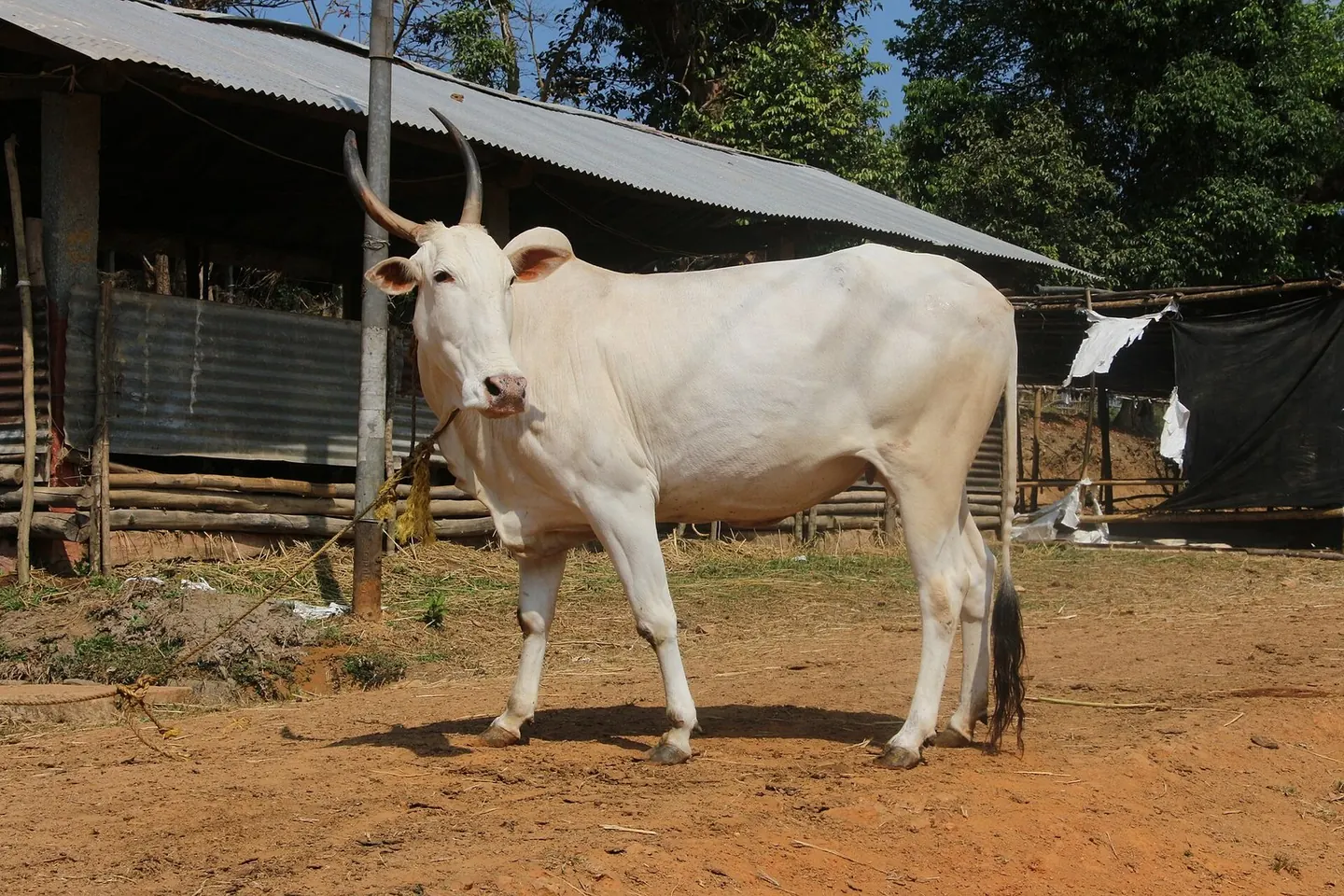
Khillari is a grey-white draught breed of north Karnataka and southern Maharashtra, with long horns that curve back and then up like a bow. Its bullocks are valued as fast, powerful workers that can cover long distances without tiring (NBAGR database). NBAGR registers it as Khillar, a breed of Maharashtra and Karnataka (ICAR-NBAGR).
How to recognise it
- Colour: mostly white or greyish-white; some animals are a brick-dust shade (NBAGR study). Bulls are darker over the forequarters and hindquarters, with mottled grey-and-white markings on the face. One type, the Tapti Khillari, is white with a carroty (pinkish-orange) nose and hooves (NBAGR database). Newborn calves are a dusty red that fades within a couple of months (TNAU).
- Horns: long and pointed, close together at the base. They grow backwards for about half their length, then turn upwards in a smooth bow, a shape typical of the breed (NBAGR database). They are black, carroty or mottled (NBAGR study).
- Head: a long, narrow forehead with a clear groove down the middle, from the nose bridge to the top of the head, and a sharp, prominent nose bridge (NBAGR database).
- Body: a long, round barrel with tight skin, a firm hump of moderate size, small pointed ears held out sideways, and a thin, short dewlap without folds. The muzzle and hooves are black or carroty (NBAGR study).
- Size and weight: males stand about 137 cm at the shoulder and females about 127 cm. NBAGR's record gives average weights of about 270 kg for males and about 220 kg for females (NBAGR database); a BAIF–NBAGR study found Khillari lighter than Deoni cattle (BAIF study).
What it is good for
- Fast farm work and carting. NBAGR classes Khillari as a draught breed known for quick work (NBAGR database). In village herds in Maharashtra, bullocks worked about 7 hours a day, ploughed an acre in about 10 hours, and pulled about 1,300 kg in a cart for up to 18 km a day (BAIF study).
- Milk. Little: about 2.5 litres a day. A study of Maharashtra village herds recorded 2.4 litres a day over about 6 months (BAIF study), and farmers in Belagavi district reported about 2.7 litres a day in a 2017–18 ICAR survey (ICAR survey). NBAGR's record gives about 450 kg in a lactation (NBAGR database).
- Calves. One at a time. In the ICAR survey, Khillari heifers came into heat earliest of Karnataka's six native breeds, and cows had the shortest gap between calvings (ICAR survey). NBAGR's record gives a first calf at about 3.5 years, then one about every 17 months (NBAGR database).
Where it is mainly found
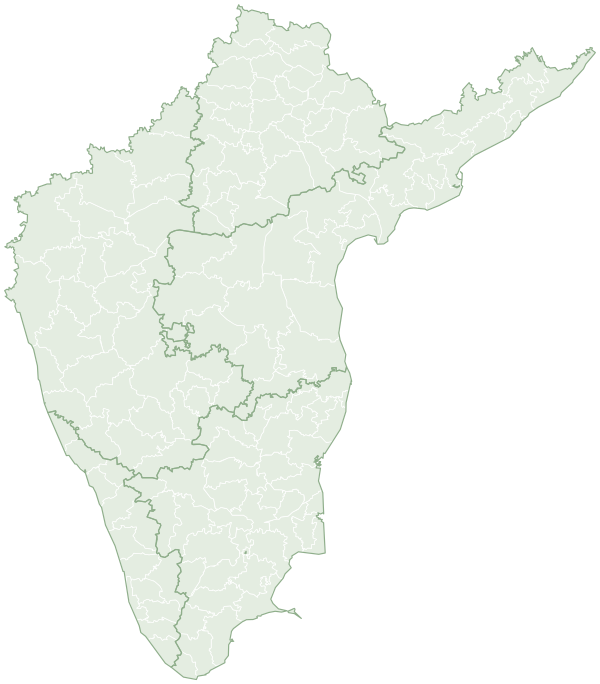
NBAGR's breed record names Belagavi, Vijayapura, Bagalkote, Dharwad and Kalaburagi districts in Karnataka, and six districts of southern Maharashtra, including Solapur, Sangli, Satara and Kolhapur (NBAGR database). NBAGR scientists place most of Karnataka's Khillari in Belagavi, Vijayapura and Dharwad (NBAGR study). The name comes from the word for a herd of cattle, and its herders are called Khillari or Thillari. NBAGR also names four local types: Atpadi Mahal, Mhaswad, Thillari and Nakali (NBAGR database).
The Karnataka Animal Husbandry Department keeps a Khillari herd as a bull-mother farm at Bankapura in Shiggaon taluk, Haveri district (Karnataka AH department). In the 2013 breed survey, Karnataka had about 2.25 lakh pure Khillari and about 4.95 lakh graded, part-Khillari cattle; pure numbers had halved between 2007 and 2012 (NBAGR study).

Looking for Khillari cattle?
Search “Khillari” in the Kattutharai app to find Khillari cows and bulls for sale near you, or see all cows for sale. The seller names the breed and Kattutharai does not check it, so look at the animal yourself before you pay.


Rearing tips
- Grazing and crop stalks. NBAGR describes Khillari as kept on grazing and fodder. Jowar and bajra are the main crops of the tract: the grain goes to the family and the stalks to the cattle, and farmers also grow maize and fodder jowar (NBAGR database). For feed amounts, see how cattle are kept.
- Do not skip the basics. In the ICAR survey of Karnataka's six native breeds, only about half the farmers vaccinated their cattle and about a third dewormed them (ICAR survey). Vaccinate on the official schedule and ask your vet about worms and ticks: see keep cattle healthy.
Buying tips
- Check the signs: a white or greyish-white body; long horns that go back and then curve up in a bow; a long, narrow forehead with a groove down the middle; small pointed ears held sideways; a thin, short dewlap. A loose, folded dewlap, long drooping ears or short horns do not fit the breed's description and point to a cross.
- Crosses are common. Graded animals outnumber pure ones in Karnataka (NBAGR study). The breed name in an ad is the seller's word, and Kattutharai does not check it. See the mother and the herd, and check the signs yourself.
- See a cow milked. Many Khillari cows are left to feed their calves: in one study about 1 cow in 6 was not milked by its owner (BAIF study). If you want milk, watch her milked by hand before you pay.
- Age, health and papers: count the teeth, ask a vet to check pregnancy, and get the ear tag number on your receipt: see buying a cow or bull.
Frequently asked questions
Is Khillari the same as Khillar?
Yes. NBAGR registers the breed as Khillar; other names include Mandeshi, Shikari and Thillar (NBAGR database).
Is Khillari a milk breed?
No, it is a draught breed. Cows give about 2.5 litres a day, and about 450 kg in a lactation by NBAGR's record. If you want milk to sell, see native cattle or crossbreds.
Why is my Khillari calf reddish?
Newborn Khillari calves are a dusty red colour that disappears within a couple of months (TNAU).
Next
Compare Khillari with Krishna Valley from the same black-soil country, with Deoni of north-east Karnataka, or with Hallikar and Amritmahal, the breeds NBAGR traces it to. Read Cows and bulls: native breeds, crossbreds, buying and care for buying and care, and browse cows for sale and bulls for sale.