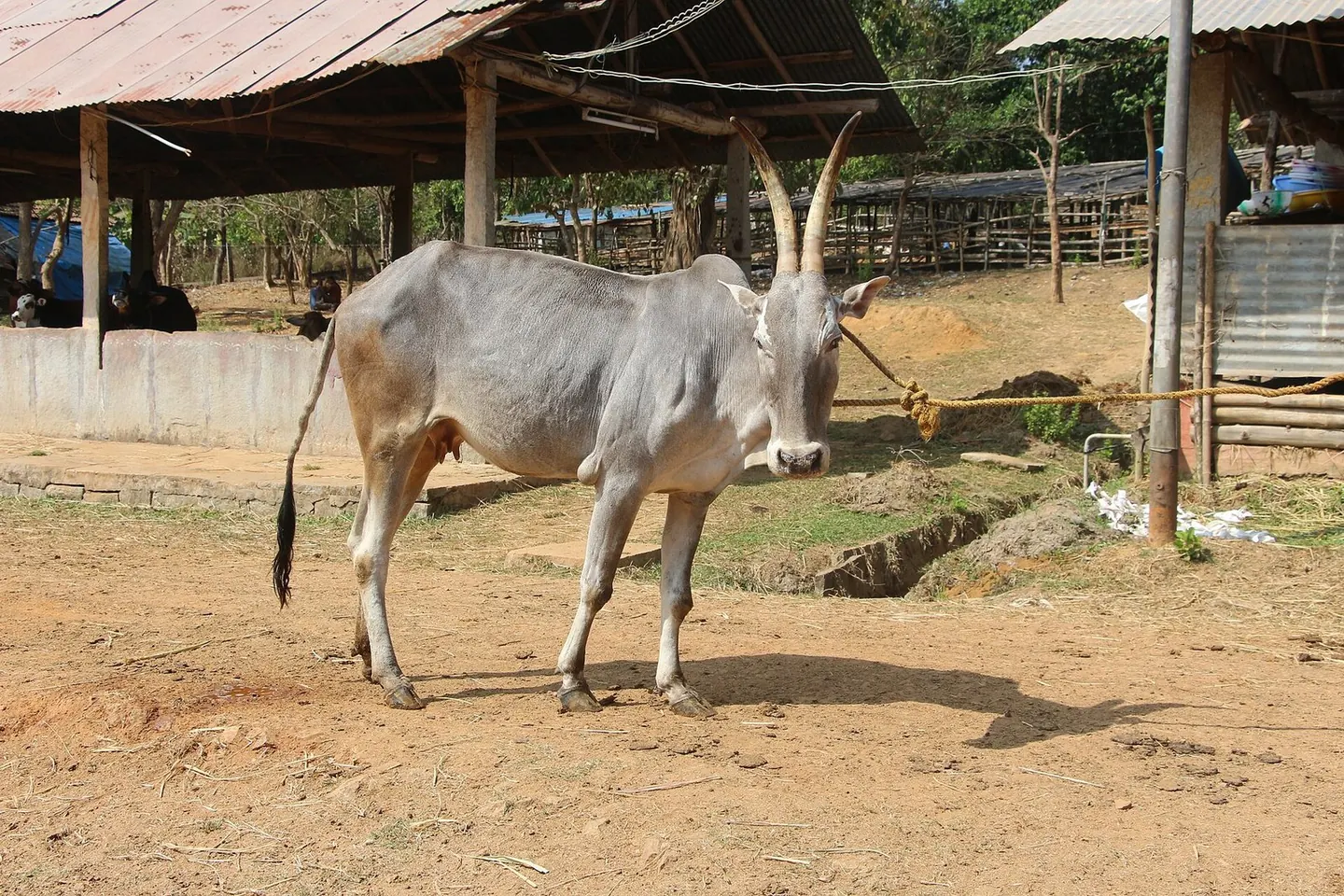
Hallikar is a white-to-grey draught breed of south Karnataka, named after the Hallikar herders of the Golla community who bred it (NBAGR database). Its bullocks are known for strength and a quick trot, and NBAGR notes that most breeds of south India trace back to it. It is one of Karnataka's registered cattle breeds (ICAR-NBAGR) and the state's most numerous: about 11.5 lakh pure animals in the 2013 breed survey (NBAGR study).
How to recognise it
- Colour: white to light grey, sometimes dark grey, with darker shading on the shoulders and hindquarters, most of all in young breeding bulls (NBAGR database, NBAGR study). NBAGR lists white markings or irregular patches around the eyes and cheeks, and on the neck or shoulders, as features of the breed (NBAGR database).
- Horns: long. They rise close together from the top of the head and run up and back in a straight line for about half their length, then sweep forwards and slightly inwards to pointed tips (NBAGR database). They can be pinkish-brown, grey, black or mixed (NBAGR study).
- Body: medium-sized, compact and muscular, with a prominent forehead and strong legs (TNAU). The ears are held level, the hump and dewlap are medium-sized, the muzzle is black, pinkish or mixed, and the tail ends below the hocks in a black switch (NBAGR study).
- Size and weight: males stand about 135 cm at the shoulder and females about 125 cm. NBAGR's record gives average weights of about 340 kg for males and about 230 kg for females (NBAGR database).
What it is good for
- Farm work and carting. NBAGR classes Hallikar as a draught breed (NBAGR database), and TNAU notes its pulling power and its ability to trot (TNAU). In a 2017–18 ICAR survey in Mysuru district, Hallikar cattle worked about 3 hours a day (ICAR survey).
- Cows work too. Cows are milked and are also used for all kinds of farm work, while bullocks get special care (NBAGR database).
- Milk. Modest: NBAGR records about 542 kg in a lactation, ranging from 227 to 1,134 kg, with about 5.7% fat (NBAGR database). Mysuru farmers reported about 3 litres a day per cow (ICAR survey).
- Calves. One at a time. Cows usually have their first calf at about 3–3.5 years and then one about every 18–20 months (NBAGR database, ICAR survey).
Where it is mainly found
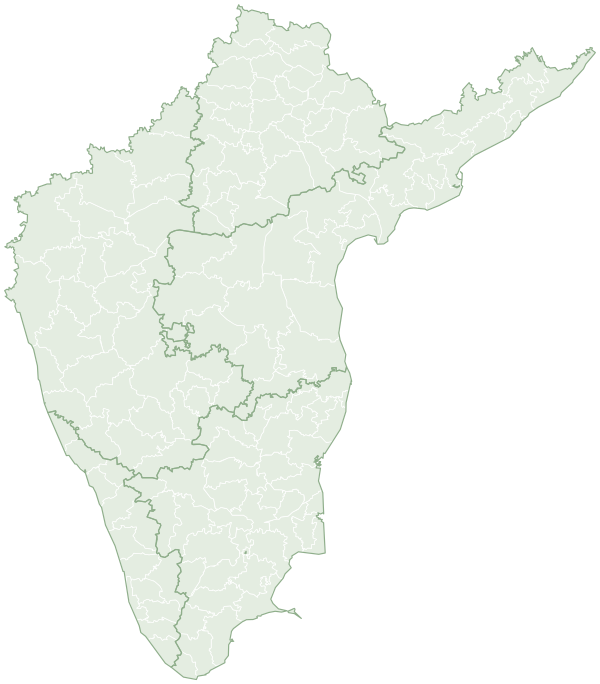
NBAGR's breed record names Tumakuru, Mysuru, Mandya, Kolar, Hassan, Chitradurga and Bengaluru districts, and adds that the breed is found in almost every district of south Karnataka and in bordering parts of Andhra Pradesh and Tamil Nadu (NBAGR database). NBAGR's field survey of the breed covered villages in Mandya, Mysuru, Tumakuru, Bengaluru Rural and Chitradurga districts (NBAGR survey). Since then, Chikkaballapura has been carved out of Kolar district, and the old Bengaluru Rural district is now split into Bengaluru North and Bengaluru South.
The breed has deep roots in the region: the royal cattle establishment of Mysore, which later became the Amrit Mahal, began with Hallikar cows brought to Srirangapatna (Karnataka AH department). Today the Karnataka Animal Husbandry Department breeds Hallikar cattle at its station at Kunikenahalli and its sub-centre at Hullenahalli, both in Tumakuru district (Karnataka AH department). Besides the pure animals, the 2013 survey counted about 5.5 lakh graded, part-Hallikar cattle in Karnataka, and pure numbers fell by about 43% between 2007 and 2012 (NBAGR study).

Looking for Hallikar cattle?
Search “Hallikar” in the Kattutharai app to find Hallikar cows and bulls for sale near you, or see all cows for sale. The seller names the breed and Kattutharai does not check it, so look at the animal yourself before you pay.


Rearing tips
- Fodder and grazing. NBAGR describes Hallikar as kept on fodder and concentrate feed, with ragi (finger millet), grass, jowar (sorghum) or bajra (pearl millet) given as green fodder (NBAGR database). For feed amounts, see how cattle are kept.
- Care for working bullocks. Farmers in the home tract give their bullocks special care (NBAGR database). Give working animals enough feed, clean water and shade.
- Do not skip the basics. In the ICAR survey of Karnataka's six native breeds, only about half the farmers vaccinated their cattle and about a third dewormed them (ICAR survey). Vaccinate on the official schedule and ask your vet about worms and ticks: see keep cattle healthy.
Buying tips
- Check the signs: white to grey colour, darker on a bull's shoulders and hindquarters; long horns that rise close together and run straight up and back before curving forwards; a compact body with strong legs; a medium hump and dewlap. A big hanging dewlap, long drooping ears or short, thick horns do not fit the breed's description and point to a cross.
- Crosses are common. Graded animals are common in the home tract (NBAGR study). The breed name in an ad is the seller's word, and Kattutharai does not check it. See the mother and the herd, and check the signs yourself.
- Bull calves at auction. The department's Hallikar station at Kunikenahalli auctions bull calves to farmers for farm work (Karnataka AH department). Ask your nearest veterinary hospital when the next auction is.
- Age, health and papers: count the teeth, see a cow milked by hand, ask a vet to check pregnancy, and get the ear tag number on your receipt: see buying a cow or bull.
Frequently asked questions
Is Hallikar a milk breed?
No, it is a draught breed, though cows are milked for the home: about 3 litres a day by farmers' estimates, and about 542 kg in a lactation by NBAGR's record. If you want milk to sell, see native cattle or crossbreds.
How heavy is a Hallikar bull?
About 340 kg on average for an adult male and about 230 kg for a female, by NBAGR's record (NBAGR database).
Is Hallikar the same as Mysore cattle?
NBAGR lists Mysore as another name for Hallikar (NBAGR database), and NBAGR scientists call it a typical Mysore-type breed (NBAGR study).
Next
Compare Hallikar with Amritmahal, whose royal herd began with Hallikar cows, and with Tamil Nadu's Kangayam. Read Cows and bulls: native breeds, crossbreds, buying and care for buying and care, and browse cows for sale and bulls for sale.