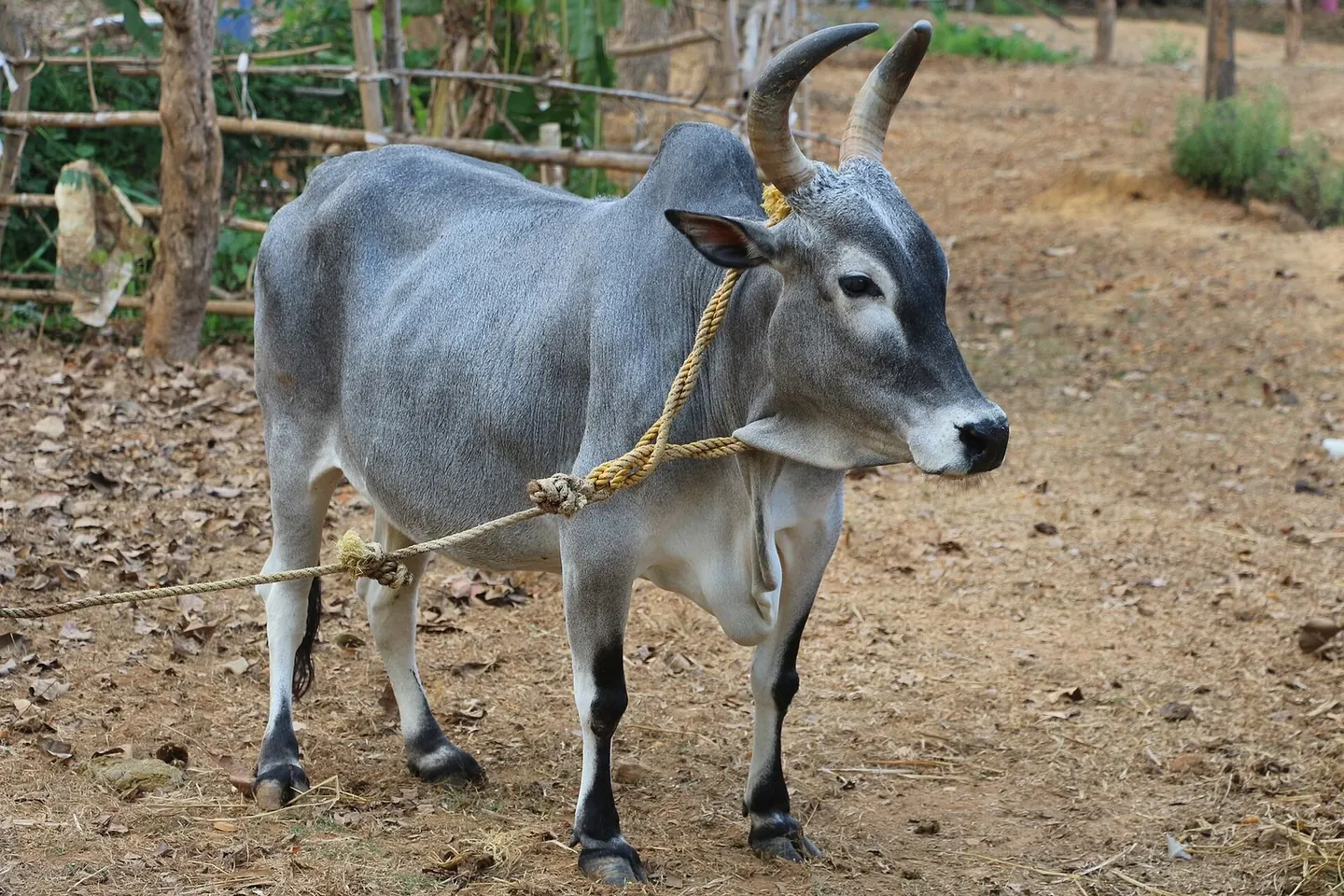
Kangayam is a grey draught breed from the dry west of Tamil Nadu, named after Kangayam taluk, now in Tiruppur district. Its bullocks are known for strength and a long working life, and farmers keep the cows mainly to raise them. It is one of Tamil Nadu's four registered cattle breeds (ICAR-NBAGR), also known as Kongu cattle (NBAGR database).
How to recognise it
- Colour: calves are born red and turn grey by about 6 months. Bulls are grey with dark grey to black on the head, neck, hump and quarters; bullocks turn plain grey after castration; cows are grey, or white and grey, many with a dark grey face (ICAR-NBAGR, TANUVAS survey).
- Horns: long and strong. They sweep backwards, outwards and upwards, then curve inwards until the tips almost meet, nearly closing a circle (ICAR-NBAGR). The horns, muzzle and hooves are black (TANUVAS survey).
- Body: medium-sized and compact, with a short, thick neck, a well-developed hump, a deep chest, a thin, short dewlap and short ears held level. Cows have a small udder (TANUVAS survey).
- Size and weight: males stand about 140 cm at the shoulder and females about 125 cm. Adult males weigh about 540 kg and females about 380 kg on average (ICAR-NBAGR).
What it is good for
- Farm work and carting. Bullocks do all field work and are preferred over other local breeds for hauling sugarcane to the mills (ICAR-NBAGR). In a TANUVAS survey of 100 pairs, a pair pulled about 3,800 kg, cart included — nearly four times their own weight — for 10–20 km without rest. Bullocks reach their best at about 5 years and keep it until about 11 (TANUVAS survey).
- Raising bullocks. Most cows are kept to produce bullocks; their milk is a by-product, used at home (TANUVAS survey).
- Milk. Little: about 2 litres a day is milked after the calf has drunk its share, for about 9 months. NBAGR's record gives about 540 kg in a lactation (ICAR-NBAGR, TANUVAS survey).
- Calves. One at a time. Cows first calve at about 40 months and then about every 15–16 months, with about 9 calves in a lifetime; twins are rare (TANUVAS survey).
Where it is mainly found
NBAGR's breed record names Erode, Coimbatore, Karur, Dindigul and Namakkal districts, with animals true to type in Kangayam and Dharapuram taluks and in Karur taluk (ICAR-NBAGR). Kangayam and Dharapuram, which the record places in Erode district, are now in Tiruppur district (TANUVAS survey). The same TANUVAS survey found that crossbred cows have replaced Kangayam cattle in parts of the old tract, such as Pollachi, Palladam and Udumalpet, after canal irrigation brought more fodder.
In the 2012–13 breed survey, about 80,620 animals were pure Kangayam and about 1,12,825 more were graded, part-Kangayam animals (TANUVAS).
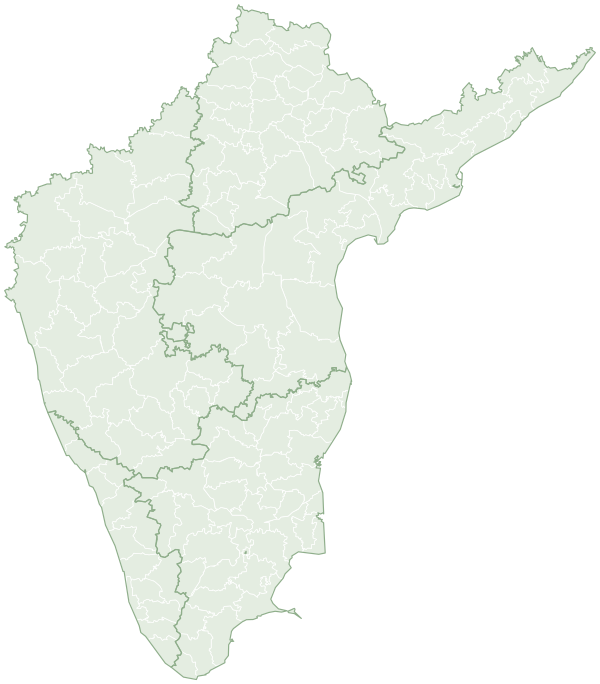

Looking for Kangayam cattle?
See cow ads in the districts where Kangayam cattle come from, or search “Kangayam” in the Kattutharai app to find them near you. The seller names the breed and Kattutharai does not check it, so look at the animal yourself before you pay.
Cow ads in its home districts, 1 Nov 2026:


Rearing tips
- Fenced dry pasture. In the home tract, Kangayam cattle graze dry land kept as pasture, called korangadu. It is split into paddocks by live hedges of thorny kiluvai and grown with kolukkattai grass, with velvel trees for shade, and farmers move the herd from paddock to paddock (ICAR-NBAGR, TANUVAS).
- Straw and extra feed. Besides grazing, the cattle get sorghum and pearl millet straw, groundnut haulms and paddy straw. In the dry season, working bullocks and milking cows also get 0.5–1 kg a day of concentrate feed such as rice bran, groundnut cake or soaked cotton seed (TANUVAS survey). For feed amounts, see how cattle are kept.
- Shelter. Most farmers have no closed shed. Give shade, and shelter from the strong winds of June to August (TANUVAS survey).
- Health. Vaccinate on time, and ask your vet about worms and ticks: see keep cattle healthy.
Buying tips
- Check the signs: a grey body, darker on a bull; black muzzle, horns and hooves; long horns curving in towards each other; a thin, short dewlap. A red or brown adult, a big hanging dewlap or long drooping ears do not fit the breed's description and point to a cross.
- A red calf can be pure. Kangayam calves are born red and turn grey by about 6 months.
- Crosses are common. In the breed survey, graded animals outnumbered pure ones (TANUVAS). The breed name in an ad is the seller's word, and Kattutharai does not check it. See the mother and the herd, and check the signs yourself.
- Buy in the home tract. Animals true to type come from Kangayam, Dharapuram and Karur taluks (ICAR-NBAGR). TANUVAS's Kangayam Cattle Research Station near Sathyamangalam keeps a pure herd and supplies calves to farmers of the breeding tract (TANUVAS).
- Age, health and papers: count the teeth and check health before you pay: see buying a cow or bull.
Frequently asked questions
Is Kangayam a milk breed?
No, it is a draught breed. Cows give about 2 litres a day after the calf has drunk, and farmers keep them mainly to raise bullocks. If you want milk to sell, see native cows or crossbreds.
Why is my Kangayam calf red?
Calves are born red and turn grey by about 6 months; young bulls darken on the hump and quarters at 18–24 months (TANUVAS survey).
How heavy is a Kangayam bull?
About 540 kg on average for an adult male, and about 380 kg for a female, by NBAGR's record (ICAR-NBAGR).
Is Kangayam good for a beginner?
Yes, if you want strong bullocks or a hardy cow that lives on dry pasture and straw. For milk to sell, a dairy breed or a cross suits better.
Next
Compare Kangayam with Tamil Nadu's other native breeds, Umblachery, Pulikulam and Bargur, or with Hallikar from Karnataka. Read Cows and bulls: native breeds, crossbreds, buying and care for buying and care, and browse cows for sale and bulls for sale.