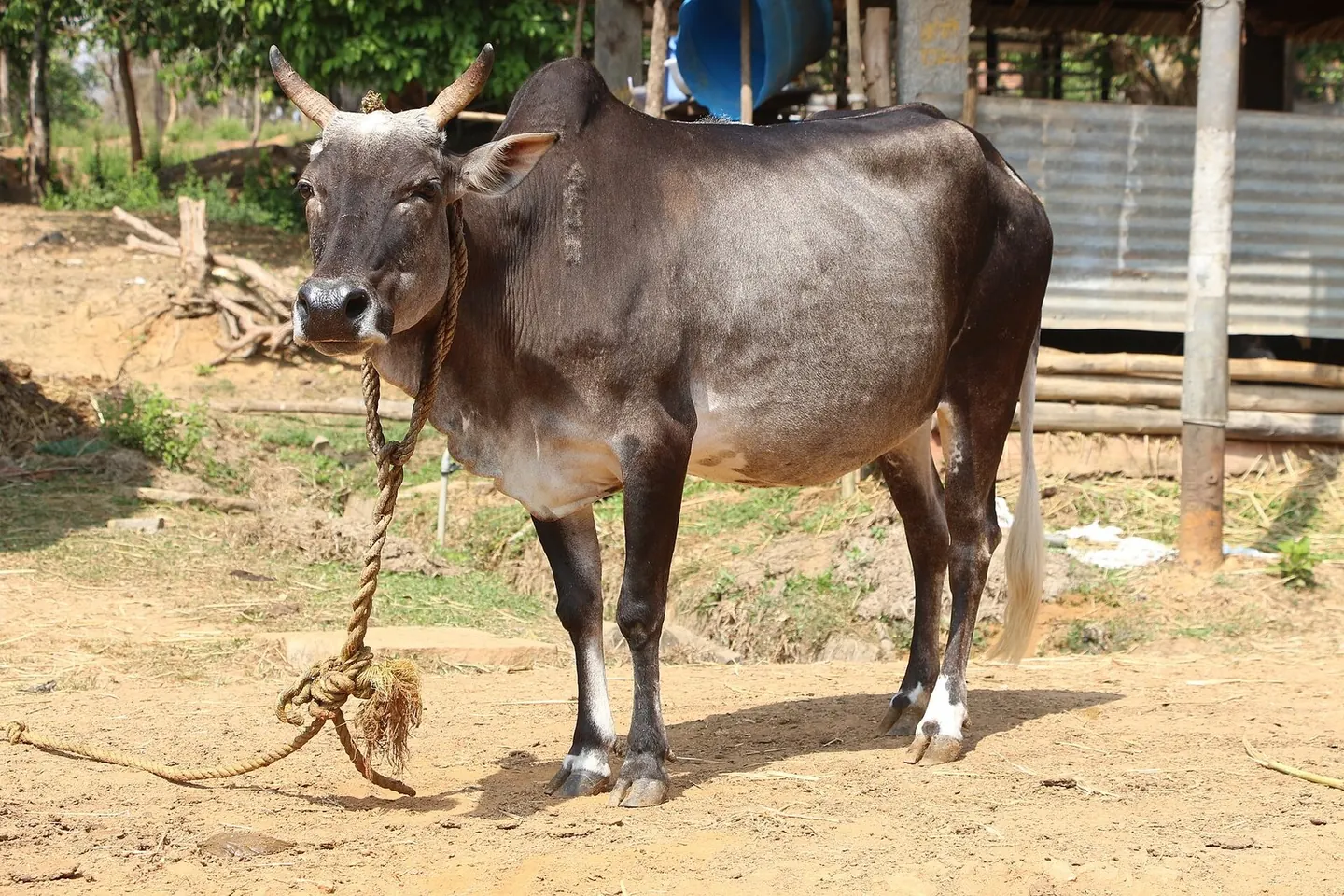
Umblachery is a small, grey draught breed of the coastal delta, bred for ploughing wet, marshy paddy fields in Tiruvarur and Nagapattinam districts. It takes its name from Umblachery village in Nagapattinam district, and it is one of Tamil Nadu's four registered cattle breeds (ICAR-NBAGR). White marks on its face, legs and tail make it easy to tell apart (NBAGR database).
How to recognise it
- Colour: calves are born red or brown, start turning grey at 3–4 months and are fully grey by 6–8 months. Cows are grey, darker on the face, neck and hips; bulls are dark grey, with black on the hump, legs and quarters; bullocks are grey (ICAR-NBAGR, TANUVAS study).
- White markings, the breed's sign: a white star on the forehead, white socks or stockings on all four legs below the hocks, a white or partly white tail switch, and often partly white hooves (ICAR-NBAGR, TANUVAS study).
- Horns and ears: the horns are very small — thick in bulls, thin in cows — and curve outwards and then inwards; the ears are short and held level (ICAR-NBAGR, TANUVAS study). Many bullocks have their horns removed when young, a local custom (TNAU).
- Size and weight: a lightly built animal. Males stand about 117 cm at the shoulder and females about 105 cm; adult males weigh about 297 kg and females about 219 kg on average (ICAR-NBAGR).
What it is good for
- Work in wet fields. The light build suits the soft soil of the delta. Bullocks plough, cart, thresh and level marshy paddy fields, and can work 6–7 hours in the hot sun; in a TANUVAS study, a pair pulled about 2,000 kg, cart included, over 20 km in 7 hours (ICAR-NBAGR, TANUVAS study).
- Milk for the home. About 2 litres a day after the calf has suckled, over a lactation of about 8 months — about 494 kg in all — mostly used at home (TANUVAS milk study, ICAR-NBAGR).
- Manure. After the harvest, herders gather village cattle into herds of 250–400, graze them until June or July, and pen them on fields at night for manure (TANUVAS study).
- Calves. One at a time. NBAGR records the first calving at about 52 months, then a calf about every 15 months (ICAR-NBAGR).
Where it is mainly found
NBAGR's record covers all of Tiruvarur district and six blocks of Nagapattinam district: Keelaiyur, Kilvelur, Nagapattinam, Thalainayar, Thirumarugal and Vedaranyam (ICAR-NBAGR). TANUVAS researchers found the most typical animals around Thiruthuraipoondi and Thalainayar (TANUVAS study). TNAU adds Thanjavur district and gives the breed's other names: Jathi madu, Mottai madu, Molai madu and Therkathi madu (TNAU).
Around 2000 the tract held about 2.8 lakh Umblachery cattle; the 2013 breed survey counted about 39,050 (ICAR-NBAGR). Farm machines and crossbreeding for milk are the main reasons for the fall (TANUVAS study).
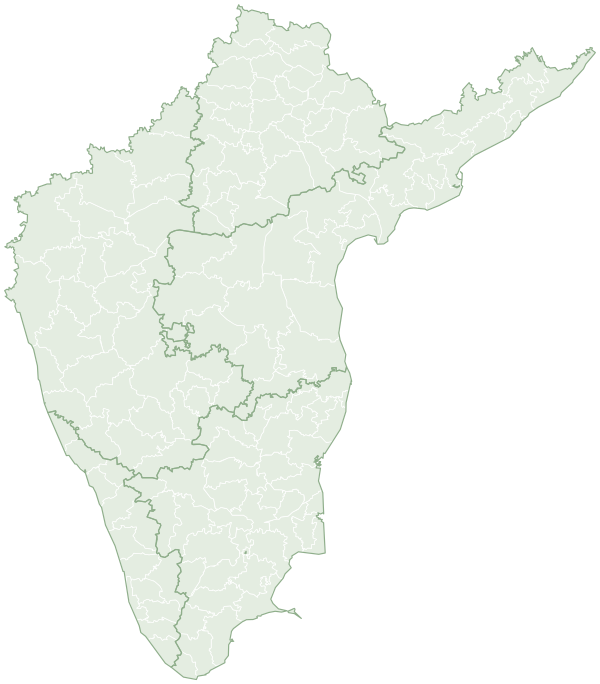

Looking for Umblachery cattle?
See cow ads in the districts where Umblachery cattle come from, or search “Umblachery” in the Kattutharai app to find them near you. The seller names the breed and Kattutharai does not check it, so look at the animal yourself before you pay.
Cow ads in its home districts, 1 Nov 2026:


Rearing tips
- Paddy straw and short grazing. In village herds, paddy straw is the main fodder. The cattle graze within 3–4 km, are tethered to pegs or trees by day and are kept in sheds at night (TANUVAS study).
- Extra feed for workers and milkers. Rice bran, soaked cotton seed and oil cakes go to working bullocks and to cows early in their lactation (TANUVAS study). For feed amounts, see how cattle are kept.
- Milking. Cows are milked by hand twice a day, at about 5 in the morning and 4 in the afternoon, and the calf suckles before and after each milking (TANUVAS milk study).
- Health. Farmers in the TANUVAS study vaccinated against black quarter, haemorrhagic septicaemia and foot-and-mouth disease (TANUVAS study). Follow the schedule in keep cattle healthy.
Buying tips
- Look for the white marks: a grey body with a white star on the forehead, white socks below the hocks and a white tail tip. A grey animal without these marks is unlikely to be an Umblachery.
- Don't judge by the horns. They are small anyway, and many bullocks have had them removed.
- Not a Kangayam. Kangayam cattle look similar but are bigger, with long horns that curve towards each other: see Kangayam cattle: breed, weight and where it is found.
- Crosses are common. Farmers in the tract have moved to crossbred cows for milk (TANUVAS study). The breed name in an ad is the seller's word, and Kattutharai does not check it. See the mother and the herd, and check the signs yourself.
- Ask about Korukkai. A government farm at Korukkai, near Umblachery village, was set up to conserve the breed and sell animals to farmers (TANUVAS study). Ask your veterinary hospital whether it has stock.
- Age, health and papers: see buying a cow or bull.
Frequently asked questions
Is Umblachery good for wet paddy fields?
Yes. It was developed for work in marshy paddy fields, and its light build suits the soft soil of the delta (ICAR-NBAGR).
Why do many Umblachery bullocks have no horns?
The breed's horns are very small, and in the tract the horns of young males are often removed — a local custom, not something the breed is born with (TNAU).
How much milk does an Umblachery cow give?
About 2 litres a day after the calf has suckled, mostly used at home (TANUVAS milk study). For milk to sell, see native cows or crossbreds.
Next
Compare Umblachery with Tamil Nadu's other native breeds, Kangayam, Pulikulam and Bargur. Read Cows and bulls: native breeds, crossbreds, buying and care for buying and care, and browse cows for sale and bulls for sale.