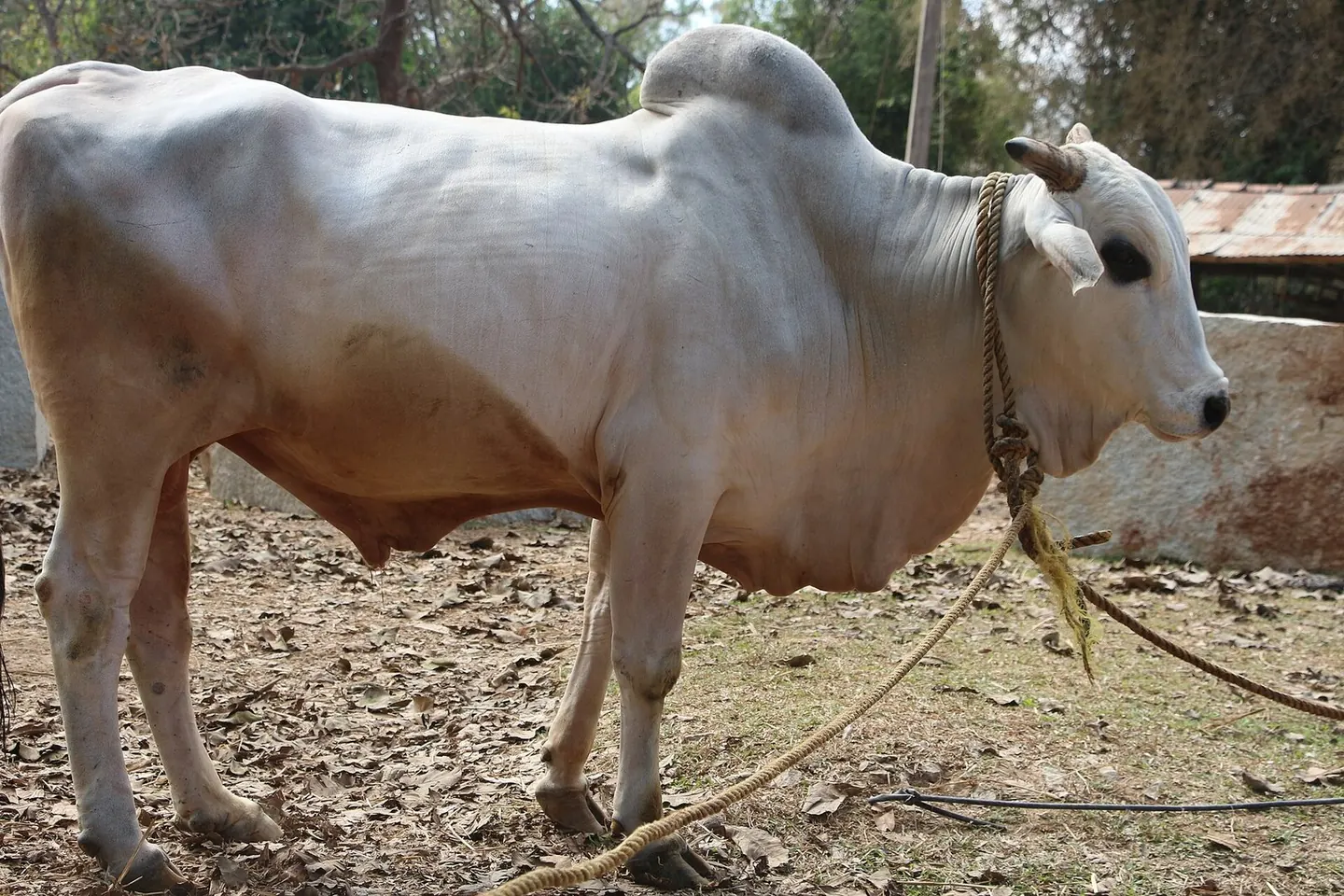
Ongole is a big, white breed from coastal Andhra Pradesh, kept for farm work and milk. It is named after Ongole, now the headquarters of Prakasam district, and is also called Nellore, because Ongole taluk was once part of Nellore district (NBAGR database). NBAGR registers it as a breed of Andhra Pradesh (ICAR-NBAGR), and its bullocks are known for their power at the plough and the cart.
How to recognise it
- Colour: glossy white. Bulls have dark grey on the head, neck and hump and black marks on the knees and fetlocks; the muzzle and eyelashes are black (NBAGR database). Some bulls are grey on the hindquarters too (ICAR study).
- Horns: short and stumpy, thick at the base and firm, growing outward and backward. Cows have thinner horns that turn outward, upward and inward (NBAGR database).
- Dewlap and body: a large, fan-shaped, fleshy dewlap that hangs in smooth folds, long ears, a big hump, long legs and a big barrel, with a short neck and tail (ICAR study, NBAGR database). Ongole cattle walk with a proud, stately gait (NBAGR database).
- Size and weight: a tall breed. In an SVVU survey of village herds, adult males stood about 147 cm at the shoulder and females about 144 cm (SVVU survey). Adult males weigh about 434 kg and females about 382 kg on average; calves weigh 26–28 kg at birth (NBAGR database).
What it is good for
- Farm work. NBAGR classes Ongole as a draught and milk breed (NBAGR database). The bullocks are very powerful and suit ploughing and pulling carts (ICAR study).
- Milk. NBAGR's record gives about 798 kg of milk in a lactation, with about 3.8% fat (NBAGR database).
- Hardiness. Ongole cattle are hardy and thrive on scarce, dry fodder; many countries have imported them to improve their own herds (NBAGR database).
- Calves. One at a time. Cows first calve at about 46 months and then about every 13 months (NBAGR database).
Where it is mainly found
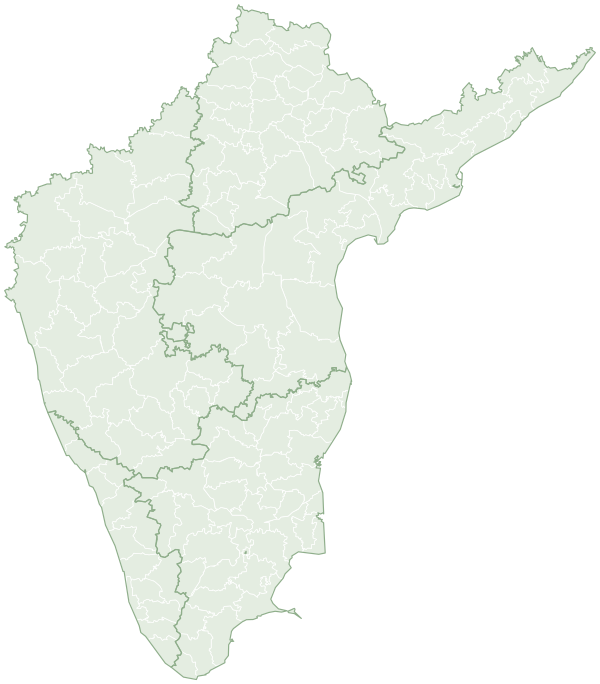
NBAGR's breed record names Prakasam (Ongole), Guntur, Nellore, Kurnool and East Godavari districts, and says the tract runs along the coast from Nellore to Vizianagaram (NBAGR database). The heart of the breed is the coastal belt of Prakasam, Guntur and Nellore (ICAR study), where an SVVU survey in 1997–2000 recorded 8,742 cattle in farmers' herds (SVVU survey). Since 2022 these old districts have been divided into smaller ones, so the home area now spans about a dozen districts.
The 2013 breed survey counted 1,15,905 Ongole cattle (NBAGR database), and NBAGR's 2022 Breed Watchlist places the breed in its "not at risk" group (Breed Watchlist). SVVU's Livestock Research Station at Lam, Guntur, has run an Ongole conservation project with NBAGR since 2014, taking insemination with Ongole semen to farmers' cows in the breeding tract (SVVU Lam). Its station at Mahanandi, now in Nandyal district, keeps an Ongole herd and has supplied young bulls to farmers since 2003 (SVVU Mahanandi).

Looking for Ongole cattle?
Search “Ongole” in the Kattutharai app to find Ongole cows and bulls for sale near you, or see all cows for sale. The seller names the breed and Kattutharai does not check it, so look at the animal yourself before you pay.


Rearing tips
- Grazing in groups. In the home tract, cattle go out to graze in groups, often with hired herders, and also get fodder and some concentrate feed (NBAGR database).
- Straw and cotton seed. Farmers feed paddy straw, the straw of pulse crops and sorghum stalks; cotton seed and cotton seed cake are widely used (NBAGR database). For amounts, see how cattle are kept.
- Feed the heifer calves too. In the tract, male calves are often allowed more milk, for longer, than female calves (NBAGR database). A heifer calf that drinks its share grows into a stronger cow.
- Health. Vaccinate on time, and ask your vet about worms and ticks: see keep cattle healthy.
Buying tips
- Check the signs: a glossy white coat (darker grey on a bull's head, neck and hump), a black muzzle and eyelashes, short stumpy horns thick at the base, and the big, fan-shaped dewlap in smooth folds. Long horns, a red, black or patchy coat, a small dewlap or a small frame do not fit the breed's description and point to a cross.
- Crosses are common. SVVU's own Lam farm crossed Ongole cows with Holstein Friesian and Brown Swiss bulls from 1971 (SVVU Lam), and in one survey of 60 villages in the tract, 7,341 cattle were found true to the breed (ICAR study). The breed name in an ad is the seller's word, and Kattutharai does not check it. See the mother and the herd, and check the signs yourself.
- Known herds. SVVU's stations at Lam (Guntur) and Mahanandi (Nandyal) keep Ongole herds (SVVU Lam, SVVU Mahanandi). Ask there, or at your nearest veterinary hospital, about animals from known herds.
- Age, health and papers: count the teeth and check health before you pay: see buying a cow or bull.
Frequently asked questions
Are Ongole and Nellore cattle the same?
Yes. NBAGR lists Nellore as another name of the breed, because Ongole taluk was once part of Nellore district (NBAGR database).
How big is an Ongole bull?
Adult males weigh about 434 kg on average and stand about 147 cm at the shoulder; females weigh about 382 kg and stand about 144 cm (NBAGR database, SVVU survey).
Is Ongole a milk breed?
It is a draught breed that also gives milk: about 798 kg in a lactation by NBAGR's record (NBAGR database). If you want milk to sell, see native cows or crossbreds.
Is Ongole good for a beginner?
It suits a farmer with space and fodder for a large animal and work for strong bullocks. It lives well on dry fodder such as straw, but a big animal still needs plenty of it.
Next
Compare Ongole with Andhra Pradesh's other registered breed, Punganur, or with the big draught breeds of the south, Kangayam and Hallikar. Read Cows and bulls: native breeds, crossbreds, buying and care for buying and care, and browse cows for sale and bulls for sale.