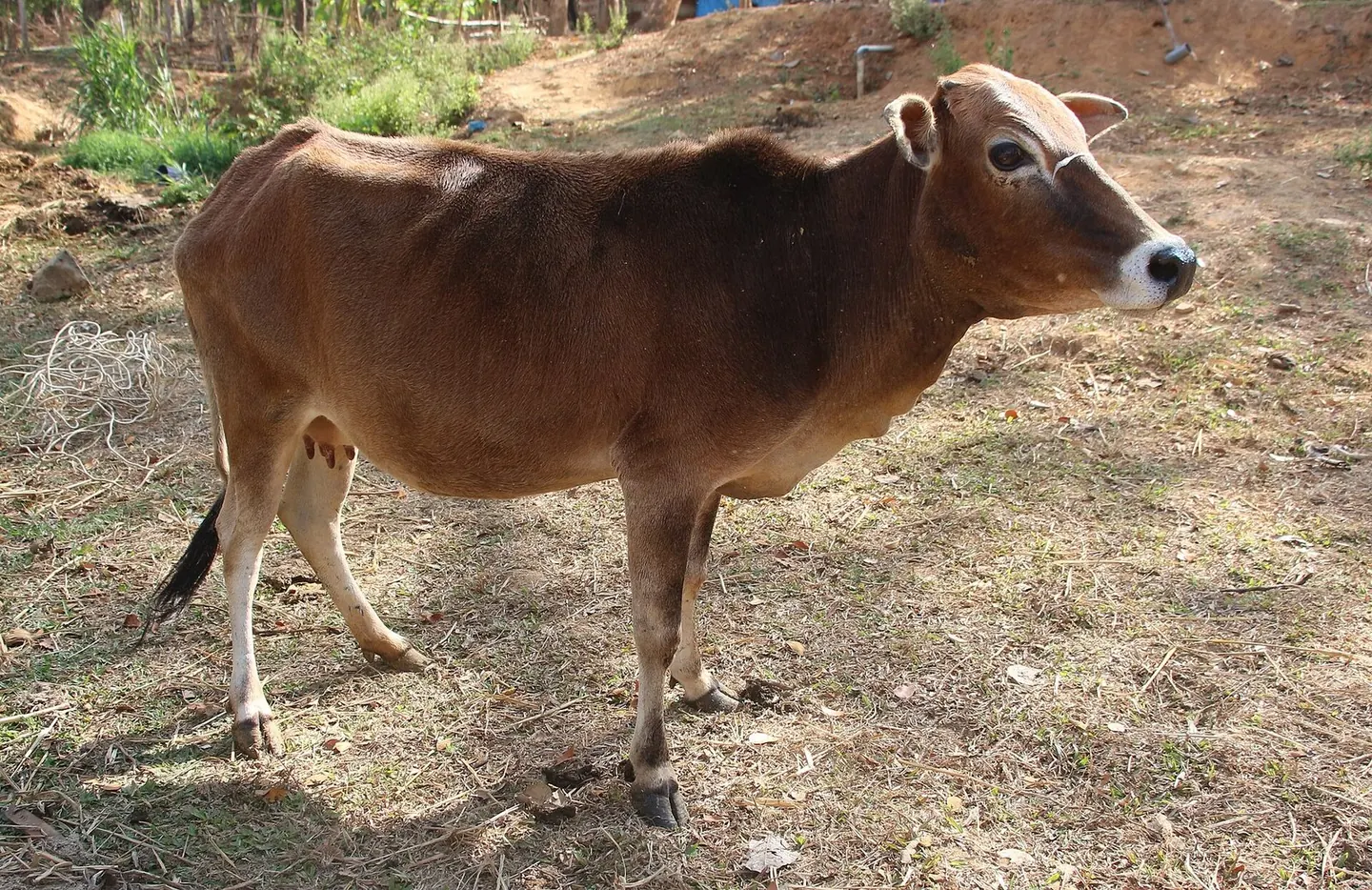
Vechur is a very small native cow from the backwater country of south Kerala, named after Vechur village near Vaikom in Kottayam district. Families keep it for milk at home and for manure. NBAGR registers it as a cattle breed of Kerala (ICAR-NBAGR). It nearly died out in the 1980s, and a conservation herd started in 1989 at the veterinary college in Mannuthy, now part of KVASU, saved it (Iype 2013).
How to recognise it
- Size: one of the smallest cattle you will see. NBAGR's averages are about 99 cm at the shoulder for bulls and 89 cm for cows (ICAR-NBAGR); a cow is rarely taller than 90 cm (KAU).
- Weight: adult bulls weigh about 178 kg and cows about 132 kg on average (ICAR-NBAGR). Calves weigh only about 10–11 kg at birth.
- Colour: light red, black, or fawn and white (ICAR-NBAGR).
- Horns: small and thin, curving forward and downward; in some cows they are so small they barely show. Bulls have small, stout horns (ICAR-NBAGR, KAU).
- Body: a long head with a narrow face, a hump that is very prominent in bulls, short legs and a long tail that almost touches the ground. The udder is well attached, with small, evenly placed teats (KAU).
What it is good for
- Milk for the family. A Vechur cow gives about 2.5 litres a day over a lactation of about 8 months (Iype 2013). NBAGR's record gives about 561 kg of milk in a lactation, with 4.7–5.8% fat (ICAR-NBAGR).
- Manure. NBAGR lists dung for manure as one of the breed's two main uses (ICAR-NBAGR).
- Low cost, hot weather. The breed formed in heavy rain and hot, humid weather on very little feed (ICAR-NBAGR). In the Mannuthy herd, Vechur cows showed no sign of distress on hot days when exotic and crossbred cattle were panting (KAU).
- Calves. One at a time. A cow first calves at about 3 years and then about every 14 months (12–17 months) (ICAR-NBAGR, KAU).
Where it is mainly found
Vechur is a small place beside Vembanad lake near Vaikom. Rivers, canals and backwaters once cut the area off, and that isolation helped the breed form (KAU). NBAGR's breed record names the Kuttanad area, which covers Alappuzha, Kottayam and Pathanamthitta districts, and Kasaragod district in the far north (ICAR-NBAGR).
The breed is rare. The 2013 breed survey counted 1,065 Vechur cattle (ICAR-NBAGR); another estimate puts Kerala's Vechur cattle at about 2,000 (Iype 2013). NBAGR's 2022 Breed Watchlist lists Vechur as vulnerable (Breed Watchlist). Crossbreeding with exotic bulls, pushed since the 1960s to raise milk yields, is what brought it so low (KAU).

Looking for Vechur cattle?
Search “Vechur” in the Kattutharai app to find Vechur cows and bulls for sale near you, or see all cows for sale. The seller names the breed and Kattutharai does not check it, so look at the animal yourself before you pay.


Rearing tips
- Grazing by day, a shed at night. In the home tract, each family lets its cattle out in the morning; they graze together in groups and come home in the evening, to a shed for the night (ICAR-NBAGR).
- Leaf bedding. Farmers spread tree leaves on the shed floor and add a fresh layer every other day. The manure is cleared 3 or 4 times a year and used as mulch on crops (ICAR-NBAGR).
- Little feed. A small cow eats little, which is one reason farmers liked the breed (KAU). For green fodder, straw and water, see how cattle are kept.
- Keep the calves pure. Breed a Vechur cow only to a Vechur bull, or ask your veterinary hospital about insemination with semen from a Vechur bull.
- Health. Vaccinate on time, and ask your vet about worms and ticks: see keep cattle healthy.
Buying tips
- Check the size and signs: a grown cow about 90 cm tall, short legs, a long tail that almost reaches the ground, and small, thin horns curving forward and down. A tall, long-legged cow or a big, deep udder does not fit the breed's description and points to a cross.
- Not every small cow is a Vechur. Kerala has other native cattle: local types such as Kasaragod cattle, which are not a registered breed (KVASU–NBAGR study), and Periyar cattle, which NBAGR has now registered as a breed of their own (ICAR-NBAGR).
- Crosses are common. About 94% of Kerala's cattle were crossbred in 2019 (KVASU–NBAGR study). The breed name in an ad is the seller's word, and Kattutharai does not check it. See the mother, ask where the parents came from, and check the signs yourself.
- Known herds. KVASU's Vechur farm at Mannuthy keeps a pure herd and has sold cows and heifers to farmers who set up conservation units (KVASU notice). Ask there, or at your nearest veterinary hospital.
- Age, health and papers: count the teeth and check health before you pay: see buying a cow or bull.
Frequently asked questions
How small is a Vechur cow?
About 89–90 cm at the shoulder and about 132 kg on average for a grown cow; bulls are about 99 cm and 178 kg (ICAR-NBAGR, KAU).
How much milk does a Vechur cow give?
About 2.5 litres a day for about 8 months (Iype 2013). That is enough for a family. If you want milk to sell, see native cows or crossbreds.
Are Kasaragod cattle the same as Vechur?
NBAGR's Vechur record counts Kasaragod district in the breed's home area (ICAR-NBAGR), but KVASU keeps Kasaragod cattle as a separate herd at its Vechur farm (KVASU), and they are not registered as a breed of their own (KVASU–NBAGR study).
Is Vechur good for a beginner?
Yes, for a small family farm that wants milk at home. It needs little feed and space and copes with heat and humidity, but it will not give much milk to sell.
Next
Compare Vechur with other small native breeds, Punganur from Andhra Pradesh and Malnad Gidda from Karnataka. Read Cows and bulls: native breeds, crossbreds, buying and care for buying and care, and browse cows for sale and bulls for sale.