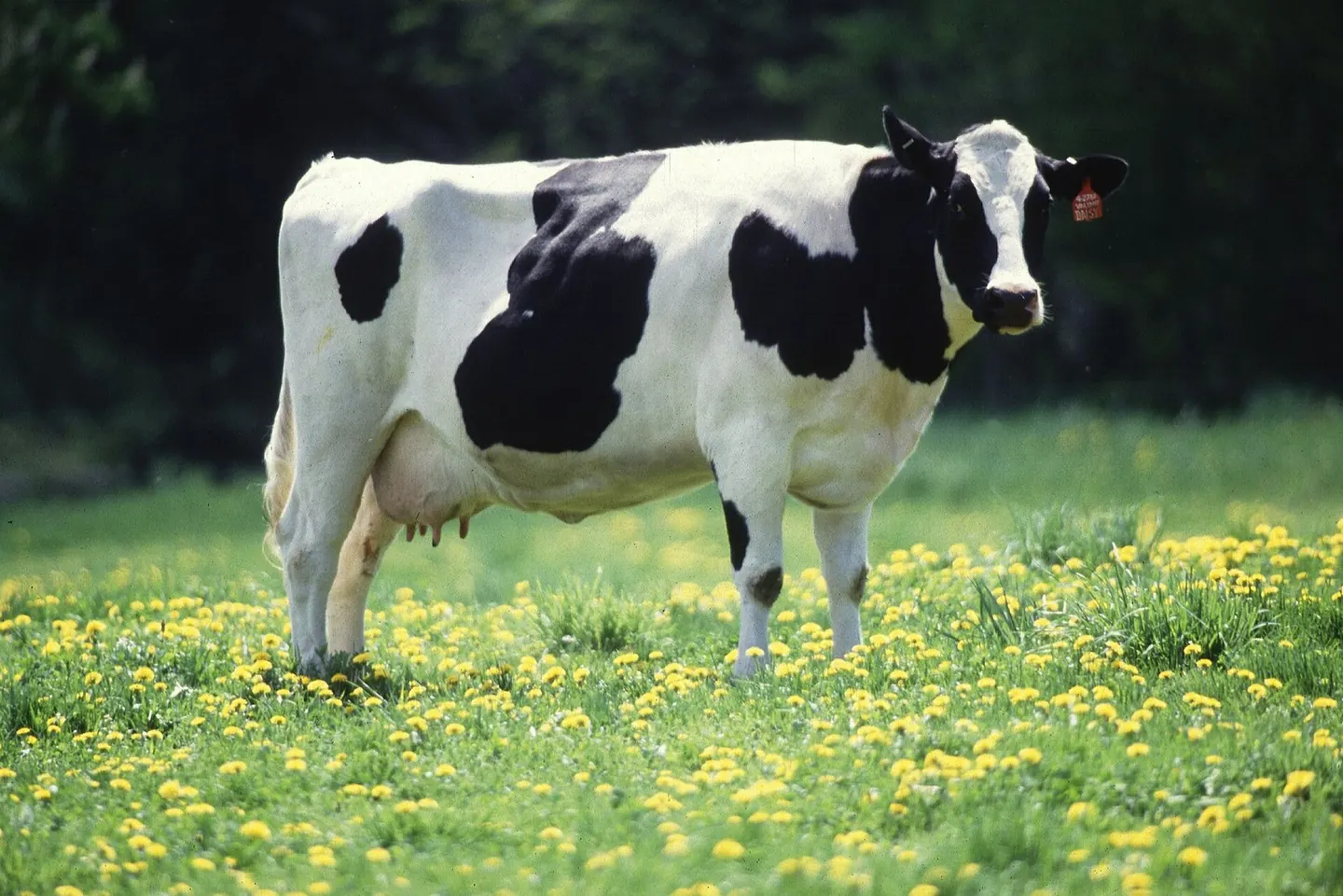
Holstein Friesian (HF) is the largest dairy breed, black and white, developed in the north of the Netherlands (TNAU). In the south, the HF cows farmers keep are mostly crosses: state breeding policies use HF on local cows and aim to keep crosses at about half HF blood (Tamil Nadu policy, Karnataka policy). HF crosses give the most milk of the common crosses, but they stand heat poorly, so they need good feed, shade and care (TNAU).
How to recognise it
- Colour: black-and-white patches that make the breed easy to spot (TNAU). Crosses vary: in Frieswal, an Indian HF cross, the share of black ranges from 10% to 90%, and some animals are all black or tan and white (NBAGR database).
- Body and udder: big and strongly built, with a large udder. Mature pure HF cows can weigh up to about 700 kg (TNAU).
- No hump: Karan Fries, an Indian HF cross registered by NBAGR, has no hump (NBAGR database).
What HF crosses are kept for
- Milk in volume. Pure HF cows give about 6,000–7,000 kg of milk in a lactation, but with little fat, about 3.45% (TNAU). HF crosses give more milk than Jersey crosses, with less fat (TNAU).
- In farmers' herds. In ICAR's field testing of HF-cross bulls in farmers' herds, Kerala among them, their daughters gave about 2,807 kg of milk in their first lactation, about 2,720 litres (ICAR-CIRC study).
- A good cow. Tamil Nadu's breeding policy counts an HF cross that gives 3,500 kg or more in her first 305-day lactation as an elite cow, worth registering (Tamil Nadu policy).
- Indian HF breeds. NBAGR registers two Indian dairy breeds with HF blood (ICAR-NBAGR): Karan Fries, bred from HF and Tharparkar at ICAR-NDRI, averages about 3,549 kg in a lactation (NBAGR database), and Frieswal, bred from HF and Sahiwal, about 3,312 kg (NBAGR database).
- Calves. One at a time. Pure HF heifers first calve at 29–30 months and then every 13–14 months (TNAU).
Where it comes from
HF was developed in the north of the Netherlands, especially Friesland (TNAU). It is not on India's breed register, which lists the country's own breeds and a few new crossbred ones (ICAR-NBAGR).
In the south, HF crosses are kept mostly where it is cooler and feed is good. Tamil Nadu's policy uses HF in the Nilgiris and Kodaikanal hills, high-rainfall Kanyakumari and the Krishnagiri highlands next to Karnataka, and only where good feed, fodder and housing are available; in the plains it uses Jersey (Tamil Nadu policy). Its District Livestock Farm at Udhagamandalam keeps both pure and crossbred HF (Tamil Nadu policy note). Karnataka's policy suggests HF crosses for Bengaluru and the districts around it (Karnataka policy), where an NBAGR study found most of the state's crossbred cattle, in a belt from Kolar and Chikkaballapur to Mysuru and Hassan (NBAGR study). Kerala's policy allows only HF and Jersey as foreign breeds (Kerala policy), and ICAR-NDRI's station in Bengaluru keeps HF crosses in its herd (ICAR-NDRI).

Looking for Holstein Friesian cattle?
Kattutharai works across India. Search “Holstein Friesian” in the app to look for Holstein Friesian cattle, or browse cows for sale near you. The seller names the breed and Kattutharai does not check it, so look at the animal yourself before you pay.


Rearing HF crosses in our heat
- Heat is the main risk. HF crosses stand heat less well than Jersey crosses and suit cooler, hilly areas; they also resist tropical diseases less well (TNAU).
- Know the signs of heat stress. A heat-stressed cow seeks shade, drinks more but eats less, stands rather than lies down, breathes fast, drools and may pant with her mouth open, and her milk drops (heat-stress guide).
- Keep her cool. Give shade, from trees, an open-sided shed or shade cloth, and plenty of cool, clean water. Fans with water sprinklers cool cows best, but do not soak the bedding: wet floors invite udder infection (heat-stress guide).
- Feed well, in the cool hours. Give good green fodder and a balanced ration, split into more feeds at cooler times of the day (heat-stress guide). For daily amounts, see how cattle are kept.
- Health. Crossbred cows need one more vaccine than native cattle: see keep cattle healthy.
Buying an HF cross
- Ask about her blood. Ask what her mother was and which bulls were used. The states aim for crosses of about half HF blood, and Kerala allows up to 75% only for farmers with good resources (Kerala policy).
- Match her to your farm. HF crosses suit cooler areas (TNAU). If you farm in the hot plains and cannot keep her cool, a Jersey cross may suit you better.
- See her milked. Watch complete milkings by hand, morning and evening, and measure the milk yourself. Ask for her calving and insemination dates.
- The breed in an ad is the seller's word. Kattutharai does not check it. For age, a brucellosis test and the ear tag, see buying a cow or bull.
Frequently asked questions
How much milk does an HF cross give?
In ICAR's field testing in farmers' herds, HF-cross cows gave about 2,807 kg (about 2,720 litres) in their first lactation (ICAR-CIRC study). Pure HF can give 6,000–7,000 kg in good conditions (TNAU). Feed, care and her blood level make the difference.
Is an HF cross right for the hot plains?
Only with shade, cooling, water and good feed: HF crosses stand heat less well than Jersey crosses (TNAU), and Tamil Nadu's policy uses HF in the hills and Jersey in the plains (Tamil Nadu policy).
What are Karan Fries and Frieswal?
Indian dairy breeds made from HF and Indian cattle and registered by NBAGR: Karan Fries from HF and Tharparkar, Frieswal from HF and Sahiwal (NBAGR database, NBAGR database).
Next
Compare HF with Jersey, and see the Indian breeds behind Indian HF crosses, Tharparkar and Sahiwal. Before you choose, read native cattle or crossbreds, then browse cows for sale and bulls for sale.