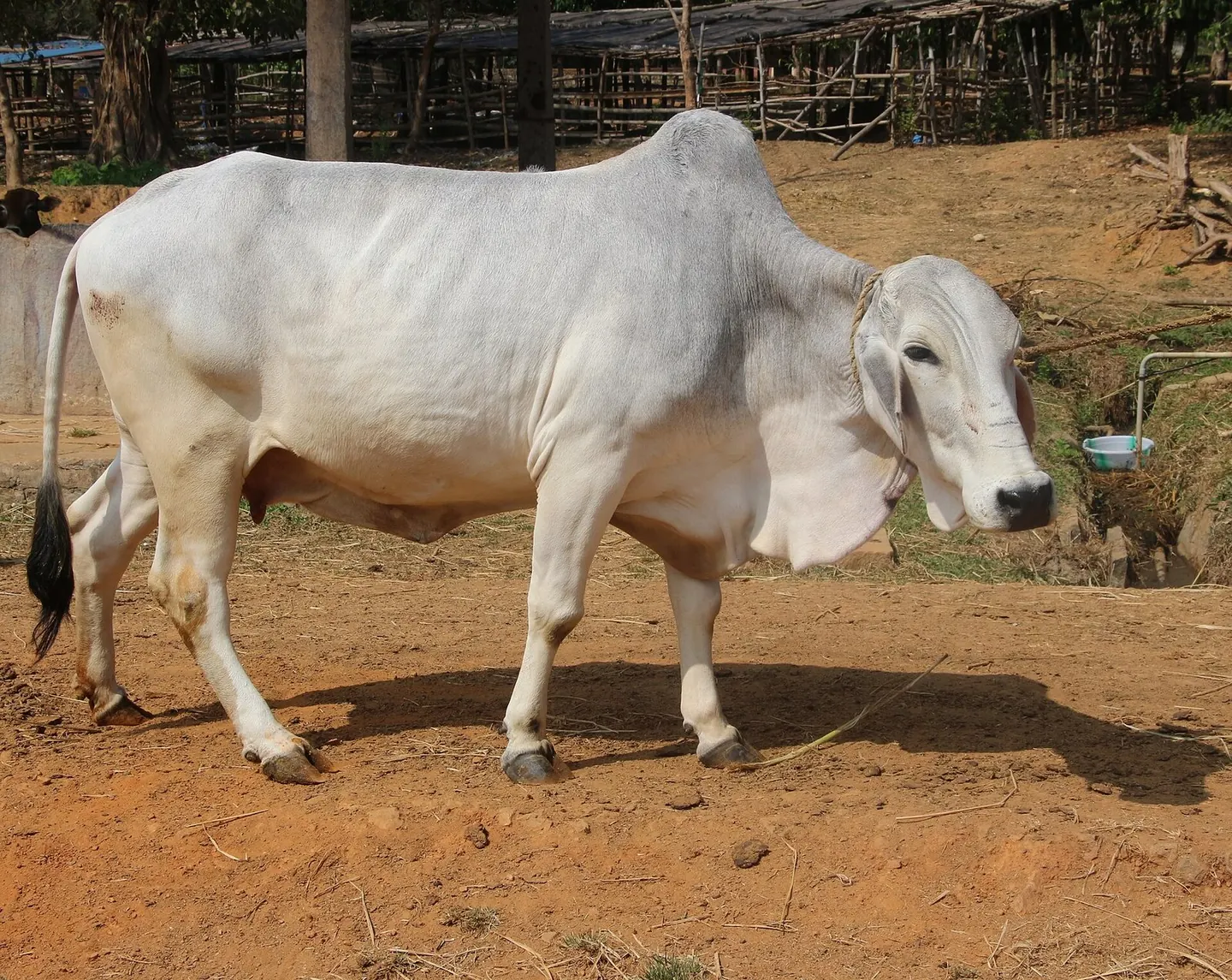
Tharparkar is a white or light-grey breed of the Thar desert, kept for both milk and farm work. NBAGR registers it as a breed of Rajasthan (ICAR-NBAGR) and NDDB lists milk and draught as its uses (NDDB). Its home runs along the border from western Rajasthan to the Rann of Kutch in Gujarat, and it is well adapted to the desert's harsh conditions (NBAGR database). This page shows how to recognise a Tharparkar, what it gives, and what to check before you buy.
How to recognise it
- Colour: white or light grey, with the face and legs darker than the body. Bulls are also darker on the neck, hump and fore- and hindquarters (NBAGR database).
- Head and horns: a convex, bulging forehead. The horns are set well apart and curve gently up and out, with blunt tips turned inward; bulls have shorter, thicker horns (NBAGR database). TNAU's guide calls them lyre-shaped (TNAU).
- Size and weight: a medium-sized, compact breed (TNAU). Bulls stand about 133 cm at the shoulder and cows about 130 cm. Adult bulls weigh about 475 kg and cows about 295 kg on average, and calves weigh about 23 kg at birth (NBAGR database).
What it is good for
- Milk. NBAGR's breed record gives about 1,749 kg of milk in a lactation on average (about 1,700 litres), ranging from 913 to 2,147 kg, with about 4.9% fat (NBAGR database). TNAU's guide gives 1,800–2,600 kg (TNAU).
- With good care. In ICAR-NDRI's herd, Tharparkar cows average about 2,334 kg in a lactation of about 330 days, with 5.3% fat (ICAR-NDRI).
- Farm work. The bullocks suit ploughing and pulling carts (TNAU).
- Calves. One at a time. NBAGR records the first calf at about 41 months and then one about every 14 months (NBAGR database).
- A parent of Karan Fries. ICAR-NDRI bred the Karan Fries dairy breed from Holstein Friesian and Tharparkar cattle (NBAGR database).
Where it is mainly found
The breed takes its name from the Thar desert. NBAGR's breed record places its home tract in Jodhpur, Jaisalmer and Barmer districts of Rajasthan and Kutch district of Gujarat, along the border with Pakistan. Its other names are White Sindhi, Grey Sindhi and Thari, and the 2013 breed survey counted about 1.97 lakh Tharparkar cattle in India (NBAGR database).
In the south, Tamil Nadu conserves Tharparkar at its District Livestock Farm at Chettinad in Sivaganga district (Tamil Nadu policy note). Tamil Nadu's breeding policy allows Tharparkar for improving non-descript cows in the plains and suggests trying it with nomadic herds (Tamil Nadu policy), and Karnataka's policy encourages it too (Karnataka policy).

Looking for Tharparkar cattle?
Kattutharai works across India. Search “Tharparkar” in the app to look for Tharparkar cattle, or browse cows for sale near you. The seller names the breed and Kattutharai does not check it, so look at the animal yourself before you pay.


Rearing tips
- Built for dry country. In the desert, Tharparkar cattle live on grazing, with sewan grass, green or as hay, as the main fodder. Only cows late in pregnancy or in milk get concentrate feed (NBAGR database). A cow in milk here still needs green and dry fodder every day: see how cattle are kept.
- Simple shelter. In the home tract, cattle are mostly kept without a shed, except on cold nights and in the hottest weeks, under thatched roofs on mud walls (NBAGR database). Here, give shade from the midday sun and a dry floor in the rains.
- Health. Vaccinate on time, and ask your vet about worms and ticks: see keep cattle healthy.
Buying tips
- Check the signs: a white or light-grey coat with a darker face, a bulging forehead, and horns set wide apart with blunt tips turned inward. A black, red or patchy coat, or long straight horns, do not fit the breed's description and point to a cross.
- White Sindhi, not Red Sindhi. Sellers may call a Tharparkar "Sindhi". It is the white one; Red Sindhi is a different, red breed. The breed name in an ad is the seller's word, and Kattutharai does not check it. Ask where the parents came from, and check the signs yourself.
- See her milked. Watch complete milkings by hand, morning and evening, and measure the milk yourself. Ask for her calving and insemination dates.
- Age, health and papers: count the teeth, ask for a brucellosis test and write the ear-tag number on your receipt: see buying a cow or bull.
Frequently asked questions
How much milk does a Tharparkar cow give?
NBAGR's breed record gives about 1,749 kg (about 1,700 litres) in a lactation on average, from 913 to 2,147 kg (NBAGR database). Cows in NDRI's well-run herd average about 2,334 kg (ICAR-NDRI).
How heavy is a Tharparkar bull?
About 475 kg on average; cows weigh about 295 kg (NBAGR database).
Can Tharparkar bullocks work in the fields?
Yes. NBAGR lists draught as one of the breed's main uses (NBAGR database), and TNAU's guide notes that the bullocks suit ploughing and carting (TNAU).
Next
Compare Tharparkar with Red Sindhi, Sahiwal and Gir, and read about Holstein Friesian crosses such as Karan Fries in HF cow (Holstein Friesian): crosses, milk and care in heat. See Cows and bulls: native breeds, crossbreds, buying and care for buying and care, and browse cows for sale and bulls for sale.