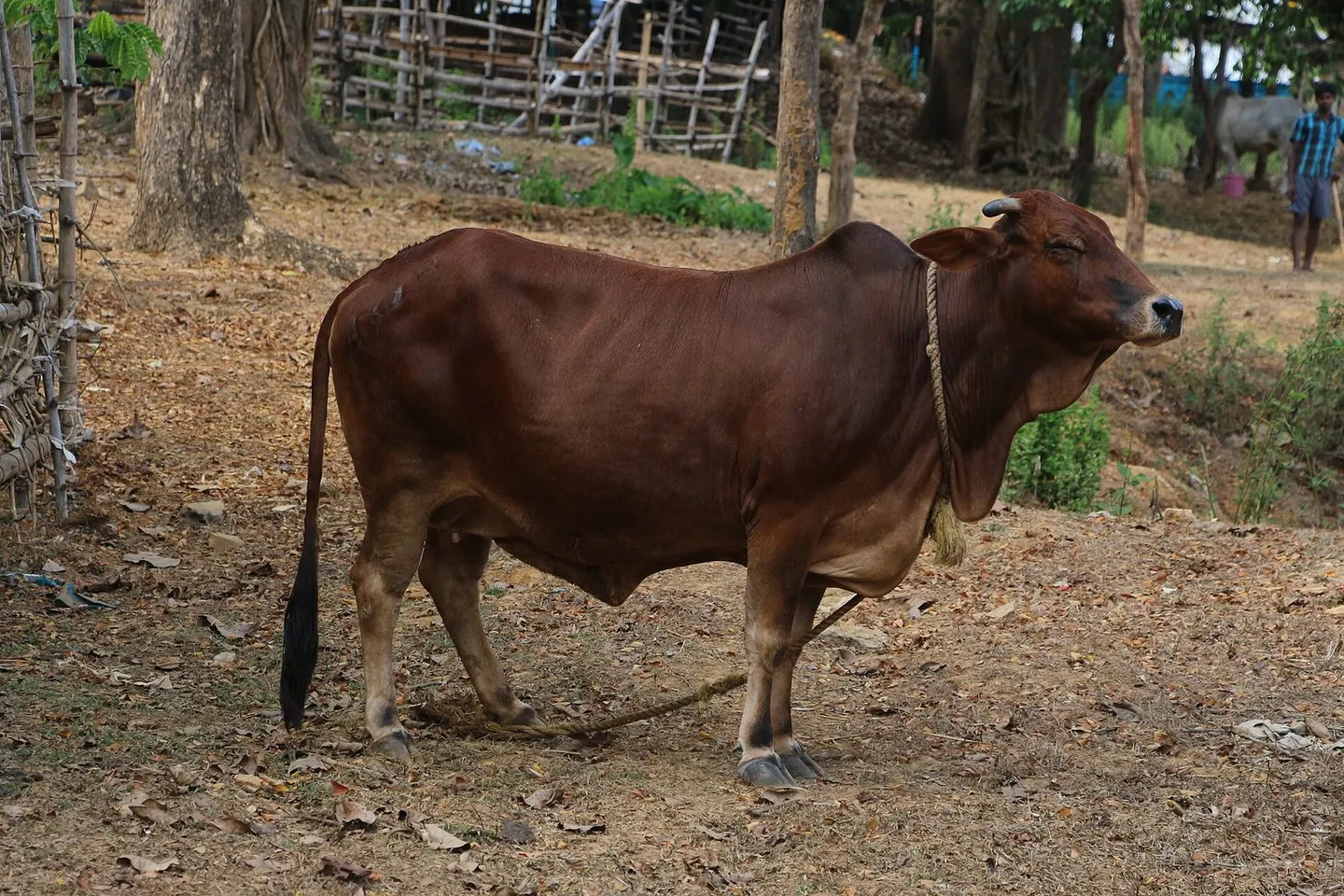
Sahiwal is a reddish-brown dairy breed with loose skin, named after the Sahiwal area of Montgomery district in Punjab, now in Pakistan. In India, NBAGR registers it as a breed of Punjab and Rajasthan (ICAR-NBAGR), NDDB lists milk as its main use (NDDB), and ICAR-NDRI keeps a Sahiwal herd at its farm in Karnal (ICAR-NDRI). This page shows how to recognise a Sahiwal, what it gives, and what to check before you buy.
How to recognise it
- Colour: reddish brown, in shades from deep mahogany to greyish red. Bulls are darker towards the head, legs and tail, and some animals have white patches (NBAGR database).
- Loose skin: one of the breed's other names, Lola, means loose skin (TNAU).
- Horns: short and stumpy, growing outward, then upward and inward (NBAGR database).
- Size and weight: a heavy breed with an even, well-shaped body (TNAU). Adult bulls weigh about 540 kg and cows about 327 kg on average, and calves weigh about 21–22 kg at birth (NBAGR database).
What it is good for
- Milk. NBAGR's breed record gives about 2,325 kg of milk in a lactation on average (about 2,260 litres), ranging from 1,600 to 2,750 kg, with about 4.9% fat (NBAGR database). TNAU's guide gives 1,400–2,500 kg (TNAU).
- With good care. In ICAR-NDRI's herd, Sahiwal cows average about 2,266 kg in a lactation of about 297 days, with 5.1% fat, and the best have given 4,560 kg in 305 days (ICAR-NDRI).
- Improving other cattle. NBAGR notes that many warm, humid countries use Sahiwal to improve their local cattle (NBAGR database). In India it is a parent of two crossbred dairy breeds: Frieswal, bred from Holstein Friesian and Sahiwal (NBAGR database), and Karan Swiss, bred from Brown Swiss and Sahiwal at NDRI (TNAU).
- Calves. One at a time. NBAGR records the first calf at about 42 months and then one about every 16 months. Good management shortens this: in NDRI's herd, cows first calve at about 35 months and then about every 13 months (NBAGR database, ICAR-NDRI).
Where it is mainly found
The breed comes from the Sahiwal area, now in Pakistan. In India, NBAGR's breed record places its home tract in Amritsar and Ferozepur districts of Punjab and Ganganagar district of Rajasthan, and notes that only a few herds of pure Sahiwal remain, around the towns of Fazilka and Abohar. The 2013 breed survey counted about 10.9 lakh Sahiwal cattle in India (NBAGR database).
In the south, Tamil Nadu's animal husbandry department conserves Sahiwal at its District Livestock Farms at Chettinad in Sivaganga district and Abishekapatti in Tirunelveli district (Tamil Nadu policy note). Tamil Nadu's breeding policy allows Sahiwal, with Red Sindhi and Tharparkar, for improving non-descript cows in the plains (Tamil Nadu policy), and Karnataka's policy encourages it too (Karnataka policy). In Andhra Pradesh, the embryo-transfer work of the National Kamdhenu Breeding Centre at Chintaladevi includes Sahiwal (Nellore district).

Looking for Sahiwal cattle?
Kattutharai works across India. Search “Sahiwal” in the app to look for Sahiwal cattle, or browse cows for sale near you. The seller names the breed and Kattutharai does not check it, so look at the animal yourself before you pay.


Rearing tips
- Open yards and grazing. In the home tract, Sahiwal cattle are often kept loose in an open yard rather than a shed. They go out to graze in the morning and also get green fodder; milking cows come back early (NBAGR database).
- Feed the milking cow. Farmers there give milking cows soaked cotton seed, barley and oil cake at milking time (NBAGR database). For daily amounts, see how cattle are kept.
- Calves. Calves get whole milk for the first month, then green fodder as well, and suckle one or two teats until about 6 months (NBAGR database).
- Health. Vaccinate on time, and ask your vet about worms and ticks: see keep cattle healthy.
Buying tips
- Check the signs: a reddish-brown coat, loose skin, short stumpy horns and a heavy, even body. A black or black-and-white coat, long horns or a small, light frame do not fit the breed's description and point to a cross.
- Pure animals are few. NBAGR notes that few pure herds remain even in the home tract (NBAGR database), so a cow sold as Sahiwal may be a cross. The breed name in an ad is the seller's word, and Kattutharai does not check it. Ask where the parents came from, and check the signs yourself.
- See her milked. Watch complete milkings by hand, morning and evening, and measure the milk yourself. Ask for her calving and insemination dates.
- Age, health and papers: count the teeth, ask for a brucellosis test and write the ear-tag number on your receipt: see buying a cow or bull.
Frequently asked questions
How much milk does a Sahiwal cow give?
NBAGR's breed record gives about 2,325 kg (about 2,260 litres) in a lactation on average, from 1,600 to 2,750 kg (NBAGR database). Well-fed cows in NDRI's herd average about 2,266 kg (ICAR-NDRI). See the cow milked before you pay.
How heavy is a Sahiwal bull?
About 540 kg on average; cows weigh about 327 kg (NBAGR database).
Why is Sahiwal also called Lola?
Lola means loose skin, one of the breed's marks. NBAGR also lists Lambi Bar, Montgomery, Multani and Teli as other names (NBAGR database).
Next
Compare Sahiwal with Gir, Red Sindhi and Tharparkar, or read about crossbred cows in HF cow (Holstein Friesian): crosses, milk and care in heat. See Cows and bulls: native breeds, crossbreds, buying and care for buying and care, and browse cows for sale and bulls for sale.