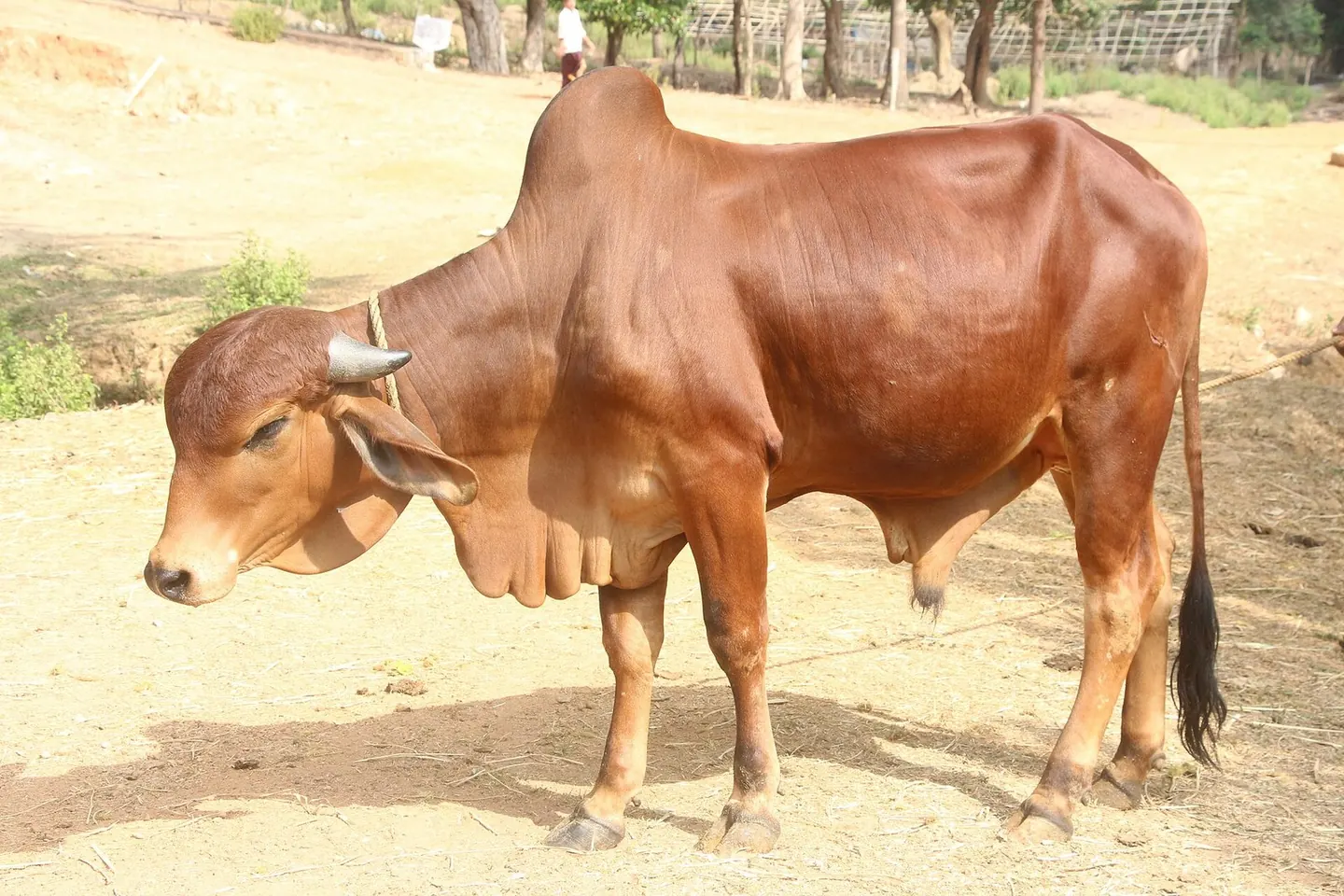
Gir is a red dairy breed from the Gir forest area of Saurashtra in Gujarat, easy to know by its long, folded, hanging ears and its curled horns. NBAGR registers it as a breed of Gujarat (ICAR-NBAGR), NDDB lists milk as its main use (NDDB), and NBAGR describes it as a hardy animal that keeps producing in difficult conditions (NBAGR database). This page shows how to recognise a Gir, what it gives, and what to check before you buy one in the south.
How to recognise it
- Colour: most Gir cattle are deep red, and some are speckled red (NBAGR database). TNAU's guide, based on TANUVAS material, also describes white animals with dark red or chocolate-brown patches (TNAU).
- Ears: long and hanging, folded like a leaf, with the inner side turned forward (NBAGR database).
- Horns: curved in a way of their own. From the base they turn sideways, down and back, then rise a little and sweep forward and inward to a fine point, like a half moon (NBAGR database).
- Size and weight: a large breed. Bulls stand about 160 cm at the shoulder and cows about 131 cm. Adult bulls weigh about 544 kg and cows about 310 kg on average; calves weigh about 21 kg at birth (NBAGR database).
What it is good for
- Milk. NBAGR's breed record gives about 2,110 kg of milk in a lactation on average (about 2,050 litres), ranging from 800 to 3,300 kg, with about 4.6% fat (NBAGR database). TNAU's guide gives a lower range of 1,200–1,800 kg (TNAU). How much your cow gives depends on her feed and care.
- Farm work. Gir bullocks can pull heavy loads on any soil, sandy, black or rocky (NBAGR database).
- Hardiness. NBAGR notes the breed's tolerance of hard conditions and its resistance to many tropical diseases. Brazil, the USA, Venezuela and Mexico have imported Gir cattle and bred them successfully (NBAGR database).
- Calves. One at a time. Cows calve for the first time at about 46 months, nearly 4 years, and then about every 13 months (NBAGR database).
Where it is mainly found
Gir takes its name from the Gir forest. NBAGR's breed record places its home tract in Saurashtra, in and around the forest: Rajkot, Junagadh, Bhavnagar and Amreli districts of Gujarat. There it is bred mostly by herding communities such as the Rabaris and Maldharis, and the 2013 breed survey counted about 13.8 lakh Gir cattle in India (NBAGR database).
Gir has no home tract in the south, but it is part of the southern states' breeding plans. Karnataka's breeding policy encourages Gir, Sahiwal and Tharparkar for raising the milk of non-descript local cattle (Karnataka policy), and Tamil Nadu's policy names Gir among the Indian breeds its farms may use when breeding crossbred bulls (Tamil Nadu policy). In Andhra Pradesh, the National Kamdhenu Breeding Centre at Chintaladevi in Nellore district was set up to conserve native breeds for the southern region, and its embryo-transfer work includes Gir (Nellore district).

Looking for Gir cattle?
Kattutharai works across India. Search “Gir” in the app to look for Gir cattle, or browse cows for sale near you. The seller names the breed and Kattutharai does not check it, so look at the animal yourself before you pay.


Rearing tips
- Grazing and concentrate. In Gujarat, Gir cattle graze and also get concentrate feed. Milking cows usually stay in the village while dry cows and young stock go out to graze (NBAGR database). For a stall-fed cow's daily fodder and concentrate, see how cattle are kept.
- Calves drink for long. In the home tract, calves are allowed to suckle for 8–12 months (NBAGR database). Leave the calf its share of milk.
- Plan for a slow start. A heifer calves first at almost 4 years, so a young Gir needs feed for years before she gives milk (NBAGR database).
- Health. Vaccinate on time, and ask your vet about worms and ticks: see keep cattle healthy.
Buying tips
- Check the signs: a red or speckled-red coat, long leaf-like hanging ears, and the half-moon horns. Short ears, or horns that grow straight up or out, do not fit the breed's description and point to a cross.
- The name is used widely. A cow sold as Gir may be a cross or a part-Gir animal. The breed name in an ad is the seller's word, and Kattutharai does not check it. Ask where the parents came from, see the mother if you can, and check the signs yourself.
- See her milked. Watch complete milkings by hand, morning and evening, and measure the milk yourself. Ask for her calving and insemination dates.
- Age, health and papers: count the teeth, ask for a brucellosis test and write the ear-tag number on your receipt: see buying a cow or bull.
Frequently asked questions
How much milk does a Gir cow give?
NBAGR's breed record gives about 2,110 kg (about 2,050 litres) in a lactation on average, from 800 to 3,300 kg (NBAGR database). Feed, care and the cow herself make the difference, so see her milked before you pay.
How heavy is a Gir bull?
About 544 kg on average; cows weigh about 310 kg (NBAGR database).
Can Gir cattle do well in the south?
NBAGR describes Gir as hardy (NBAGR database), and Karnataka's breeding policy encourages it (Karnataka policy). Like any big dairy cow, it still needs shade, clean water and good feed every day.
Is Gir the same as Kathiawari?
Yes, for cattle: Kathiawari is one of Gir's other names, along with Bhodali, Desan, Gujarati, Sorthi and Surati (NBAGR database). Kathiawari is also the name of a horse breed: see Kathiawari horse: breed, height and how to recognise it.
Next
Compare Gir with the other dairy breeds from the north-west, Sahiwal, Red Sindhi and Tharparkar, or read Cows and bulls: native breeds, crossbreds, buying and care for buying and care. To see what farmers near you are selling, browse cows for sale and bulls for sale.