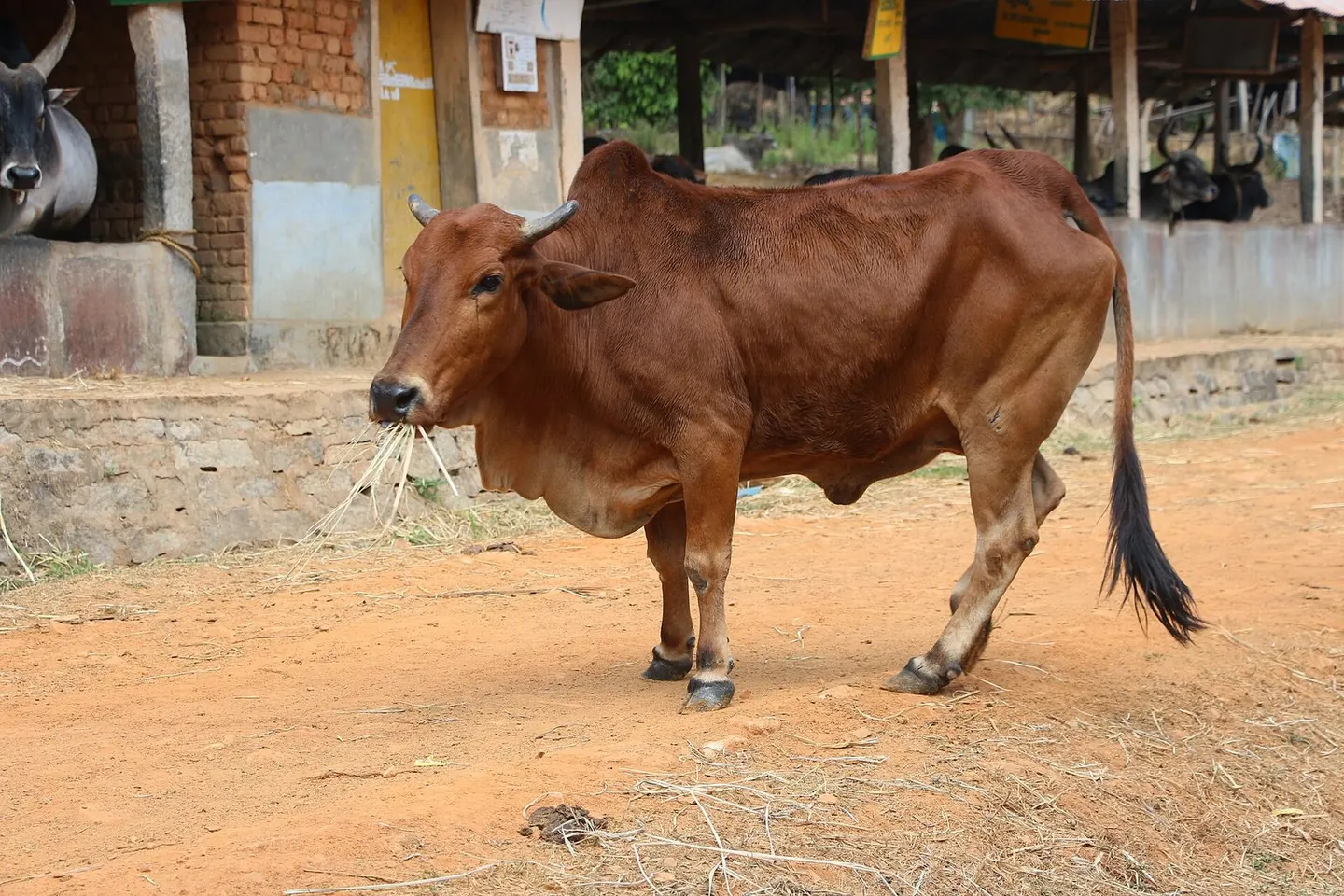
Red Sindhi is a red dairy breed from Sindh and Balochistan, now in Pakistan, known for its milk and for standing heat well (NBAGR study). In India it has no home district: NBAGR registers it for organised farms only (ICAR-NBAGR), and NDDB lists Tamil Nadu and Kerala among the states where such herds are kept (NDDB). This page shows how to recognise a Red Sindhi, what it gives, and what to check before you buy.
How to recognise it
- Colour: clearly red, in shades from dark red to a dull yellowish red. There may be white patches on the dewlap and sometimes on the forehead, but no large white patches on the body, and bulls are darker on the shoulders and thighs (NBAGR database). NBAGR's field study notes that the red is not as dark as a Sahiwal's (NBAGR study).
- Horns: thick at the base, growing out sideways and then curving upward (NBAGR database); the field study found them black (NBAGR study).
- Udder and nature: a well-developed, hanging udder and a calm, docile temper (NBAGR study).
- Size and weight: bulls stand about 130 cm at the shoulder and cows about 120 cm. Adult bulls weigh about 450 kg and cows about 320 kg, and calves weigh about 22 kg at birth (NBAGR database).
What it is good for
- Milk. NBAGR's breed record gives about 1,840 kg of milk in a lactation on average (about 1,790 litres), ranging from 1,100 to 2,600 kg, with about 4.5% fat (NBAGR database). In NBAGR's field study, cows averaged about 2,429 kg in a lactation of about 318 days (NBAGR study), while TNAU's guide gives 1,250–1,800 kg (TNAU).
- Heat. The breed is known for its tolerance of heat (NBAGR study).
- Bullocks. TNAU's guide notes that the bullocks are slow, but can be used for road and field work (TNAU).
- Calves. One at a time. NBAGR records the first calf at about 44 months and then one about every 15 months (NBAGR database).
Where it is mainly found
NBAGR's breed record traces Red Sindhi to the Las Bela cattle of Balochistan. Its home tract is in Pakistan, and in India it is kept on organised farms in Odisha, Tamil Nadu, Bihar, Kerala and Assam (NBAGR database). Its numbers are uncertain. The 2013 breed survey recorded about 60,000 cattle as Red Sindhi (NBAGR database), but an NBAGR field study found that pure animals were hardly seen outside the farms, put the total at no more than 1,000, and called the breed endangered (NBAGR study).
In Tamil Nadu, the District Livestock Farm at Hosur in Krishnagiri district keeps and conserves Red Sindhi. By the 2023–24 policy note, its embryo-transfer programme had transferred 372 Red Sindhi embryos, and 43 Red Sindhi calves had been born (Tamil Nadu policy note). The state's breeding plan also uses Red Sindhi to improve part of its non-descript cattle (TNLDA), and its farms may use it as the Indian parent of crossbred bulls (Tamil Nadu policy).

Looking for Red Sindhi cattle?
Kattutharai works across India. Search “Red Sindhi” in the app to look for Red Sindhi cattle, or browse cows for sale near you. The seller names the breed and Kattutharai does not check it, so look at the animal yourself before you pay.


Rearing tips
- Farm-style feeding. On organised farms, Red Sindhi cattle are kept intensively on cut fodder and concentrate feed rather than grazing (NBAGR database). Plan green fodder, dry fodder and concentrate for every day: see how cattle are kept.
- Shade and water. The breed stands heat well (NBAGR study), but a cow in milk still needs shade and plenty of clean water in summer.
- Health. Vaccinate on time, and ask your vet about worms and ticks: see keep cattle healthy.
Buying tips
- Check the signs: an even red coat with no large white patches, black horns that grow out sideways and curve up, and a well-developed udder. Big white patches, a black or grey coat, or long straight horns do not fit the breed's description and point to a cross.
- True Red Sindhi is rare. Pure animals live mostly on organised farms (NBAGR database), so a cow sold as Red Sindhi, or just "Sindhi", may well be a cross. The breed name in an ad is the seller's word, and Kattutharai does not check it. Ask where the parents came from, and check the signs yourself.
- Compare it with Sahiwal. Both are red dairy breeds, but Red Sindhi is a lighter red (NBAGR study), while Sahiwal has short, stumpy horns and loose skin: see Sahiwal cow: milk, weight and how to recognise it.
- See her milked, and check her health. Watch complete milkings by hand, morning and evening, and measure the milk. For age, a brucellosis test and the ear tag, see buying a cow or bull.
Frequently asked questions
How much milk does a Red Sindhi cow give?
NBAGR's breed record gives about 1,840 kg (about 1,790 litres) in a lactation on average, from 1,100 to 2,600 kg (NBAGR database). See her milked before you pay.
Are Sindhi and Red Karachi the same breed?
Yes. NBAGR lists Red Karachi, Sindhi and Malir as other names of Red Sindhi (NBAGR database).
Where are pure Red Sindhi cattle kept in the south?
On government farms such as the District Livestock Farm at Hosur, which keeps them for conservation (Tamil Nadu policy note); NBAGR also lists organised herds in Kerala (NBAGR database). Ask your nearest veterinary hospital where animals from known herds can be found.
Next
Compare Red Sindhi with Sahiwal, Gir and Tharparkar, or with Tamil Nadu's own Kangayam. Read Cows and bulls: native breeds, crossbreds, buying and care for buying and care, and browse cows for sale and bulls for sale.