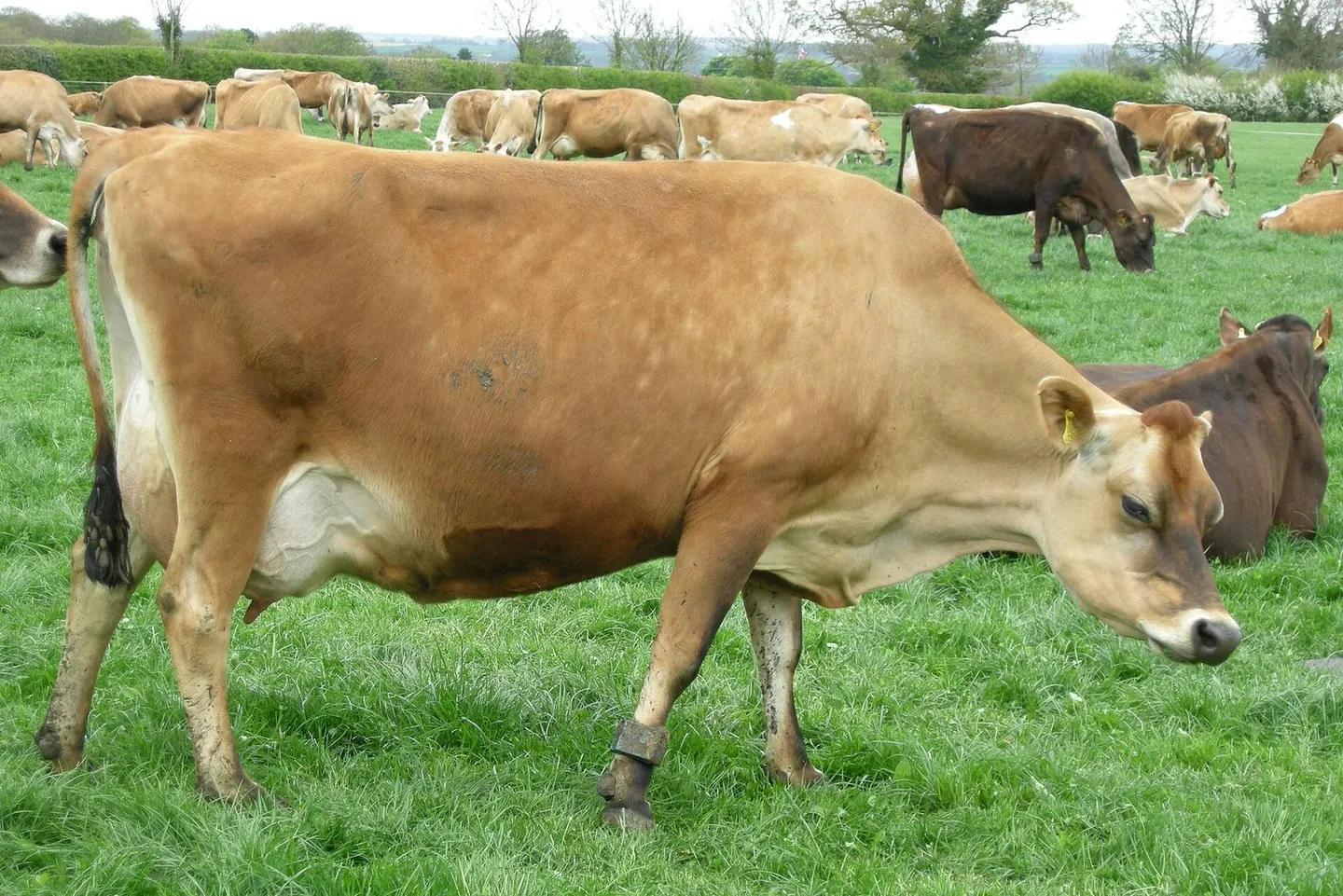
Jersey is the smallest dairy breed, reddish fawn, developed on the island of Jersey; in India it has settled in well and is widely used to cross with local cows (TNAU). In the south, the Jersey cows on farms are mostly crosses, reared widely in the plains (Tamil Nadu policy note). Jersey crosses stand heat better than other exotic crosses (TNAU), which is why Tamil Nadu chose Jersey for its plains (Tamil Nadu policy).
How to recognise it
- Colour: typically reddish fawn (TNAU).
- Head and body: a dished forehead and a compact, angular body; pure Jerseys are the smallest of the dairy breeds (TNAU).
- Crosses: Jersey crosses are medium-sized cows (TNAU).
What Jersey crosses are kept for
- Milk with more fat. Pure Jerseys give about 4,500 kg of milk in a lactation, with about 4.5% fat (TNAU).
- More milk than the local mother. Depending on the local cow, a first Jersey cross can give 2–3 times her milk (TNAU).
- In farmers' herds. A TANUVAS study of 75,627 Jersey-cross cows recorded by Tamil Nadu's cooperative milk federation found about 2,480 kg of milk in a lactation on average, about 2,410 litres (TANUVAS study).
- A good cow. Tamil Nadu's breeding policy counts a Jersey cross that gives 2,500 kg or more in her first 305-day lactation as an elite cow, worth registering (Tamil Nadu policy).
- Calves. One at a time. Pure Jersey heifers first calve at 25–30 months and then every 13–14 months (TNAU).
Where it comes from
Jersey was developed on the island of Jersey (TNAU). It is not on India's breed register, which lists the country's own breeds (ICAR-NBAGR).
In the south, Jersey crosses are the main dairy cows of the plains. Tamil Nadu's breeding policy chose Jersey for the plains because roughage is short and concentrate feed costly, and it keeps crosses at about half Jersey blood (Tamil Nadu policy). In 2021–22, exotic and crossbred cows produced about 91 lakh of the state's 101 lakh tonnes of milk, and government farms such as the Exotic Cattle Breeding Farm at Eachenkottai in Thanjavur district keep Jersey and Jersey crosses (Tamil Nadu policy note). Tamil Nadu has India's largest crossbred cattle population, and nearly half of it is in Villupuram, Tiruvannamalai, Salem, Vellore, Dharmapuri, Krishnagiri, Cuddalore and Erode (NBAGR study). Karnataka's policy suggests Jersey crosses outside the Bengaluru region (Karnataka policy), and Kerala allows only Jersey and HF as foreign breeds (Kerala policy).

Looking for Jersey cattle?
Kattutharai works across India. Search “Jersey” in the app to look for Jersey cattle, or browse cows for sale near you. The seller names the breed and Kattutharai does not check it, so look at the animal yourself before you pay.


Rearing Jersey crosses
- Better in the heat, but not heat-proof. Jersey crosses suit the plains and tolerate heat better than other exotic crosses (TNAU). Still give shade, cool water and an airy shed in summer. A cow that pants, drools and eats less is suffering from heat and needs cooling (heat-stress guide).
- Heat costs milk. Pure Jerseys at Eachenkottai, on the Thanjavur plains, gave about 1,561 kg in a lactation over many years, much less than Jerseys kept in the hills (TANUVAS study).
- Feed for the milk. Give green fodder, dry fodder and concentrate every day, in line with the milk she gives: see how cattle are kept.
- Health. Crossbred cows need one more vaccine than native cattle: see keep cattle healthy.
Buying a Jersey cross
- Ask about her blood. A cow sold as "Jersey" is almost always a cross. In Tamil Nadu, crosses are bred on with Jersey-cross bulls rather than pure Jersey (TNLDA). Ask what her mother was and which bulls were used.
- Look for the type: a fawn coat, a dished forehead and a compact body. A big black-and-white cow is more likely an HF cross: see HF cow (Holstein Friesian): crosses, milk and care in heat.
- See her milked. Watch complete milkings by hand, morning and evening, and measure the milk yourself. Ask for her calving and insemination dates.
- The breed in an ad is the seller's word. Kattutharai does not check it. For age, a brucellosis test and the ear tag, see buying a cow or bull.
Frequently asked questions
How much milk does a Jersey cross give?
In the TANUVAS study of 75,627 Jersey-cross cows in Tamil Nadu farmers' herds, about 2,480 kg (about 2,410 litres) in a lactation on average (TANUVAS study). Feed and care make the difference, so see her milked before you pay.
Should I buy a Jersey cross or an HF cross?
For the hot plains, usually a Jersey cross: it stands heat and tropical diseases better. An HF cross gives more milk, with less fat, and suits cooler hills (TNAU). Tamil Nadu uses Jersey in the plains and HF in the hills (Tamil Nadu policy).
Why does Jersey milk have more fat?
It is a trait of the breed: pure Jersey milk has about 4.5% fat, against about 3.45% for pure HF (TNAU), and Jersey crosses give milk with more fat than HF crosses (TNAU).
Next
Compare Jersey with HF, or with Indian dairy breeds such as Red Sindhi and Sahiwal. Read native cattle or crossbreds, and browse cows for sale and bulls for sale.